The Thaj Gold: a child's gold mask and glove from an Arabian incense-trade city
Famous find 1st century AD · Found in 1998 See it on the timeline →
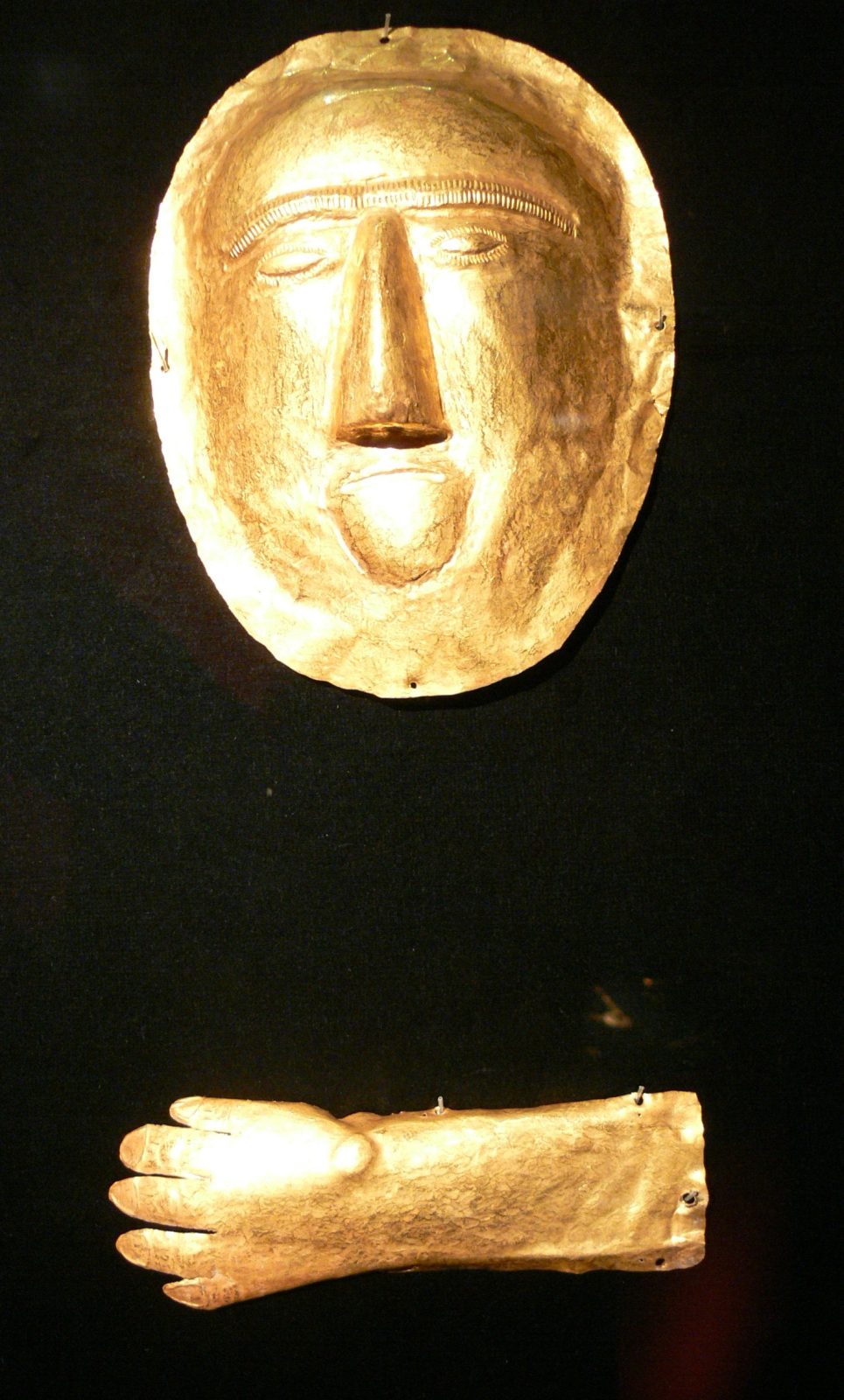
In 1998 archaeologists from the Dammam Regional Museum, digging at Tell al-Zayer outside the ancient walled city of Thaj in eastern Saudi Arabia, found a hidden burial chamber. In it a young girl lay with a small gold mask, a gold glove and jewellery of gold, pearls and rubies.
Thaj, in the Eastern Province of Saudi Arabia, was a walled city that flourished on the trade routes of ancient Arabia, perhaps the famous incense-trading city of Gerrha, though that is not proven. In 1998 a team from the Dammam Regional Museum, led by Abdulhameed Al-Hashash, was excavating at Tell al-Zayer, a mound just outside the city walls, when they found a pit concealing a burial chamber.
It was a family tomb. With three men and a woman lay a girl of about six, buried with extraordinary riches. Over her face was a small funerary mask of gold, 17.5 by 13.5 centimetres, made by hammering the metal from behind, with narrow eyes, a long nose and a tight-lipped mouth. A gold glove covered one hand. She wore a gold belt and necklaces of gold, pearls, turquoise and rubies, and there were gold statuettes and more than two hundred gold buttons, once sewn onto her clothes. Reports describe her lying on a wooden bed with gold bands on her head.
The burial dates from around the 1st century AD, when Thaj and its region grew rich from the trade in incense, pearls and luxury goods between Arabia, India and the Mediterranean. The pearls came from the Gulf, and the rubies probably from India. The mask is often compared with the gold Mask of Agamemnon from Mycenae, though it was made more than 1,500 years later, and for a child.
The Thaj treasures travelled abroad in the exhibition Roads of Arabia, shown at the Louvre in Paris in 2010, in Berlin in 2012 and in the United States. They belong to the National Museum in Riyadh.
Written for Global Finds from AramcoWorld (2011), Asharq Al-Awsat (2017), Arab News (2017) and Saudipedia. Photo: the gold mask and glove from Thaj in the Roads of Arabia exhibition, Pergamon Museum, Berlin, Wolfgang Sauber, Wikimedia Commons, CC BY-SA 3.0.
Approximate location26.87, 48.72View on map
Source: AramcoWorld