The Óc Eo Pendant: a Roman emperor's gold coin, copied in the Mekong Delta, then lost after 1975
Famous find Copied from a gold coin of AD 152 · Found in 1944 See it on the timeline →
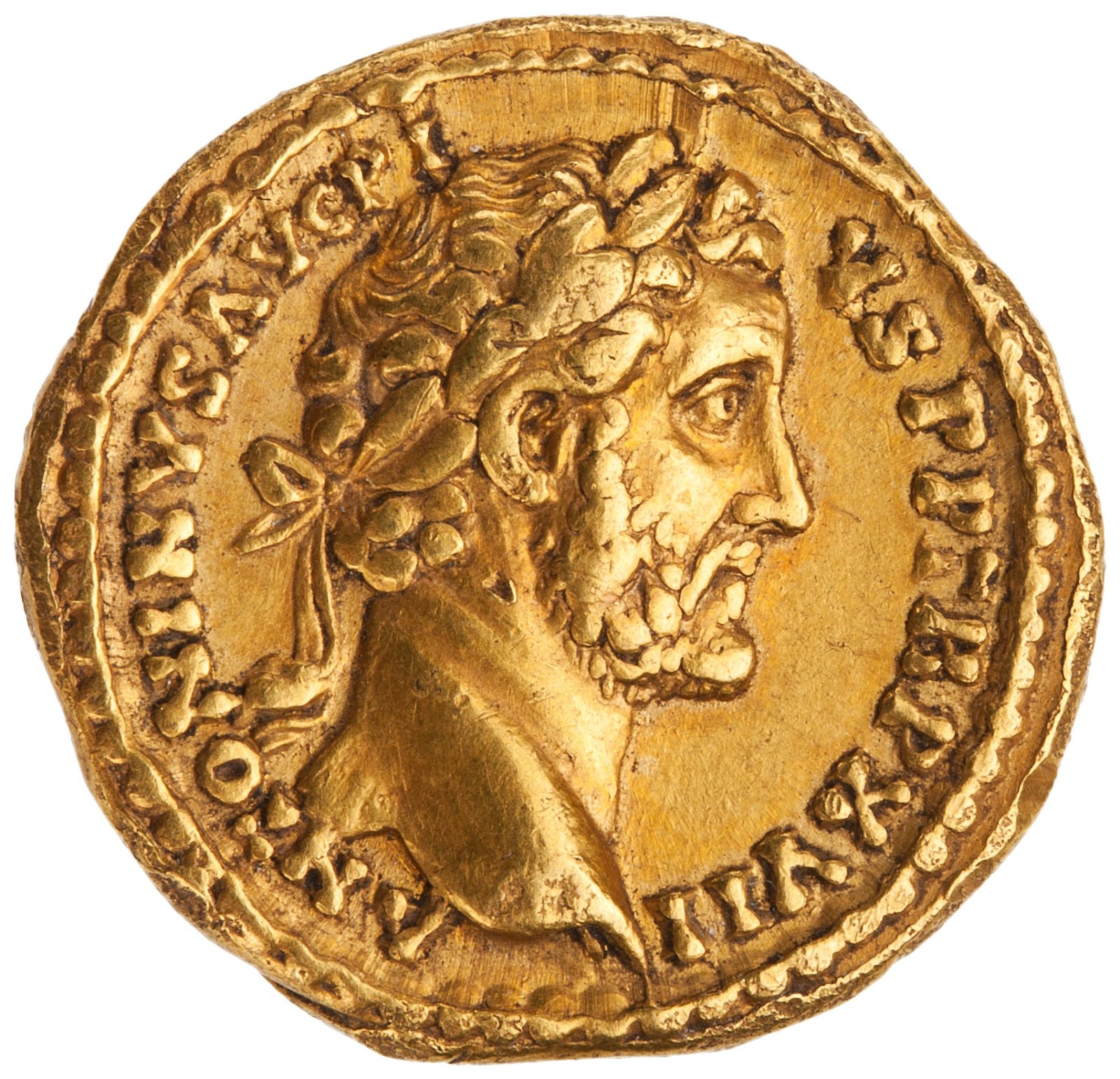
In 1944 the French archaeologist Louis Malleret's work at Óc Eo in southern Vietnam produced a gold disc showing the Roman emperor Antoninus Pius. Long called a Roman medallion, it is now seen as a local copy worn as a pendant. It has been missing since 1975.
In 1943, Louis Malleret, curator of the museum in Saigon, went to Óc Eo, in the Mekong Delta of what is now southern Vietnam, after people digging there in secret for gold began turning up ancient objects. In 1944 he excavated there for two months, in the middle of the war, and also collected objects from the gold diggers. Among the finds from Óc Eo that year was a small disc of gold bearing the head of a Roman emperor.
It is the size of a Roman gold coin, 19 millimetres across, but it is not one. The disc is a thin sheet of 22-carat gold, only 0.3 millimetres thick and weighing about 1.4 grams, under a fifth of the weight of a real aureus. It was struck into a die, so the design stands up on the front and sinks into the back, and a broken tab at the top shows it was hung as a pendant. It shows the bearded head of Antoninus Pius, emperor from AD 138 to 161, and copies a gold coin of AD 152. The maker copied the lettering imperfectly: one N is back to front, and part of the emperor's titles has become nonsense.
For decades it was published as a Roman coin or medallion and quoted as proof that Roman traders reached South-East Asia. In 2014 the archaeologist Brigitte Borell showed it is a local copy, made in the region in the 2nd or early 3rd century, perhaps by a jeweller who had seen a real aureus. It is still evidence of contact, just more indirect. Óc Eo was the port of Funan, linked by canal to the Gulf of Thailand, and Chinese annals record people claiming to be envoys of "Andun", the Roman emperor Antoninus, arriving by sea in AD 166. A second gold pendant from Óc Eo copies a coin of a later emperor.
The Antoninus Pius pendant was kept in the museum in Saigon, but the museum told Borell in 2006 that it could not be found after 1975. The second pendant is still in the Museum of Vietnamese History in Ho Chi Minh City.
Written for Global Finds from B. Borell, "The Power of Images", Zeitschrift für Archäologie Außereuropäischer Kulturen 6 (2014), and L. Malleret, L'Archéologie du delta du Mékong (1962). Photo: a genuine gold aureus of Antoninus Pius of the kind that was copied, not the Óc Eo pendant, American Numismatic Society, Wikimedia Commons, CC0.
Source: B. Borell, The Power of Images (2014), via the Angkor Database