The Lough Erne Shrine: an early Irish reliquary hooked by a fisherman's line
Famous find 8th to 9th century AD · Found in 1891 See it on the timeline →
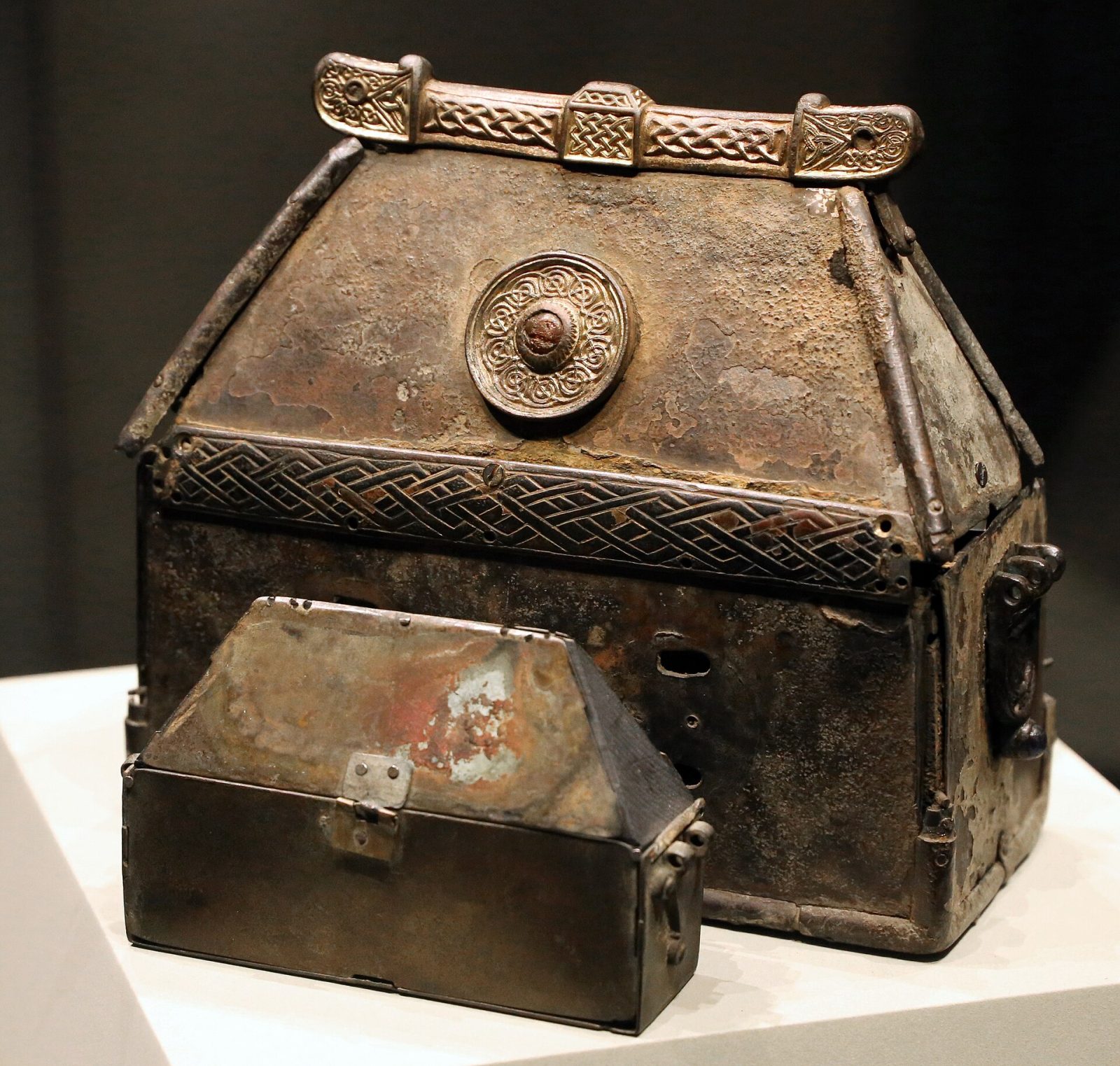
In the summer of 1891 a fisherman on Lower Lough Erne in County Fermanagh felt his line snag on what he took for a tree stump. When he landed his fish, the stump turned out to be an early medieval house-shaped shrine of bronze, with a second shrine inside it.
In the summer of 1891, fishermen were out on Lower Lough Erne, in County Fermanagh, near Tully on the lough's western shore, about midway between Enniskillen and Belleek. One of them hooked a fish, which dived, and his line caught on something he took to be the stump of a tree. When he finally drew in his line, the fish came up, and so did the stump. It was a metal box. Both fish and box were landed.
The box was a reliquary, a container made to hold the relics of a saint, in the shape of a little house or church with a steeply ridged roof. It is a shrine within a shrine. The outer case is made of bronze plates over a core of carved yew wood, with a ridge decorated with interlace and animal-head terminals, a band of lozenge interlace, a decorated boss, and a hinge plate for a chain, so that it could be carried hung from the neck. Inside it was a second, plain bronze box about 7 centimetres high. It is one of the largest house-shaped shrines to survive from early medieval Ireland.
The Lough Erne Shrine is usually dated to the 8th or 9th century AD, although some scholars have argued for a later date. How it came to be in the lough is unknown; it may have been lost from a boat or deliberately hidden in the water.
Two days after the find it was bought by Thomas Plunkett, chairman of the Enniskillen town commissioners, and it was described to the Royal Society of Antiquaries of Ireland the following year. It later entered the national collection, and it is displayed in the National Museum of Ireland on Kildare Street, Dublin.
Written for Global Finds from D. Murphy in the Journal of the Royal Society of Antiquaries of Ireland (1891 and 1892) and the National Museum of Ireland. Photo: the outer shrine and inner box of the Lough Erne Shrine in the National Museum of Ireland, Sailko, Wikimedia Commons, CC BY 3.0.
Approximate location54.46, -7.81View on map
Source: Journal of the Royal Society of Antiquaries of Ireland (1892, Internet Archive)