The Eyrarland Figure: a tiny bronze of Thor, or Christ, dug up on an Icelandic farm
Famous find Late Viking Age, about AD 950 to 1100 · Found in 1816 See it on the timeline →
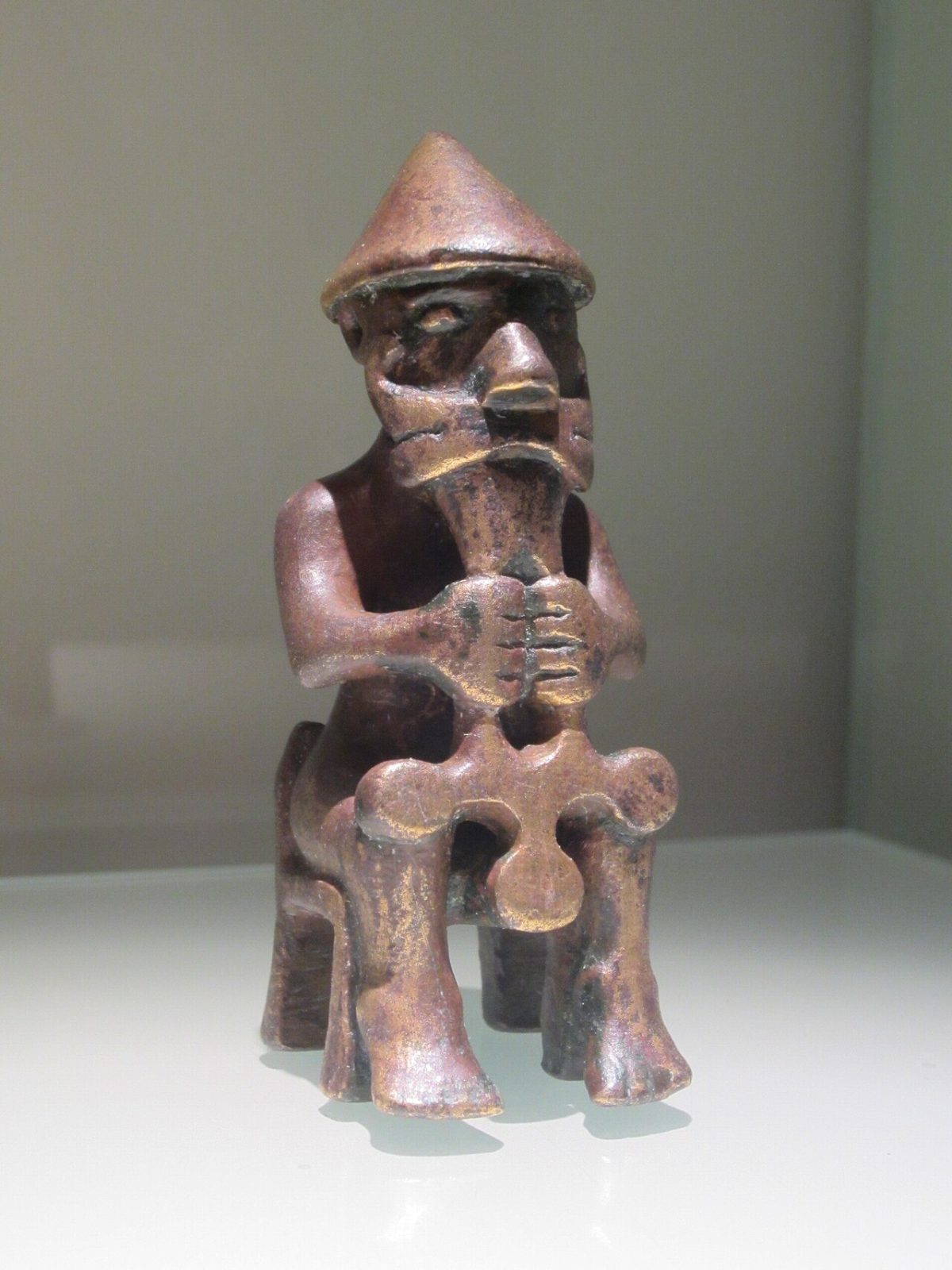
Around 1815 or 1816 someone digging on the farm of Eyrarland, near Akureyri in north Iceland, turned up a little bronze figure of a seated, bearded man gripping a hammer-like object. It is usually seen as the god Thor, and is one of Iceland's national treasures.
Around 1815 or 1816, someone digging on the farm of Eyrarland in Eyjafjörður, in the north of Iceland, uncovered a small bronze figure. The finder's name was not recorded, and there were two farms of that name; the 19th-century scholar Kristian Kålund placed it at Stóra-Eyrarland, which now lies within the town of Akureyri. In November 1817 a local merchant, Jóhann Gottlieb Gudmann, sent it to the Royal Museum for Nordic Antiquities in Copenhagen. It stayed in Denmark for more than a century, until it was transferred to the National Museum of Iceland in 1930.
The figure is just 6.7 centimetres high and weighs about 115 grams. It was cast in bronze by the lost-wax method. It shows a man sitting down, wearing a pointed cap, with large curling moustaches and wide staring eyes. With both hands he grips his long beard, which divides and runs into a cross-shaped object. A description from 1820 noted traces of gilding on its back.
Most scholars see the figure as Thor, the thunder god of the Norse, holding his hammer Mjölnir, and it is often called the Thor statue. But others have argued that the cross-shaped object makes it Christ, or that it was the king piece from a board game. It dates from the late Viking Age, around AD 950 to 1100, the period when Iceland was turning from the old gods to Christianity, around the year 1000, which may be why it is so hard to read.
The Eyrarland figure is one of the best-known objects of Viking-age Iceland, and has appeared on milk cartons and souvenirs. It is on display in the permanent exhibition of the National Museum of Iceland in Reykjavík.
Written for Global Finds from R. Perkins's Thor the Wind-Raiser and the Eyrarland Image (Viking Society for Northern Research, 2001), K. Eldjárn (1981) and the National Museum of Iceland. Photo: the Eyrarland figure in the National Museum of Iceland, L3u, Wikimedia Commons, CC BY-SA 3.0.
Approximate location65.68, -18.10View on map
Source: National Museum of Iceland