The Pentney Hoard: six Anglo-Saxon silver brooches found by a gravedigger in a Norfolk churchyard
Famous find Made in the late 8th and early 9th centuries AD · Found in 1978 See it on the timeline →
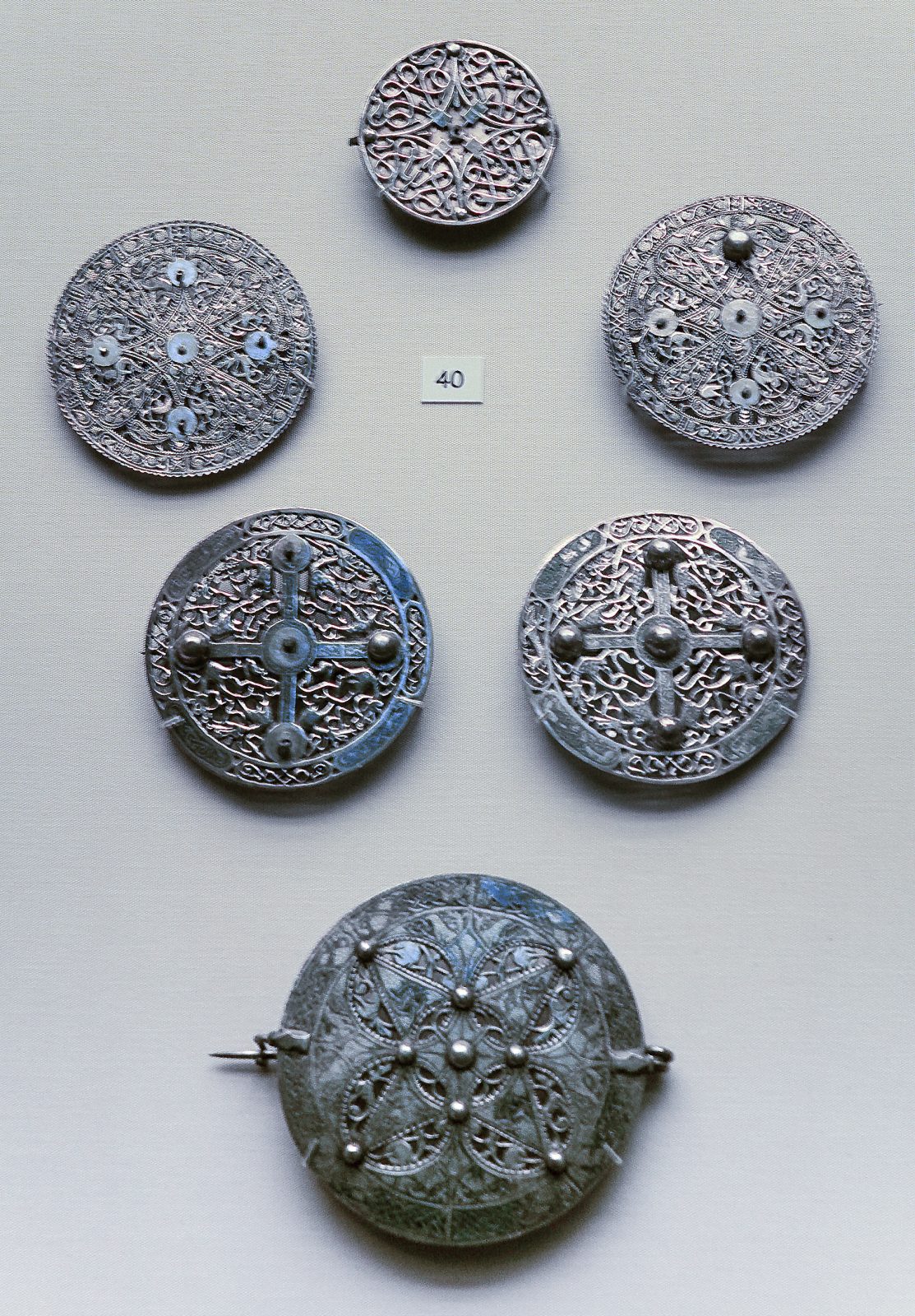
In 1978 William King, gravedigger at Pentney in west Norfolk, was digging a grave when he found six silver disc brooches in the soil. They turned out to be among the finest Anglo-Saxon brooches ever found, made around AD 800 and now in the British Museum.
In 1978, William King, the gravedigger at the church of St Mary Magdalene at Pentney, in west Norfolk, was digging a new grave at the edge of the churchyard when he noticed a silver disc in the soil. Searching further, he pulled out five more. He handed them to the rector, and for a time they were kept in the parish chest, until a new rector took them to Norwich Castle Museum. There they were recognised as Anglo-Saxon brooches of the finest quality.
The six brooches are made of silver in openwork, decorated in the Trewhiddle style with animals, plants and interlace, picked out in black niello. The largest is 10.2 centimetres across. There is a pair with scalloped, beaded edges, a second pair with a plain cross design and heavy niello, and a smaller single brooch with a silver face riveted over a gilded copper-alloy backing. Five still have their pins, springs and hinges, and only the smallest shows signs of wear. All six seem to have come from the same workshop.
The smallest brooch was made in the late 8th century and the others around AD 800 to 840. Why they were buried in what is now a churchyard is not known. Some scholars have suggested that they were hidden in the middle of the 9th century, when Viking raiders were attacking East Anglia, but that cannot be proved.
An inquest declared the brooches treasure trove, and the British Museum acquired them in 1980. King received a reward of about £135,000, according to the Norfolk Historic Environment Record, and reportedly gave £25,000 of it to the church. When the Norfolk Archaeological Unit re-excavated the spot in 1980, a metal detector swept over the soil turned up a silver boss, probably from one of the brooches. The six are displayed together in the British Museum in London.
Written for Global Finds from the Norfolk Historic Environment Record (Norfolk Heritage Explorer), Medieval Archaeology (1981) and the British Museum. Photo: the six Pentney brooches in the British Museum, Francesco Gasparetti, Wikimedia Commons, CC BY 2.0.
Approximate location52.69, 0.54View on map
Source: Norfolk Heritage Explorer