Noin-Ula: Mongolian royal tombs found by a gold prospector, full of silk, lacquer and silver
Famous find Late 1st century BC to early 1st century AD · Found in 1924 See it on the timeline →
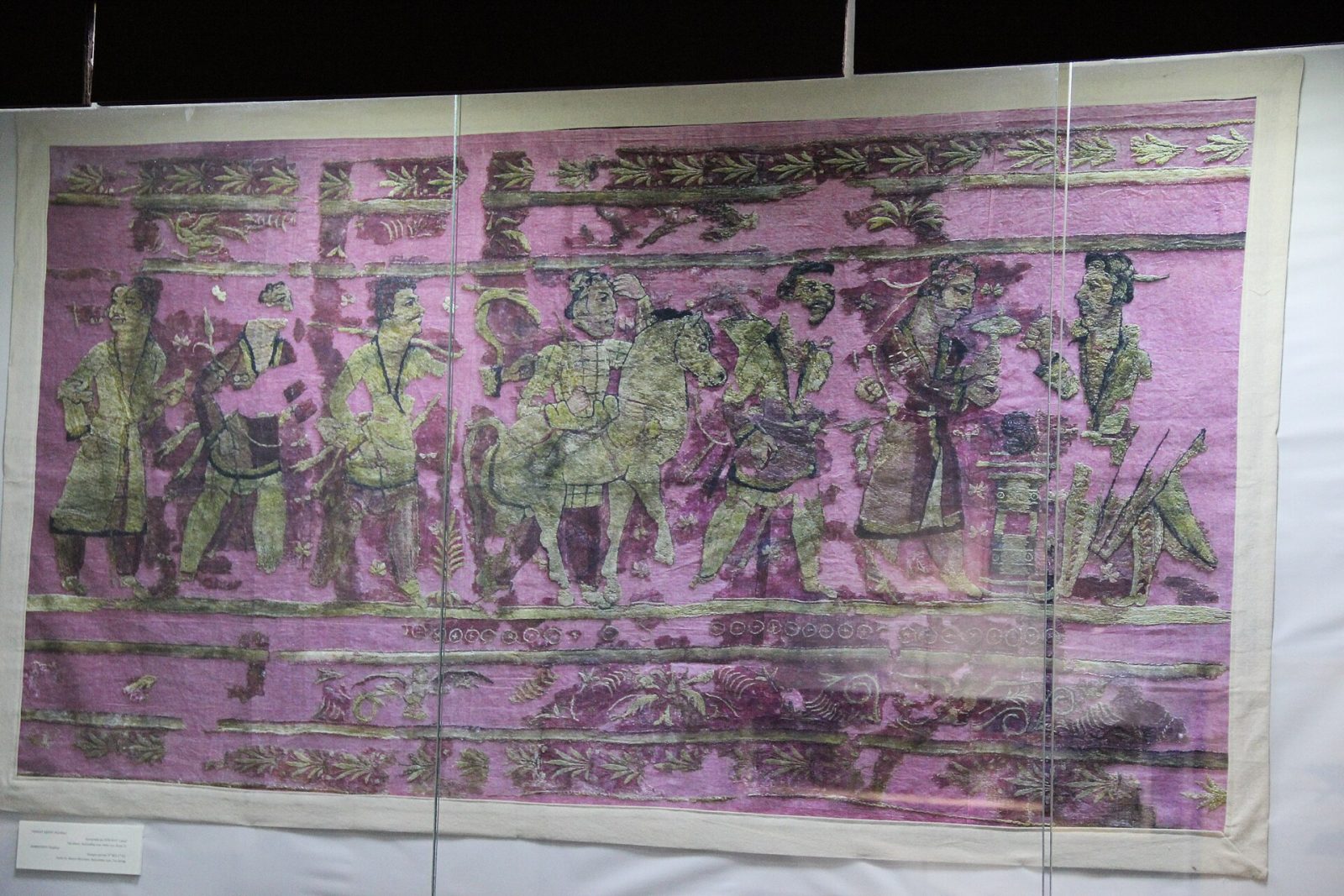
Around 1912 a gold-mining prospector in northern Mongolia dug into what he thought were old mine workings. They were the tombs of Xiongnu nobles, frozen and waterlogged for 2,000 years, preserving silks, embroidered hangings, Chinese lacquer and silver plaques.
Around 1912 or 1913, Andrei Ballod, surveying for a gold-mining company in the Noyon hills north of Ulaanbaatar, in northern Mongolia, noticed a group of large mounds. Taking them for old mine workings, he dug into one. They were burial mounds, more than two hundred of them, and they belonged to the Xiongnu, the nomadic empire that dominated the steppe north of China from the 3rd century BC.
In 1924 and 1925 archaeologists of the Russian explorer Pyotr Kozlov's expedition, S. A. Kondratiev and S. A. Teploukhov, excavated several of the largest tombs. Deep inside, each had a burial chamber built of timber boxes one inside another, hung with textiles. The tombs had been robbed in antiquity, but water had seeped in and frozen, preserving what gold-hunters left behind: silk and wool clothing, a large carpet, braids of human hair in red silk cases, bronze mirrors, gold plaques set with stones, and silver plaques showing a yak and a deer. Chinese lacquer cups were among the finds, one of them inscribed with a date equivalent to 2 BC.
The tombs date from the late 1st century BC to the early 1st century AD, and one may have been the burial of a Xiongnu ruler. Their contents show how far the Xiongnu's connections reached. Since 2006 a Russian and Mongolian expedition led by Natalia Polos'mak has excavated further tombs and found embroidered wool hangings probably made in Bactria or Gandhara, far to the south-west, and a Greek-style silver horse ornament, as well as more dated Chinese lacquer.
Most of the finds of 1924 and 1925 are in the State Hermitage Museum in St Petersburg. Finds from the more recent excavations are shown in Ulaanbaatar, at the National Museum of Mongolia and the Chinggis Khaan National Museum.
Written for Global Finds from D. C. Waugh's Silk Road Seattle (University of Washington), N. Polos'mak and others in SCIENCE First Hand, and The Guardian (2017). Photo: an embroidered wool hanging from Noin-Ula in the National Museum of Mongolia, Gary Todd, Wikimedia Commons, CC0.
Approximate location48.39, 106.75View on map