The Rosetta Stone: a broken slab in a fort wall that unlocked Egyptian hieroglyphs
Famous find Decree of 196 BC · Found in 1799 See it on the timeline →
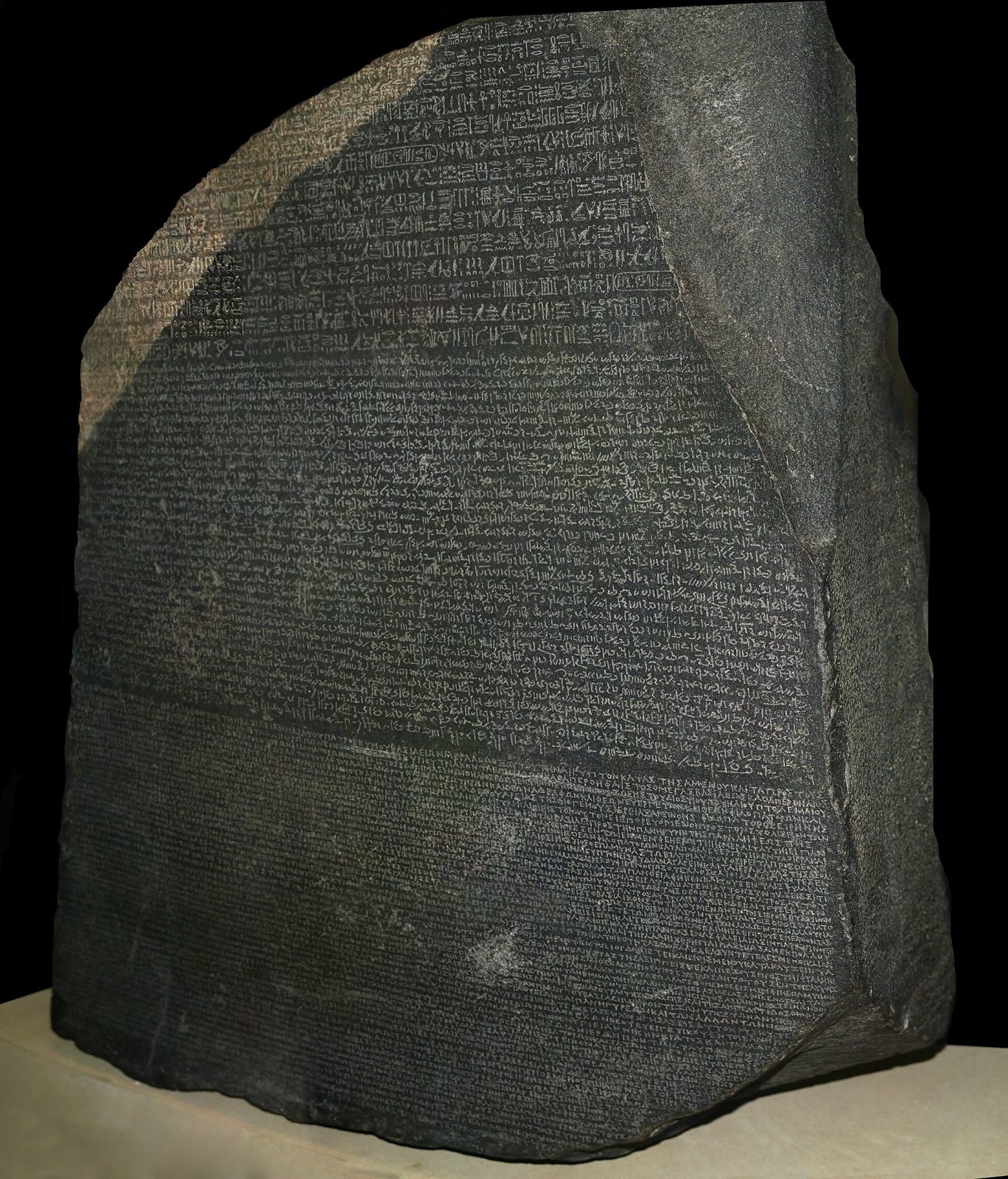
In July 1799 French soldiers rebuilding a fort near Rosetta in Egypt found an inscribed stone built into an old wall. It carried the same decree in hieroglyphs, Demotic and Greek, and it became the key to reading ancient Egyptian. It has been in the British Museum since 1802.
In July 1799, during Napoleon's invasion of Egypt, French soldiers were strengthening the old fort at Rashid, which the Europeans called Rosetta, near the mouth of the Nile, renamed Fort Julien. As a wall was being pulled down, an engineer officer, Pierre-François Bouchard, noticed that one of the blocks carried inscriptions. The exact day is uncertain; sources give 15 or 19 July. The block had been reused as building material, and it had probably once stood in a temple.
It is a broken slab of dark granodiorite, often wrongly called basalt, 112 centimetres high, 76 centimetres wide and about 28 centimetres thick, weighing about 760 kilograms. It carries a decree issued by a council of priests in 196 BC, honouring the young king Ptolemy V. The decree is written three times: in Egyptian hieroglyphs, in Demotic, the everyday Egyptian script of the time, and in ancient Greek. Because scholars could read the Greek, the stone offered a way into the other two.
The French moved it to Cairo to be studied, but after their defeat it was handed to the British under the Capitulation of Alexandria in 1801. It reached England in 1802 and was placed in the British Museum, where it has been ever since; its sides still carry the painted words Captured in Egypt by the British Army in 1801. Working from the stone and other texts, the French scholar Jean-François Champollion announced in 1822 that he had deciphered the hieroglyphs, opening up the written history of ancient Egypt.
The Rosetta Stone is one of the most visited objects in the British Museum, displayed in its Egyptian sculpture gallery. Egyptian scholars and campaigners, including the archaeologist Zahi Hawass, have called for its return, and a petition launched in 2022 had gathered hundreds of thousands of signatures by 2026. The British Museum says it has received no formal request from the Egyptian government. A full-size replica stands in Rashid.
Written for Global Finds from The National (2026), the Fondation Napoléon, Al Jazeera (2022) and the British Museum. Photo: the Rosetta Stone in the British Museum, Hans Hillewaert, Wikimedia Commons, CC BY-SA 4.0.
Approximate location31.44, 30.39View on map
Source: The National