The Tomb of Tin Hinan: a Saharan queen's gold bracelets, dated by the ghost of a Roman coin
Famous find Buried in the 4th or 5th century AD · Found in 1925 See it on the timeline →
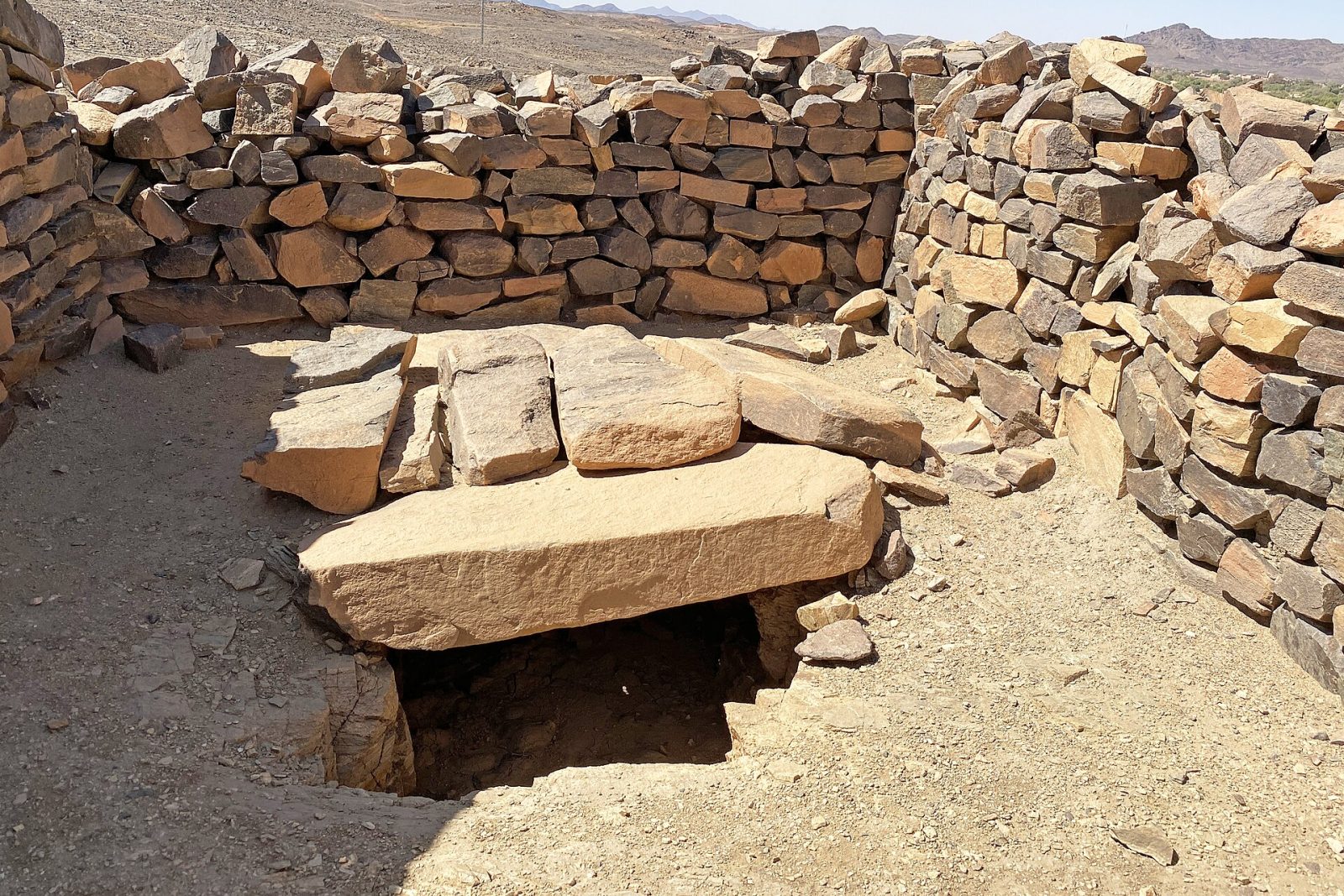
In 1925 an expedition led by the showman Byron Khun de Prorok opened a great stone tomb at Abalessa in the Algerian Sahara. Inside lay a woman wearing seven gold bracelets weighing more than 1.7 kilograms, revered by the Tuareg as their ancestral queen, Tin Hinan.
In late 1925, a French and American expedition led by the self-styled Count Byron Khun de Prorok, with support from the French army, opened a great stone tomb on a hill above the valley at Abalessa, about 80 kilometres west of Tamanrasset in the Hoggar mountains of southern Algeria. Tuareg tradition holds that it is the tomb of Tin Hinan, the ancestral queen of the Kel Rela. Prorok, widely regarded as a showman, dug only the burial chamber and never published his work properly. The archaeologist Maurice Reygasse returned for fuller excavations in the 1930s.
The tomb is an oval cairn about 26 by 24 metres and four metres high, hiding a stone building of eleven rooms. In a pit beneath large slabs in one room lay the skeleton of a woman on a carved wooden bed. She wore seven gold bracelets weighing more than 1.7 kilograms together, with seven or eight silver bracelets on her right forearm, a gold ring, gold beads and necklaces of stone and glass. Around her were iron arrowheads, an iron knife, a glass goblet, since lost, a Roman-type lamp and a small figurine.
Among the finds was a scrap of very thin gold foil that had been pressed over a bronze coin of the Roman emperor Constantine the Great, struck between AD 308 and 324. The coin itself was not found, but its design survives in the gold, showing that the burial cannot be earlier than 308. Wood from the bed was radiocarbon-dated to about AD 470, give or take 130 years, which places the burial in the 4th or 5th century. Whether the woman really was Tin Hinan cannot be proved, but the French scholar Gabriel Camps argued that the building was made as her tomb.
Prorok took the skeleton and grave goods to the United States, and they were handed back in Algiers in 1926. They are held by the Bardo National Museum in Algiers. Many Tuareg regard the opening of the tomb as a desecration.
Written for Global Finds from G. Camps in Zephyrus (1974), Algerie360 (2018) and Algeria's Law 98-04 on the protection of cultural heritage. Photo: the burial chamber of the tomb of Tin Hinan at Abalessa, Bernard Gagnon, Wikimedia Commons, CC BY 4.0.
Approximate location22.89, 4.85View on map
Source: Zephyrus (G. Camps, 1974)