The Ahiram Sarcophagus: a Phoenician king's coffin with one of the first alphabet texts and a curse on robbers
Famous find Inscription about 1000 BC; the coffin may be older · Found in 1923 See it on the timeline →
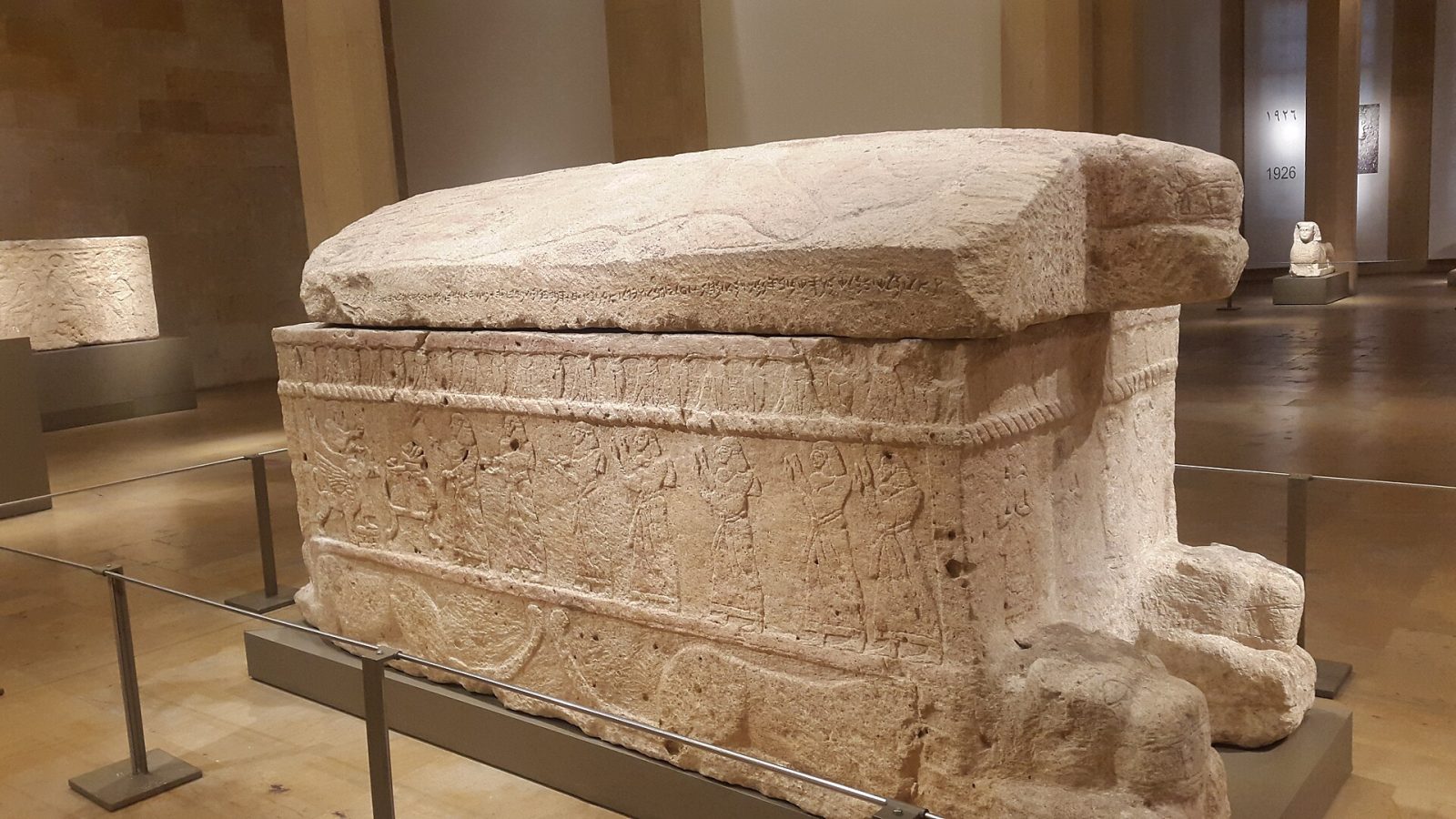
In 1922 a landslide at Byblos in Lebanon exposed royal tombs. In 1923 the archaeologist Pierre Montet found the tomb of King Ahiram, whose stone coffin carries one of the earliest texts in the Phoenician alphabet, ending in a curse on anyone who disturbs it.
On 16 February 1922, after heavy rain, part of a cliff collapsed at Byblos, now Jbeil, on the coast of Lebanon north of Beirut, exposing the entrance to an ancient tomb. It was the first of the royal tombs of Byblos, one of the oldest continuously inhabited towns in the world. The French Egyptologist Pierre Montet began a systematic excavation of the royal cemetery, and in 1923 he found Tomb V, the tomb of King Ahiram.
A deep shaft led down to the burial chamber. Partway down, an inscription scratched into the wall warned intruders of what awaited them below. The chamber had been robbed in antiquity, and was half full of mud, but it still held three stone coffins. The finest stands on four crouching lions. Its long sides show the king seated on a throne flanked by sphinxes, receiving a procession of people bringing offerings; its ends show mourning women. Around the rim and on the lid runs an inscription of 38 words, which reads in part: coffin which Ittobaal, son of Ahiram, king of Byblos, made for Ahiram his father. It ends with a curse on any king or general who uncovers it: may the sceptre of his rule be torn away and his throne overturned.
The text is the earliest substantial inscription in the fully developed Phoenician alphabet, the ancestor of the Greek and Latin alphabets and so of the letters on this page. Its date is debated. Objects in the tomb name the Egyptian pharaoh Ramesses II, of the 13th century BC, so some scholars think the coffin was carved then and inscribed later; most date the inscription to around 1000 BC, though some argue for later still.
The sarcophagus was raised in 1926 and taken to the National Museum of Beirut. During Lebanon's civil war, from 1975 to 1990, the museum's director, Emir Maurice Chehab, had the great stone coffins encased in wood and reinforced concrete to protect them. The museum reopened in 2000, and the Ahiram sarcophagus is one of its greatest treasures.
Written for Global Finds from the Digital Encyclopedia of Ancient Phoenician Scripts (Ohio State University), C. Rollston in Maarav (2008), the Oman Observer (2025) and Global Times (2026). Photo: the Ahiram sarcophagus in the National Museum of Beirut, Emna Mizouni, Wikimedia Commons, CC BY-SA 4.0.
Approximate location34.12, 35.65View on map
Source: Digital Encyclopedia of Ancient Phoenician Scripts (Ohio State University)