The Mohenjo-daro Seals: thumbnail-sized stamps carrying a script nobody can read
Famous find Mature Harappan, about 2600 to 1900 BC · Found in 1922 See it on the timeline →
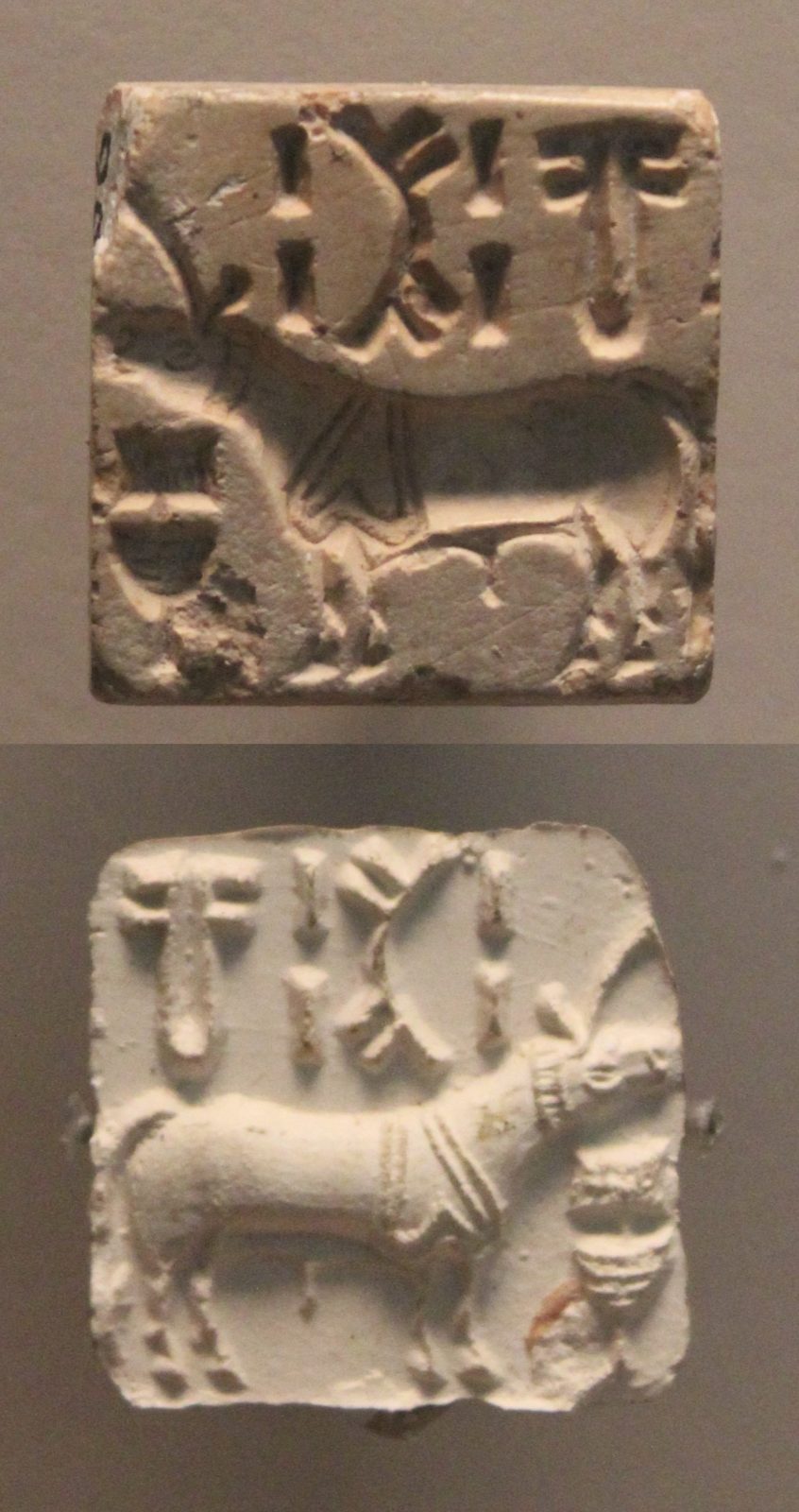
In the early 1920s archaeologists digging at Mohenjo-daro in Pakistan revealed a forgotten Bronze Age civilisation. Among its most famous finds are hundreds of small carved stone seals showing a one-horned 'unicorn' and a line of the Indus script, which has never been deciphered.
In the early 1920s, R. D. Banerji of the Archaeological Survey of India was investigating a Buddhist stupa on a mound beside the Indus river in Sindh, in what is now Pakistan, when he realised that the mound held something far older. On 20 September 1924 the survey's director, Sir John Marshall, announced to the world in the Illustrated London News that a forgotten civilisation had been found. Mohenjo-daro turned out to be one of the great cities of the Indus civilisation, which flourished from about 2600 to 1900 BC, with planned streets, brick houses, wells and drains.
Among its most characteristic finds are seals. They are small square stamps, typically 2.5 to 4 centimetres across, carved from a soft stone called steatite and then fired hard and white, with a pierced knob on the back so that they could be carried. Each shows an animal, and above it a short line of signs in the Indus script. The commonest animal at Mohenjo-daro, on more than half of the seals, is a bull-like beast shown in profile with a single horn, usually called the unicorn, standing in front of an object that may be an offering stand. The seals were probably pressed into clay to mark goods or authority, and they have been found as far away as Mesopotamia.
A century after Marshall's announcement, the Indus script has still not been deciphered. There are only a few thousand short inscriptions, none much longer than a couple of dozen signs, and no bilingual text like the Rosetta Stone to unlock them.
When India and Pakistan were partitioned in 1947 the finds from Mohenjo-daro were divided between the two countries, and seals are held in the National Museum of Pakistan in Karachi, in the National Museum in New Delhi and in museums in Europe and America. Mohenjo-daro itself is a UNESCO World Heritage Site, threatened by salt and groundwater damage to its brickwork.
Written for Global Finds from History Reclaimed (2024), J. M. Kenoyer, the Metropolitan Museum of Art and The Friday Times (2026). Photo: a unicorn seal and its modern impression from Mohenjo-daro, Musée Guimet, Paris, Zunkir, Wikimedia Commons, CC BY-SA 4.0.
Approximate location27.33, 68.14View on map
Source: History Reclaimed