The Trebenište Gold Masks: royal graves found by soldiers mending a road near Lake Ohrid
Famous find Late 6th century BC · Found in 1918 See it on the timeline →
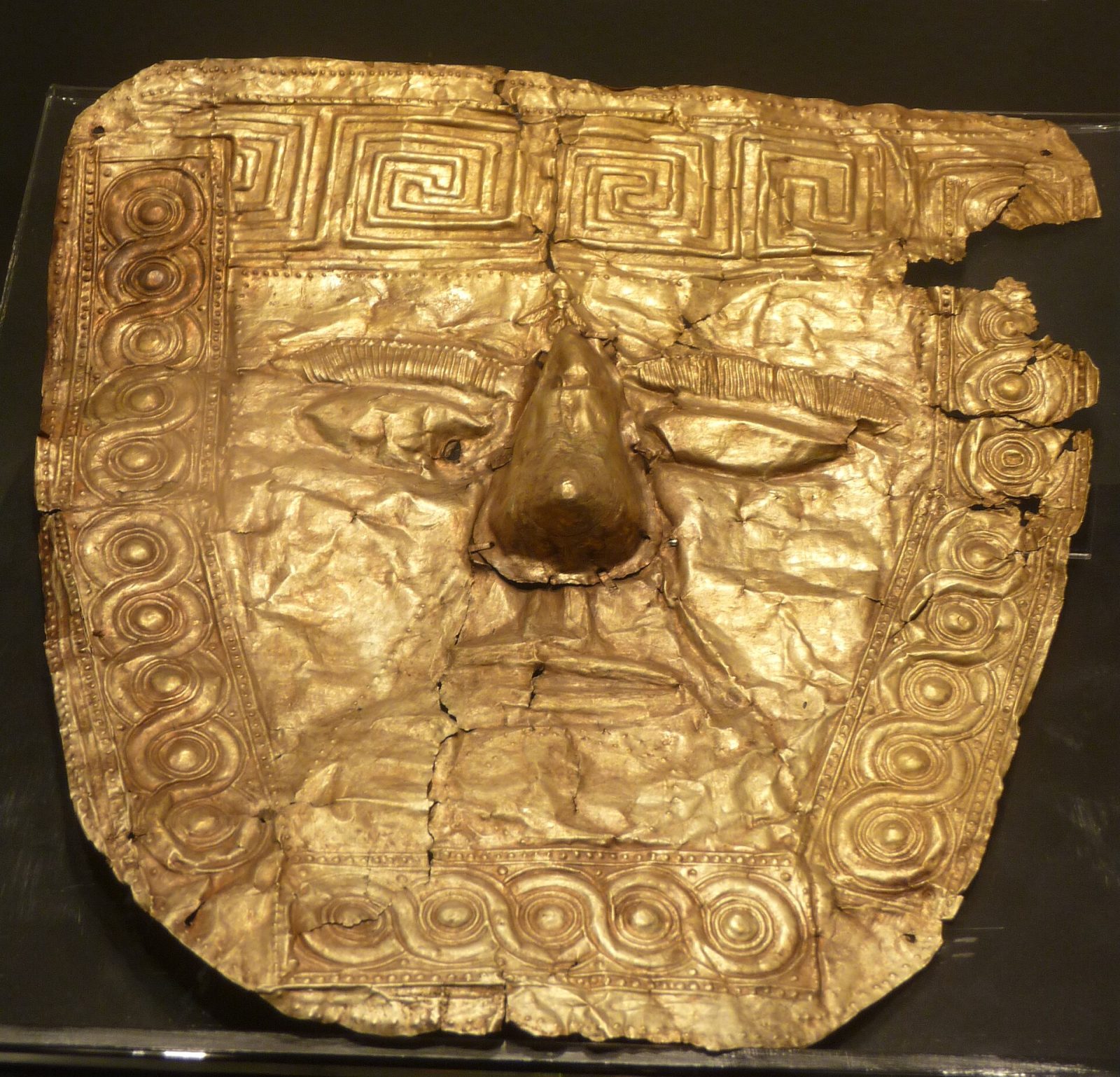
In the spring of 1918 Bulgarian soldiers repairing a road near the village of Trebenište, by Lake Ohrid in what is now North Macedonia, broke into a rich grave. It held a gold funerary mask, a gold hand with a ring and a great bronze wine bowl, from about 525 to 500 BC.
In the spring of 1918, during the First World War, a unit of the Bulgarian army was repairing roads near the village of Trebenište, close to the northern shore of Lake Ohrid, in what is now North Macedonia, when the soldiers broke into a grave of extraordinary richness. They handed what they found to the authorities in Ohrid, and more graves came to light before archaeologists arrived. Karel Škorpil and Bogdan Filov then excavated further graves, and published the finds in 1927.
The first grave contained a gold funerary mask, a thin sheet of gold beaten to cover the face of the dead, with a raised nose and borders of meanders and spirals. With it were a gold hand still wearing its ring, a gold sandal, silver cups, a gilded helmet, beads of amber and glass, and a large bronze krater, a vessel for mixing wine, with handles shaped like the Gorgon and cattle around its neck. The graves date from the late 6th century BC, about 525 to 500 BC. Who the people buried at Trebenište were, whether local Illyrian, Thracian or Macedonian rulers, is still debated.
Further excavations followed, by the Serbian archaeologist Nikola Vulić in the 1930s and in later decades, and the cemetery eventually produced dozens of graves and four gold masks. Because the excavations were carried out by different countries at different times, the finds are now divided: the first mask and the grave goods of 1918 are in the National Archaeological Institute with Museum in Sofia, Bulgaria; the finds of the 1930s, including another gold mask, are in the National Museum of Serbia in Belgrade; and other material is in Ohrid and Skopje. Parts of the find were brought together for exhibitions marking its centenary, in Skopje in 2019 and in Sofia in 2023 and 2024.
Written for Global Finds from the National Archaeological Institute with Museum, Sofia, The Sofia Globe (2023), Haemus (2019), L. Ilieva and E. Penkova in ArcheoSciences (2009) and Livius. Photo: the gold mask from Grave I at Trebenište in the National Archaeological Museum, Sofia, Simin, Wikimedia Commons, CC BY-SA 4.0.
Approximate location41.20, 20.76View on map
Source: The Sofia Globe