The West Mebon Vishnu: Southeast Asia's largest bronze, dug up after a farmer's dream at Angkor
Famous find Second half of the 11th century AD · Found in 1936 See it on the timeline →
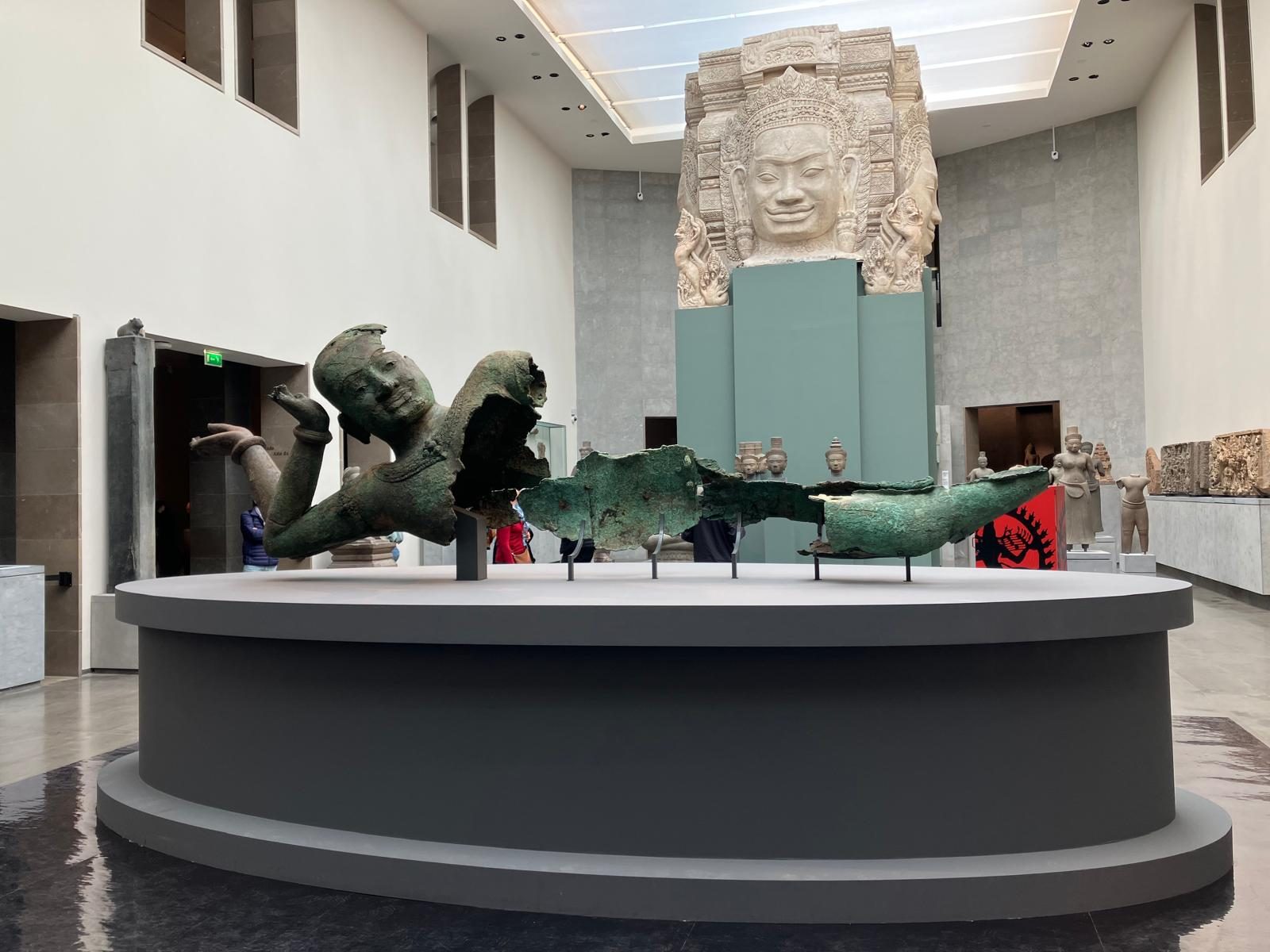
In 1936, the story goes, a farmer at Angkor in Cambodia dreamed the Buddha asked to be freed from the earth. Digging at the West Mebon temple uncovered the head and shoulders of a giant bronze Vishnu, the largest bronze ever cast in Southeast Asia, now reassembled for the first time.
In 1936, according to a story still told at Angkor, in north-western Cambodia, a local farmer dreamed that the Buddha asked to be freed from the ground. He dug at the West Mebon, a temple on an artificial island in the middle of the West Baray, the vast rectangular reservoir built by the kings of Angkor. What he found was not the Buddha but a huge bronze head. Between December 1936 and January 1937 archaeologists of the French School of the Far East, Henri Marchal and Maurice Glaize, recovered it from a pit, with dozens of loose bronze fragments.
It is the god Vishnu, lying on his side on the cosmic serpent Ananta, the moment before he dreams the universe into being. Complete, the figure was between five and six metres long. What survives is the head, the upper body and two of the four arms, about a quarter of the original. It was cast in the second half of the 11th century and is the largest bronze statue ever made in Southeast Asia. The hollows of its eyes, brows and moustache once held inlays, and it was originally gilded.
For decades the head and shoulders were displayed in the National Museum of Cambodia in Phnom Penh. In 2024 the statue and 39 fragments recovered with it were taken to France for study and restoration, and in 2025, at the Musée Guimet in Paris, the pieces were shown reassembled for the first time since the god fell. The statue then travelled to the United States: it was shown at the Smithsonian's National Museum of Asian Art in Washington from March to September 2026 and at the Asian Art Museum in San Francisco from October 2026, its last stop before returning home to Phnom Penh.
Written for Global Finds from the Smithsonian's National Museum of Asian Art (2026), the Musée Guimet (2025), the Angkor Database and Le Petit Journal Cambodge. Photo: the West Mebon Vishnu reassembled for the Royal Bronzes of Angkor exhibition at the Musée Guimet, Paris, Nosyne, Wikimedia Commons, CC0.
Approximate location13.43, 103.80View on map