The Areni-1 Shoe: a 5,500-year-old leather shoe found under an upturned pot in an Armenian cave
Famous find Made about 3600 to 3400 BC · Found in 2008 See it on the timeline →
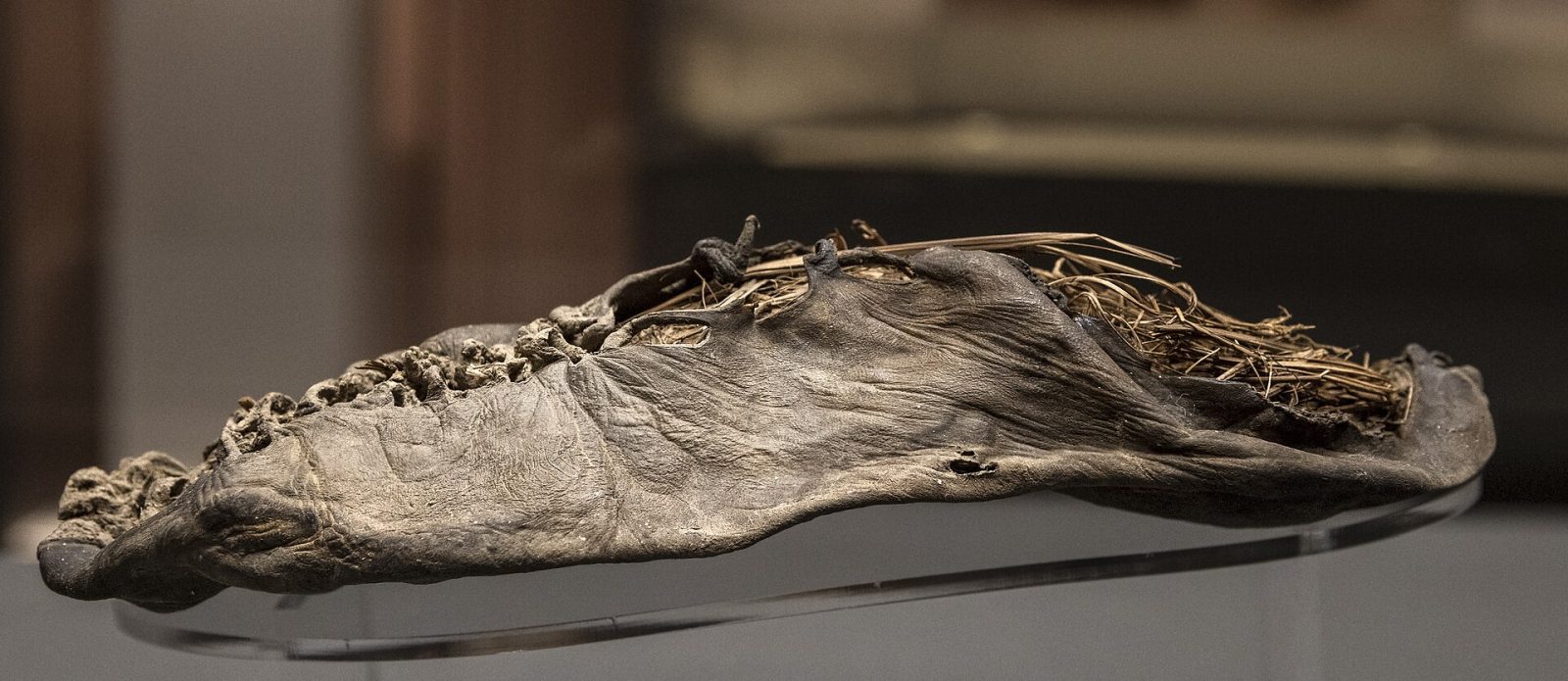
In 2008 an Armenian student digging in the Areni-1 cave found a complete leather shoe stuffed with grass, lying beneath a broken pot. Radiocarbon dating showed it was made about 5,500 years ago, centuries older than the shoes of Ötzi the Iceman.
In 2008, Diana Zardaryan, an Armenian PhD student, was digging in the Areni-1 cave in Vayots Dzor province, in southern Armenia, as part of an Armenian, Irish and American excavation led by Boris Gasparyan, Ron Pinhasi of University College Cork and Gregory Areshian of the University of California, Los Angeles. At the bottom of a small pit lined with plaster she found an upturned broken pot, and beneath it, lying upside down, a leather shoe. The pit also held the shoulder blade of a red deer, two wild goat horns and a fish bone.
The shoe is for a right foot and was made from a single piece of leather, probably cowhide, wrapped around the foot and laced along the top and the back with a leather thong. It is 24.5 centimetres long, about a modern European size 37. It had been stuffed with grass, perhaps to keep its shape, and its wear shows that someone had walked in it. The floor of the cave was sealed by a thick layer of sheep dung, which helped to preserve it so well that the laces survived, and the team at first thought it was only a few hundred years old.
Radiocarbon dating of the leather, at Oxford and at the University of California, Irvine, placed it between about 3627 and 3377 BC, and the grass inside proved to be the same age. When the find was published in the journal PLoS ONE in 2010, it was the oldest leather shoe known, a few centuries older than the shoes worn by Ötzi the Iceman. Its design is almost the same as the pampooties worn on Ireland's Aran Islands until the middle of the 20th century. Who wore it, and why it was placed in a pit under a pot, is not known.
The shoe was conserved and went on display at the History Museum of Armenia in Yerevan in 2010, where it can still be seen.
Written for Global Finds from R. Pinhasi and colleagues in PLoS ONE (2010), the History Museum of Armenia, University College Cork (via ScienceDaily) and Armenpress (2022). Photo: the Areni-1 shoe in the History Museum of Armenia, David Castor, Wikimedia Commons, CC0.
Approximate location39.73, 45.20View on map
Source: PLoS ONE (Pinhasi et al., 2010)