The Nisa Rhytons: Parthian kings' ivory drinking horns found in a treasury in Turkmenistan
Famous find Parthian, about 3rd to 1st century BC · Found in 1948 See it on the timeline →
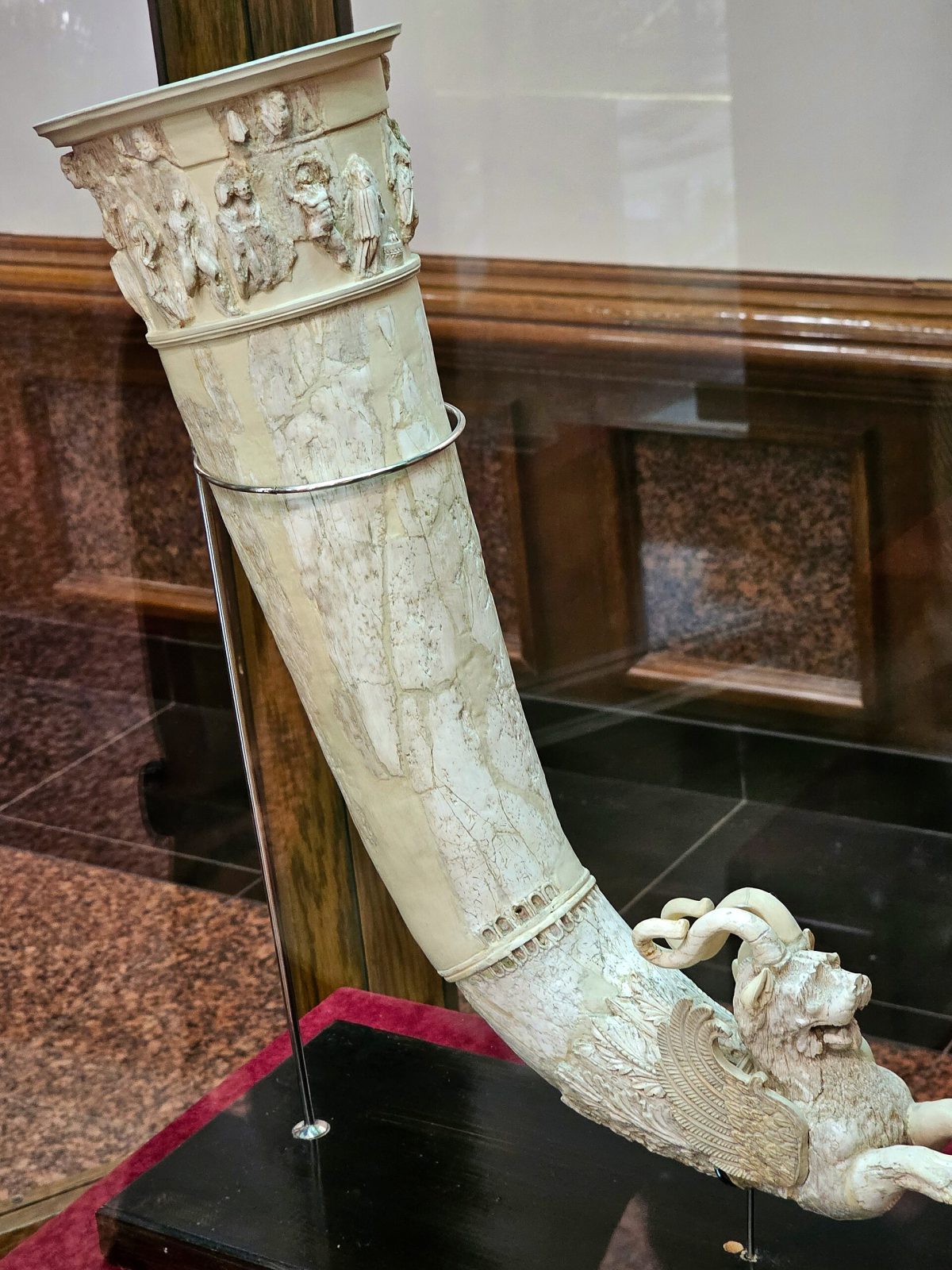
In the autumn of 1948 archaeologists excavating the treasury of Old Nisa, an early capital of the Parthian kings in Turkmenistan, found dozens of carved ivory drinking horns still lying on the bench where they had been stored, decorated with griffins, centaurs and Greek gods.
Old Nisa, on the edge of the Kopet Dag mountains just west of Ashgabat in Turkmenistan, was an early royal fortress of the Parthians, the dynasty that ruled Iran and Mesopotamia from the 3rd century BC and fought Rome for three centuries. Its ancient name was Mithradatkert. In the autumn of 1948 the South Turkmenistan Archaeological Expedition, led by Mikhail Masson, was excavating a building known as the Square House, which turned out to be a treasury. In it a team led by Elena Davidovich found around forty ivory rhytons, still lying on the bench where they had been stored.
A rhyton is a horn-shaped vessel for drinking or for pouring offerings. The Nisa rhytons were made of elephant ivory, built up from several pieces of tusk, and carved at their lower ends into creatures: winged lion-griffins, centaurs and a bull with a human head. Bands around their rims show Greek gods and scenes of sacrifice, and one carries an inscription to the goddess Hestia. Traces of paint and inlay survive, and some pieces were combined with bronze. They are among the finest examples of the mixture of Greek and Iranian art that followed the conquests of Alexander the Great, and they date from around the 3rd to the 1st century BC.
Only weeks after the find, on 6 October 1948, a great earthquake devastated Ashgabat, and the rhytons were damaged. They were conserved in 1950 and later divided: twelve went to museums in Moscow and St Petersburg, the Pushkin Museum, the State Museum of Oriental Art and the Hermitage, and the rest stayed in Turkmenistan. The Pushkin Museum completed a new conservation of its four in 2019. In Ashgabat they are displayed in the National Museum of History. The ruins of Nisa became a UNESCO World Heritage Site in 2007.
Written for Global Finds from the Pushkin State Museum of Fine Arts (2019), Encyclopaedia Iranica and the State Museum of Oriental Art (via Colors and Stones). Photo: an ivory rhyton from Nisa in the National Museum of History, Ashgabat, Richard Mortel, Wikimedia Commons, CC BY 2.0.
Approximate location37.95, 58.20View on map