The Erebus Bell: raised on the first dive to Franklin's lost ship, found thanks to Inuit memory
Famous find Cast in 1845; the ship was abandoned in 1848 · Found in 2014 See it on the timeline →
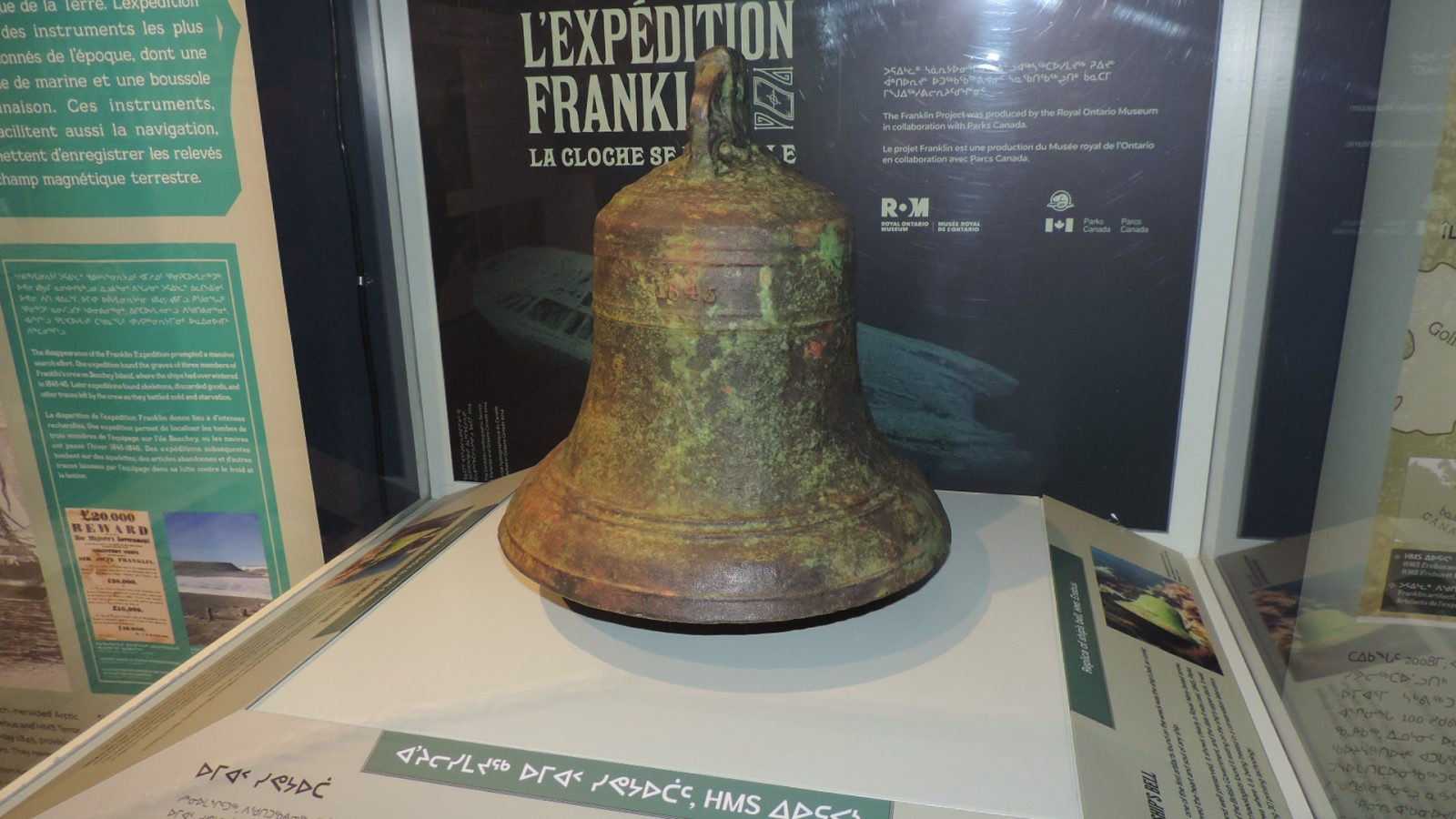
In September 2014 a Parks Canada-led search found HMS Erebus, one of the two ships of Sir John Franklin's lost Arctic expedition, guided by Inuit oral history and a rusty iron fitting spotted on a beach. On the first dive, archaeologists raised the ship's bell, dated 1845.
In May 1845 Sir John Franklin sailed from England with two Royal Navy ships, HMS Erebus and HMS Terror, and 129 men to find the Northwest Passage through the Arctic. Both ships were trapped in the ice off King William Island and abandoned in 1848, and none of the men survived.
For more than 160 years searchers looked for the ships. In Gjoa Haven, the historian Louie Kamookak spent over thirty years recording Inuit accounts of a ship that had sunk near Utjulik, south of King William Island. In 2014 a search led by Parks Canada, with the Government of Nunavut, the Royal Canadian Navy, the Canadian Coast Guard and the Arctic Research Foundation, worked in those waters. On 1 September a helicopter pilot, Andrew Stirling, noticed a rusty iron fitting on a small island, and Nunavut archaeologists recognised it as a davit pintle from a ship. The next day, 2 September, sonar found Erebus in Wilmot and Crampton Bay, sitting upright and largely intact in shallow water.
On the very first dive, the archaeologists raised the ship's bell. It lay on the deck beside the windlass it had once hung above, intact and in very good condition, marked with the Royal Navy's broad arrow and the date 1845. It spent many months being conserved in a bath of distilled water at Parks Canada's laboratory in Ottawa, was unveiled there in November 2014, and was shown in the exhibition Death in the Ice at the National Maritime Museum in Greenwich in 2017.
In 2018 the United Kingdom gave the wrecks of Erebus and Terror to Canada, and they are now jointly owned by Canada and the Inuit Heritage Trust. Britain kept the artefacts that had already been raised, including the bell. Replicas were made for partner museums, among them the Nattilik Heritage Centre in Gjoa Haven.
Written for Global Finds from Parks Canada, the UK Government (2018), CBC News (2018) and Royal Museums Greenwich. Photo: a replica of the Erebus bell at the Nattilik Heritage Centre, Gjoa Haven (not the original bell), Kerry Raymond, Wikimedia Commons, CC BY 4.0.
Approximate location68.18, -98.75View on map
Source: Parks Canada