The Pioneer Helmet: an Anglo-Saxon boar-crested helmet, found after a detector picked up a hanging bowl
Famous find Buried in the late 7th century AD · Found in 1997 See it on the timeline →
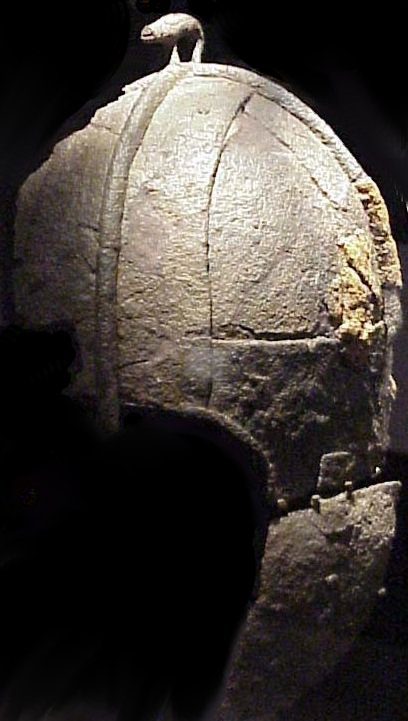
At Easter 1997, a metal-detector survey ahead of gravel quarrying at Wollaston in Northamptonshire found a bronze hanging bowl, which led archaeologists to a 7th-century warrior's grave. In it lay an iron helmet with a boar crest, one of only six Anglo-Saxon helmets known.
At Easter 1997, Northamptonshire Archaeology was investigating land at Wollaston, in Northamptonshire, before gravel extraction by the company Pioneer Aggregates. A metal-detector survey by Steve Critchley, working with the site director Ian Meadows, picked up a bronze hanging bowl decorated with a millefiori mount, and the bowl led the archaeologists to a grave.
The grave was 2.8 metres long and 1.3 wide, but after centuries of ploughing it was only about 15 centimetres deep, and it had probably once lain under a mound beside a road. It held the remains of a young man. By his left hip lay an iron helmet, which the excavators first took for a bucket. With him were a pattern-welded sword about three feet long, made from four twisted bundles of iron rods, with traces of a leather scabbard lined with fleece, the hanging bowl, three buckles and a knife.
The helmet's cap was made from twelve riveted pieces of iron, and its crest is a boar forged from a single iron rod. About half of it had been destroyed by the plough, and the rest was in between 100 and 200 fragments, so it was lifted in a block of soil wrapped in cling film and plaster bandage, scanned at Leicester General Hospital and painstakingly reassembled. The nose guard had been deliberately bent before burial, perhaps as a ritual act. Buckles in the grave date it to the late 7th century, around 675. It is one of only six Anglo-Saxon helmets known and one of three with a surviving boar crest, the kind of helmet described in the poem Beowulf.
The helmet is named after Pioneer Aggregates, which paid for the excavation and conservation. After being shown in Leicester, it went to the Royal Armouries in Leeds, where it has been on long-term display.
Written for Global Finds from MOLA, Archaeology magazine (1997), the Royal Armouries and I. Meadows in Northamptonshire Archaeology (1997). Photo: the Pioneer Helmet in the Royal Armouries, Leeds, Nathandbeal, Wikimedia Commons, CC BY-SA 3.0.
Approximate location52.26, -0.70View on map
Source: MOLA