The Kingittorsuaq Runestone: a Norse message found by a Greenlandic hunter far north of any Viking settlement
Famous find Carved about 1250 to 1333 · Found in 1824 See it on the timeline →
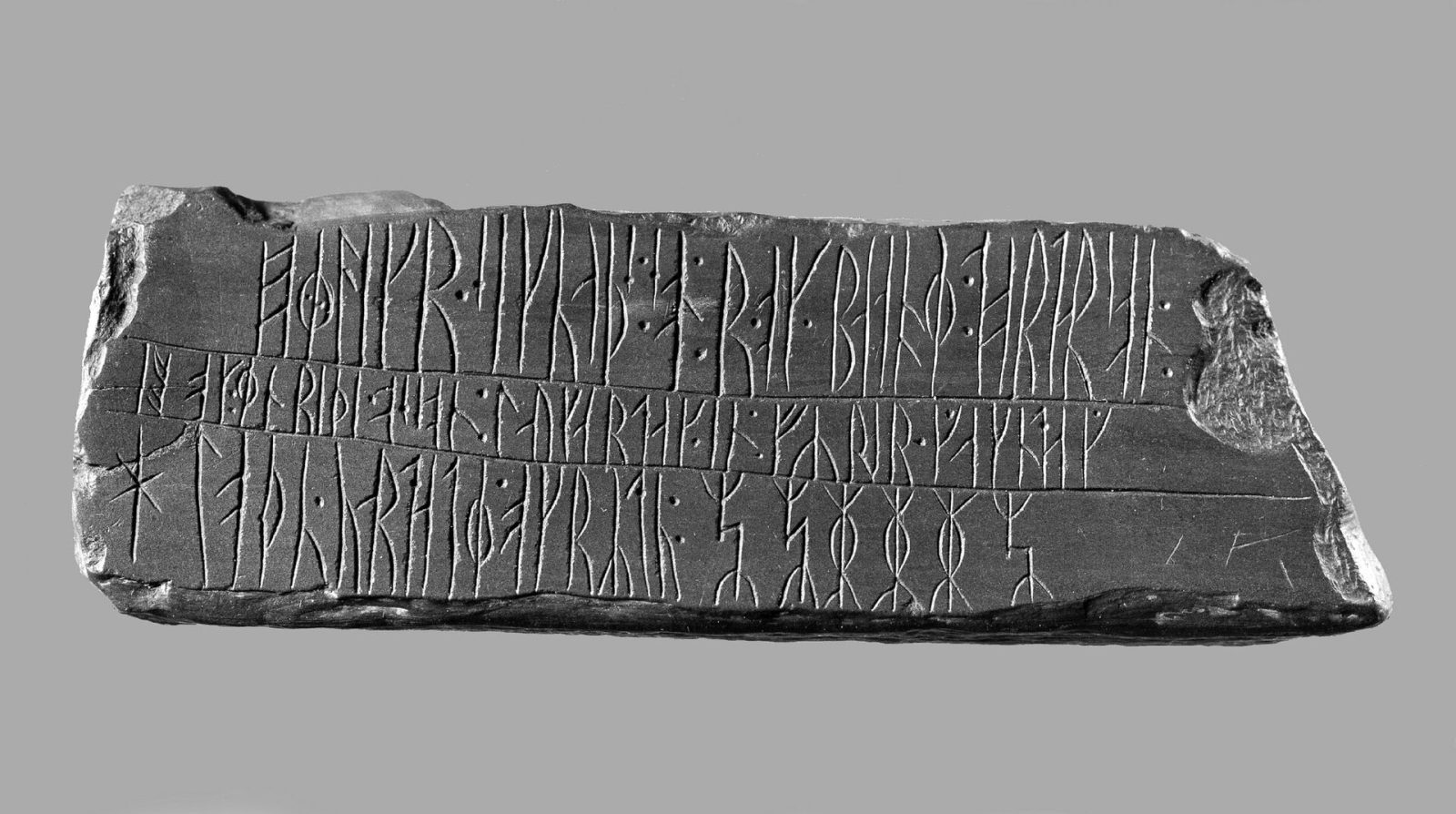
In 1824 the Greenlandic hunter Pelimut found a small stone carved with runes on the island of Kingittorsuaq, north of Upernavik. It records three Norsemen who built cairns there in the 13th or 14th century, and it is the most northerly Norse runic inscription known.
In 1824, the Greenlandic hunter Pelimut, also known as Filemon, found a small slate stone covered in runes on Kingittorsuaq, a small island north of Upernavik on the north-west coast of Greenland. According to the accounts of the find, it lay among three cairns on the island's summit.
The stone is only about the size of a palm. Its inscription, as translated by the National Museum of Denmark, says that Erling Sigvatsson, Bjarne Thordarsson and Einride Oddsson raised the cairn on the Saturday before Rogation Day, the church festival of 25 April. It ends with six more runes that nobody has deciphered. They have been read as a date, as a cipher, and as a magic charm; one scholar, William Thalbitzer, suggested in 1951 that they were a charm against the ice.
Norse settlers from Iceland had colonised the south-west of Greenland from the late 10th century, in two settlements far to the south, and the colony disappeared in the 15th century. Kingittorsuaq lies at about 73 degrees north, far beyond them, and the stone is the most northerly Norse runic inscription known. It is usually dated to between about 1250 and 1333 from the forms of its runes. Older studies once placed it as early as 1135, a date now abandoned, while Thalbitzer argued for 1314. Because nobody could have sailed so far north from the settlements by late April, the museum argues that the three men must have spent the winter there, though the Danish historian Finn Gad questioned that reading.
The stone was sent to Copenhagen, where it has been studied ever since, and it is in the collection of the National Museum of Denmark, catalogued as runic inscription MCCXII. Two centuries after Pelimut picked it up, the three cairn-builders remain the only Norsemen known by name to have reached so far north.
Written for Global Finds from the National Museum of Denmark and W. Thalbitzer (1951). Photo: the Kingittorsuaq runestone, Lennart Larsen, National Museum of Denmark, Wikimedia Commons, public domain (the museum licenses it CC BY-SA 4.0).
Approximate location72.97, -56.24View on map
Source: National Museum of Denmark