The Yukon Coin: a Chinese emperor's coin came up in the first shovelful of a mine-road survey, deep in the Canadian north
Famous find Cast about 1667 to 1671, in the reign of the Kangxi emperor · Found in 2011 See it on the timeline →
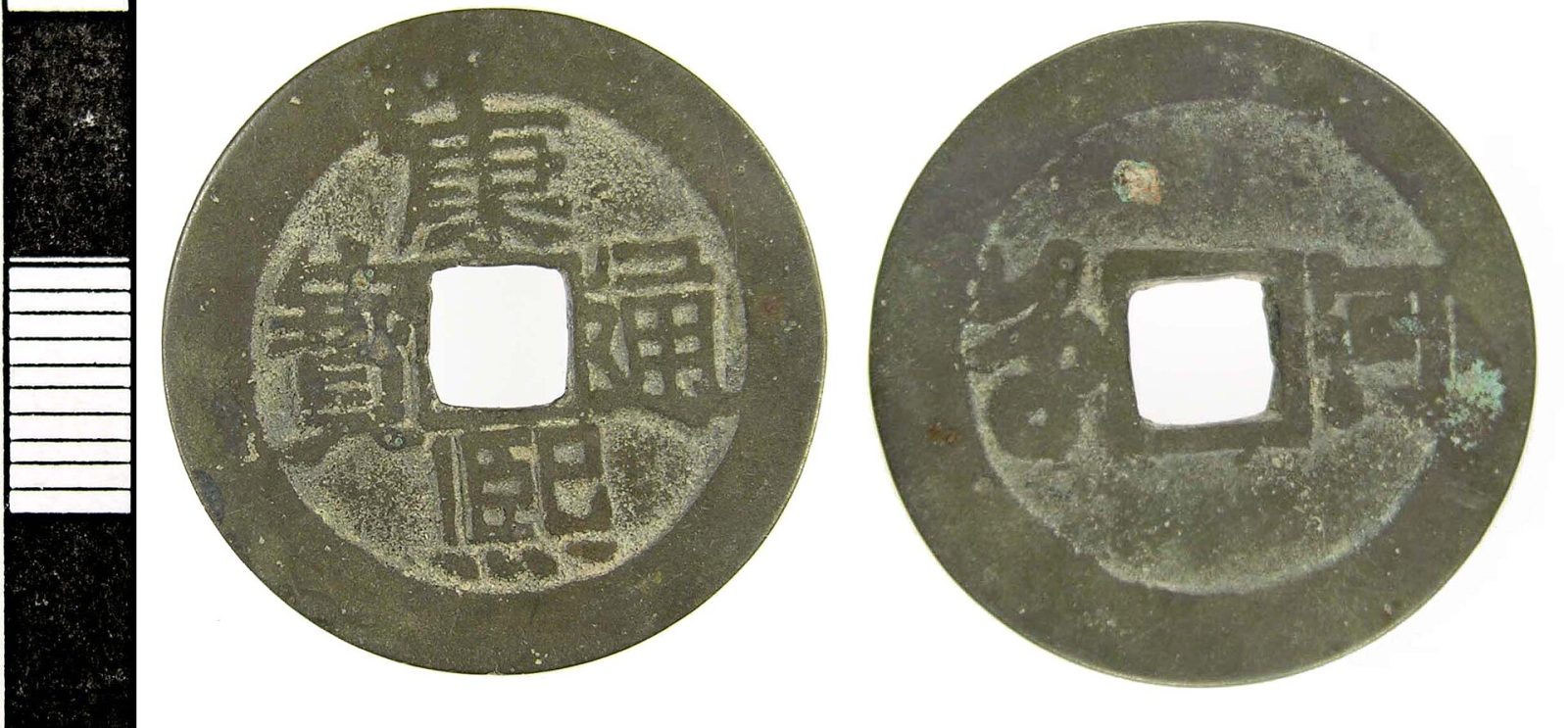
In summer 2011 archaeologists surveying the route of a mine road near Carmacks, Yukon, turned over their first shovel of topsoil and saw a Chinese coin dangling from the turf. Cast in the reign of the Kangxi emperor around 1667 to 1671, it had travelled thousands of miles inland.
In the summer of 2011, a team from Ecofor Consulting was carrying out a heritage survey for a proposed road to the Casino copper and gold mine, north-west of Carmacks in the Yukon, Canada. On a breezy promontory above the meeting of a river and a creek, a likely spot for an old campsite, the archaeologist Kirby Booker turned over the very first shovel of topsoil, and James Mooney, less than a metre away, saw something dangling from the turf. It was a Chinese coin. Mooney called it the neatest discovery he had ever been part of.
The coin is a round copper-alloy cash coin with a square hole in the middle, cast in the reign of the Kangxi emperor of China's Qing dynasty. It belongs to a series known to collectors as "poem coins", whose mint names on the back, read in order, make up a poem, and reports placed it at a mint in Zhili province around 1667 to 1671. Unusually, it has four extra small holes, one beside each corner of the square hole.
How did it get there? The site lies on an old trading trail that ran from the coast at Dyea inland to Fort Selkirk, within the traditional territory of the Selkirk First Nation. Mooney's explanation was that Russian fur traders, who sold furs in China, brought Chinese coins back across the Pacific, and that coastal Tlingit traders, who controlled the passes into the interior, carried them inland. Tlingit warriors are known to have sewn Chinese coins onto hide armour, overlapping like shingles, to help stop arrows, and the extra holes might have been made for sewing, though they might also have been made in China, where coins were sometimes nailed up for luck. As Mooney said, nobody really knows how this coin was used.
It was only the third Chinese coin ever found in the Yukon, and it reached the interior more than a century before the Klondike gold rush of 1898. The survey team recommended rerouting the road so that the site could be studied further. The coin belongs to the people of the Yukon and was to be passed to the territory's heritage branch.
Written for Global Finds from Yukon News (2011), Western Copper and Gold (2011) and NBC News (2011). Photo: a Kangxi coin of the same series from a different mint, not the Yukon coin, Kate Sumnall, Museum of London, Portable Antiquities Scheme, Wikimedia Commons, CC BY-SA 2.0.
Linked finds
Source: Yukon News (2011)