The Ponce Monolith: a Tiwanaku god found lying in the earth, with a Christian cross cut into its shoulder
Famous find Tiwanaku, about AD 500 to 1100 · Found in 1957 See it on the timeline →
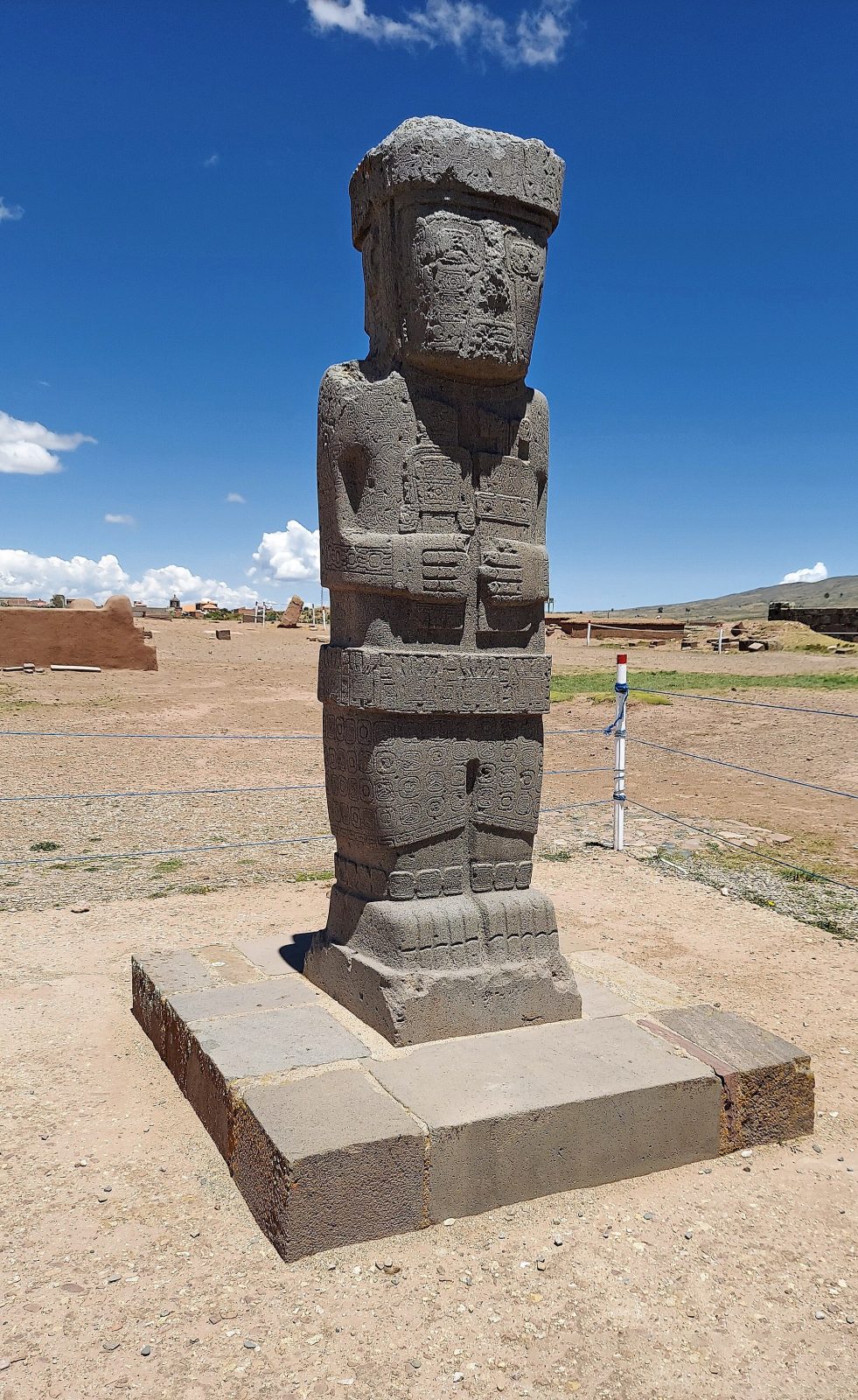
In 1957 Bolivian archaeologist Carlos Ponce Sanginés and his team uncovered a three-metre stone figure lying on its side inside the Kalasasaya at Tiwanaku, near Lake Titicaca. Carved between about AD 500 and 1100, it is the best-preserved complete sculpture of the Tiwanaku culture.
In 1957, a team from the Centre for Archaeological Research in Tiwanaku, led by the Bolivian archaeologist Carlos Ponce Sanginés, was excavating inside the Kalasasaya, the great walled platform at the heart of the ancient city of Tiwanaku, near Lake Titicaca in western Bolivia. In the central enclosure they uncovered a carved stone figure lying on its left side, facing south.
The monolith, now named after Ponce, is a block of grey andesite three metres tall, 79 centimetres wide and 54 deep. It shows a standing figure holding a kero, a ritual drinking cup, in its left hand and a snuff tablet, used for taking a psychoactive snuff, in its right. Its body and clothing are covered in carved designs, and of the 145 small creatures that hang from the patterns, 89 are fish. It is the best-preserved complete sculpture of the Tiwanaku culture, and the second largest after the 7.3-metre Bennett monolith.
Tiwanaku was the centre of a powerful Andean culture between about AD 500 and 1100, and its monoliths seem to show ancestors or gods taking part in rituals of drinking and snuff-taking. Long after the city declined, someone carved a Christian cross into the figure's shoulder. That cross shows the monolith was still visible after the Spanish conquest, and records suggest that local people buried such figures during a campaign against "idolatry" in 1627, which may explain how it came to be lying under the ground.
After the Kalasasaya was restored by Ponce's team, a reconstruction that is itself debated, the monolith was set upright in the middle of the enclosure, where it still stands. Tiwanaku became a UNESCO World Heritage Site in 2000.
Written for Global Finds from J. Villanueva Criales in Latin American Antiquity (2024), the Cotsen Institute of Archaeology (UCLA) and World History Encyclopedia. Photo: the Ponce Monolith in the Kalasasaya at Tiwanaku, P. Hughes, Wikimedia Commons, CC BY 4.0.
Approximate location-16.56, -68.67View on map