The Aegina Treasure: Minoan gold kept hidden in a cellar for ten years, and its Master of Animals
Famous find Made about 1850 to 1550 BC · Found in 1880 See it on the timeline →
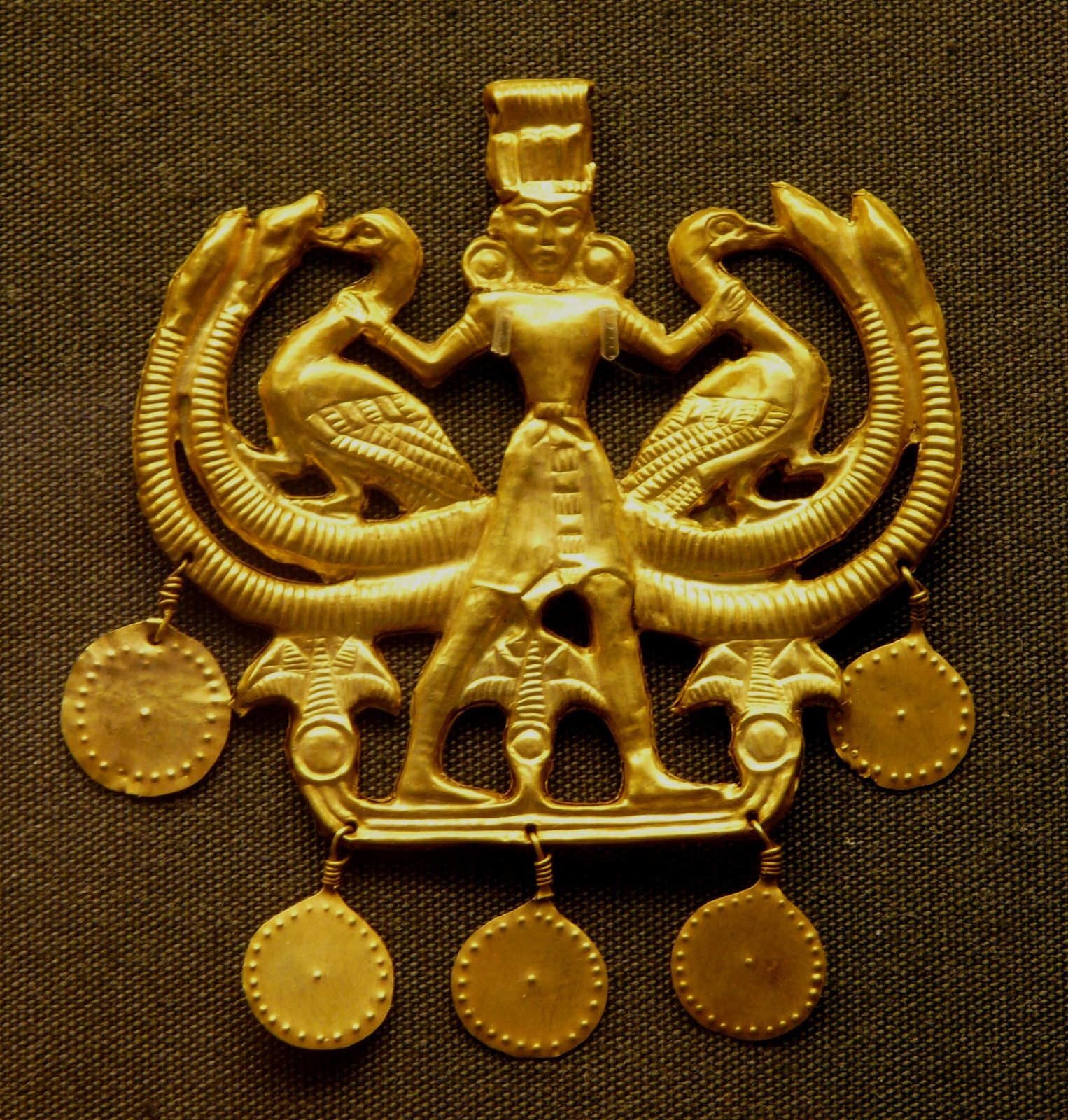
Minoan gold jewellery said to have come from the Greek island of Aegina was offered to the British Museum by a London sponge merchant in 1891. Its finest piece, a gold god holding two birds, is famous, but where and how the treasure was found is still argued over.
In 1891 the British Museum was offered a collection of ancient gold jewellery by Cresswell Brothers, sponge merchants in London, on behalf of a young man named George Brown. According to the museum's own research, published in 2009, his father, also George Brown, had found it on his property on the Greek island of Aegina, north and east of the ancient site of Kolonna, in about 1880, and kept it hidden in his cellar. The museum bought it in 1892, and more pieces in 1914. In 1913 one of the Cresswells drew a circle on a map to show the keeper of antiquities where it had been found.
The treasure is Minoan, the work of the Bronze Age civilisation of Crete, mostly from about 1850 to 1550 BC. It includes diadems, earrings, a bracelet, rings, a gold cup, dozens of rosette plaques and beads of gold, lapis lazuli, carnelian, amethyst and jasper. The most famous piece is the Master of Animals pendant: a god in a tall headdress and kilt standing among lotus flowers, holding a waterbird by the neck in each hand, with curving shapes behind him and gold discs hanging below. A pair of earrings shows double-headed snakes framing pairs of hounds.
Its story has been doubted for a century. Many scholars believed it had really been looted from the Chryssolakkos, the "gold pit" cemetery at Malia on Crete, and smuggled out through Aegina, while others have argued that its mixed styles and dates mean it was never a single find at all. Recent opinion has swung back towards Aegina. In April 2026 Greek and Austrian archaeologists excavating at Kolonna announced 32 gold and carnelian pieces from their 2025 season, including amulets very like those in the treasure.
The Aegina Treasure is in the British Museum.
Written for Global Finds from J. L. Fitton (ed.), The Aigina Treasure (British Museum, 2009), as reviewed in Bryn Mawr Classical Review (2010), the French School at Athens and the Jerusalem Post (2026). Photo: the Master of Animals pendant from the Aegina Treasure in the British Museum, Bkwillwm, Wikimedia Commons, CC BY-SA 4.0.
Linked finds
Source: Bryn Mawr Classical Review (2010), on The Aigina Treasure (British Museum, 2009)