The Tureholm Treasure: Sweden's biggest gold hoard, twelve kilos found a hand's depth down, and nearly all melted
Famous find Made about AD 400 to 550 · Found in 1774 See it on the timeline →
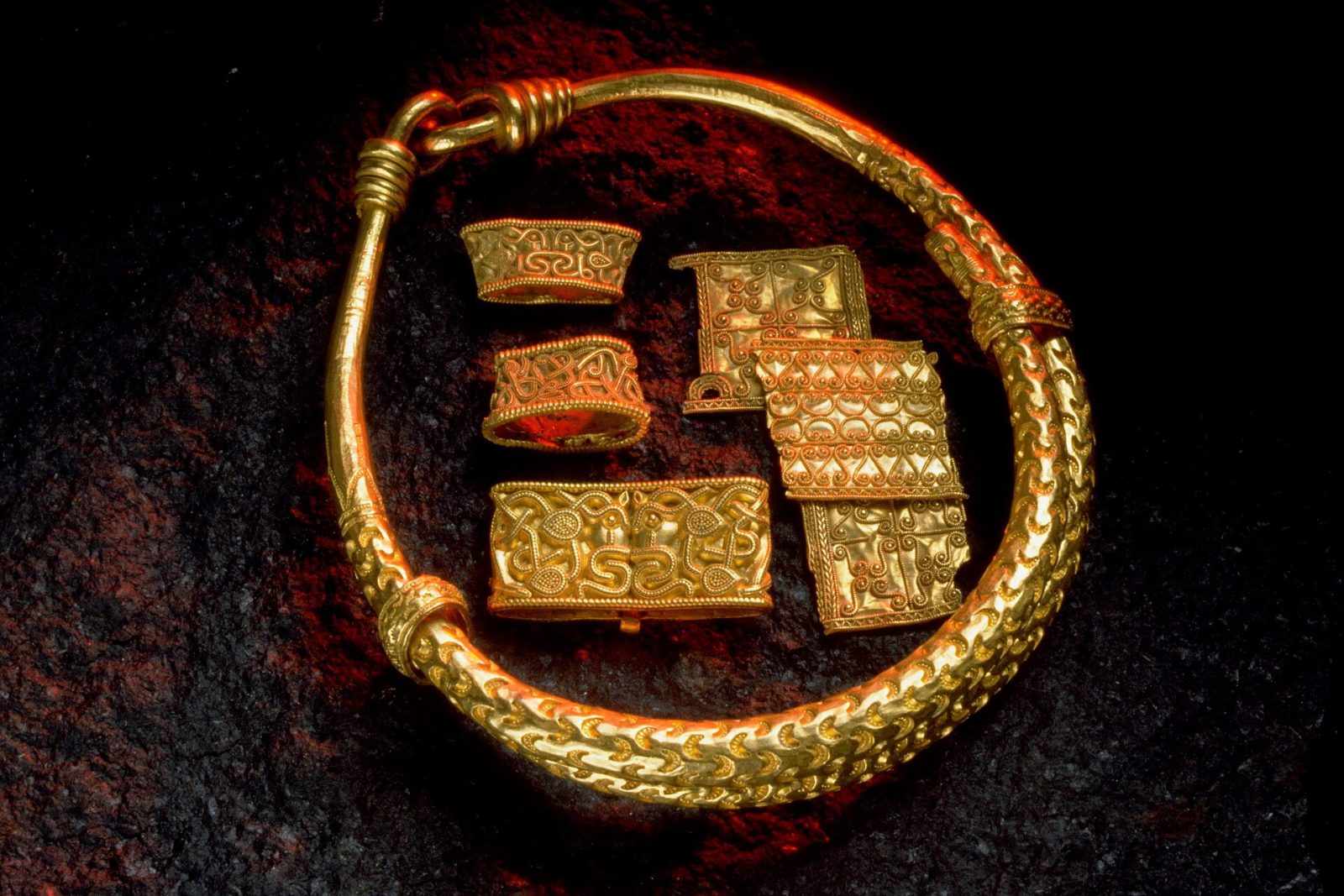
In 1774, on the Tureholm estate near Trosa in Sweden, about 12 kilograms of Migration Period gold came out of the ground where an old storehouse had stood. Most of it was melted down. A kilo-weight gold neck ring and sword fittings survive in Stockholm.
In 1774, at the village of Tuna on the Tureholm estate in the parish of Västerljung, near Trosa on the coast south of Stockholm, new building plots were being marked out on the land of Storegården farm. About half an ell down, roughly 30 centimetres, on the spot where an old storehouse had stood, the ground gave up gold. Accounts of who found it differ. Tradition links it to the estate's owner, Count Nils Adam Bielke, while a local curate wrote in 1799 that a farm maid at Tuna had found more than 30 marks of fine gold.
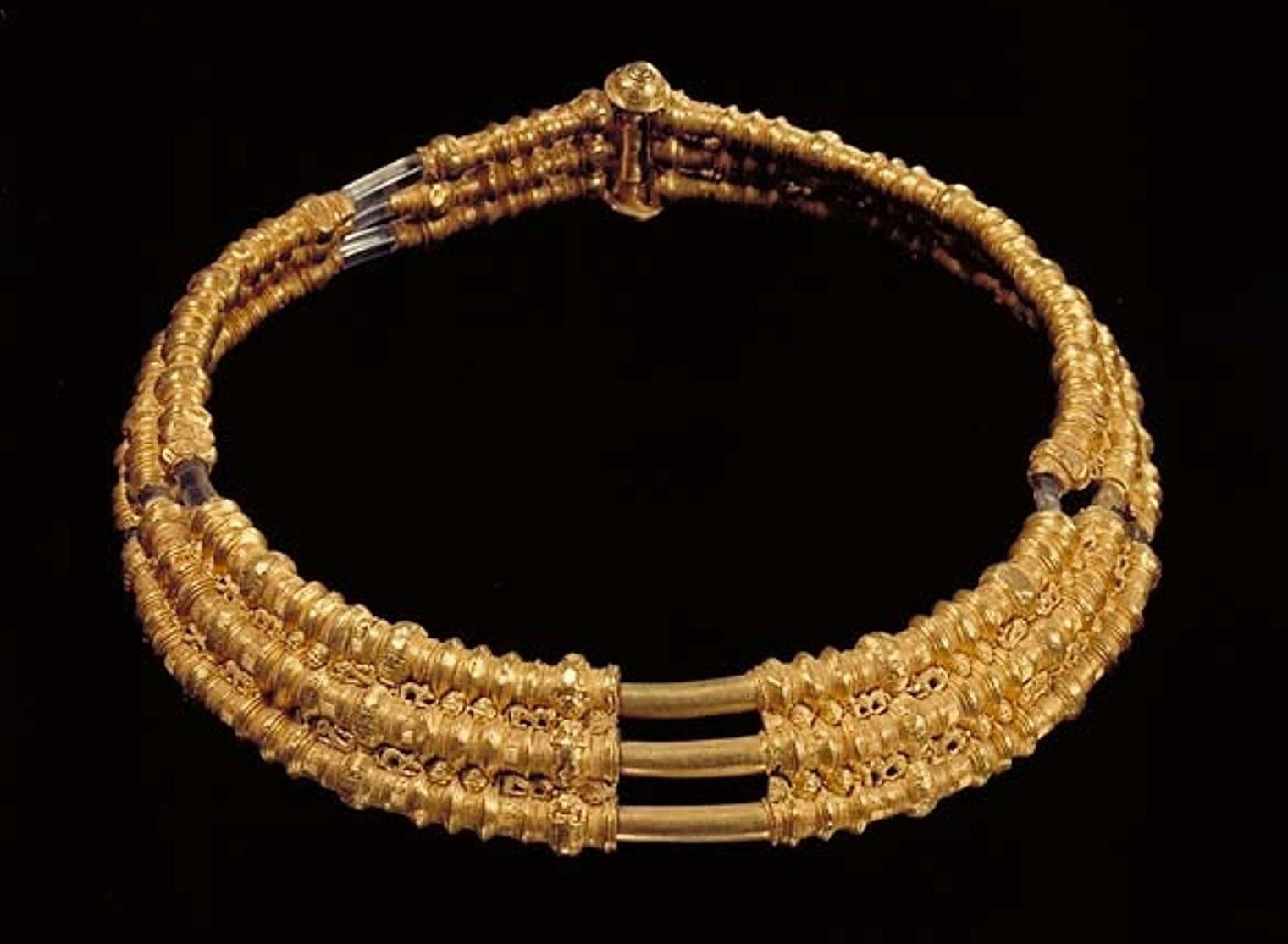
It was a great deal of gold, about 12 to 12.5 kilograms, and the Tureholm Treasure is often called the largest gold hoard ever found in Sweden. Most of it was melted down soon afterwards. What survives is a gold neck ring and a set of gold sword fittings. The neck ring is made of two massive gold rods that wrap around the neck and lock together with two decorated bands, and it weighs 985 grams, the heaviest of its kind in the museum's collection. It is stamped all over with tiny crescents that make a pattern like a reptile's skin, and one end carries a punched triangle that may be a stylised snake's head. The sword fittings, from the mouth of a scabbard and the grip, are decorated gold sleeves.
The treasure belongs to the Migration Period, about AD 400 to 550, when gold reached Scandinavia in quantity, much of it probably Roman gold coins that were melted and reworked into rings and weapon fittings for chieftains. Why so much was buried at Tuna is not known. It may have been a chieftain's treasury hidden in a time of danger, or an offering.
The surviving pieces are in the Swedish History Museum in Stockholm, and the neck ring has been on show in its Gold Room since 1994.
Written for Global Finds from the Swedish History Museum's collection catalogue, the Swedish National Heritage Board's register Fornsök and Sörmlands museum (2014). Photo: the Tureholm neck ring and sword fittings in the Swedish History Museum, Christer Åhlin, SHM, Wikimedia Commons, CC BY 4.0.