The Birka Ring: a Viking woman's ring inscribed "for Allah", catalogued for 130 years as gilded amethyst
Famous find Buried in the 9th century AD · Found in 1877 See it on the timeline →
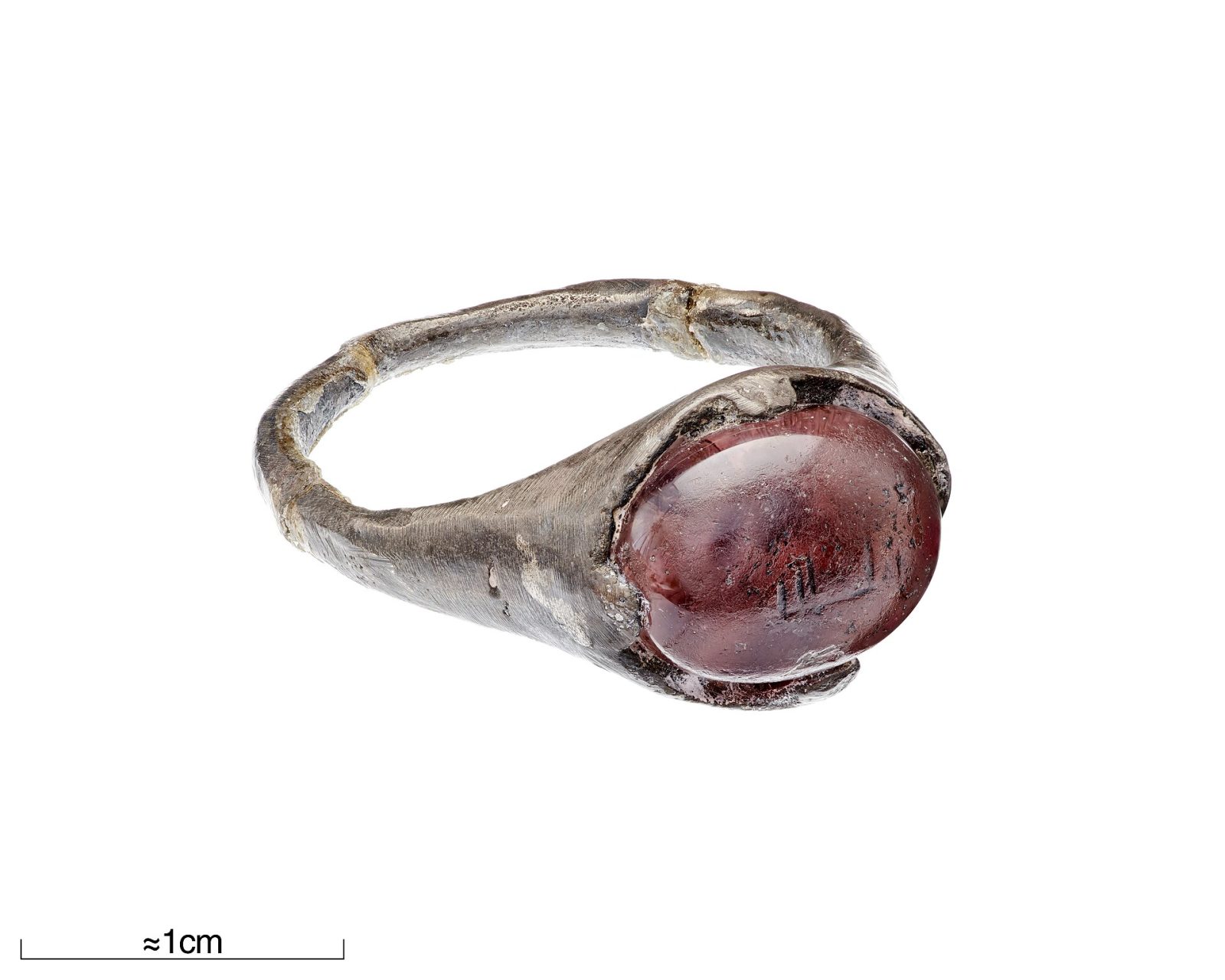
In 1877 Hjalmar Stolpe excavated a 9th-century woman's grave at the Viking town of Birka in Sweden and found a silver ring set with a violet stone engraved in Arabic. A 2015 study showed the stone is glass and the inscription probably reads "for Allah".
In 1877, the Swedish naturalist and archaeologist Hjalmar Stolpe was excavating the graves of Birka, the Viking trading town on the island of Björkö in Lake Mälaren, west of modern Stockholm. In a coffin burial in the cemetery north of the town's hillfort, a grave later numbered Bj 515, lay the remains of a woman buried in the 9th century. Among her belongings was a small silver finger ring set with a violet stone, and on the stone were letters that were not runes.
The ring was catalogued by the Swedish History Museum as gilded silver set with an amethyst, and it stayed that way for well over a century. In 2015 a team led by Sebastian Wärmländer of Stockholm University examined it with a scanning electron microscope. The stone turned out to be coloured soda-lime glass, an exotic material for Vikings at the time, and the metal was ungilded silver of about 94.5 per cent purity. The engraving is in Kufic, an early Arabic script, and the team read it as "for Allah" or "to Allah", although other readings have been suggested.
The microscope also showed something a detectorist will appreciate: the marks left when the ring was cast and filed are still sharp, so it was hardly worn. The researchers concluded it may have passed from the silversmith who made it to the woman in the grave with few owners in between. Perhaps she came from the Islamic world herself, or perhaps someone close to her had travelled there and brought it home by trade or by plunder. Birka lay at one end of the routes along the rivers of Russia that carried Arab silver coins to Scandinavia by the tens of thousands.
It is the only ring with an Arabic inscription known from a Scandinavian archaeological site. It is in the Swedish History Museum in Stockholm, and the museum's catalogue lists it in its Viking exhibition, The World of the Vikings.
Written for Global Finds from the Swedish History Museum's collection catalogue, S. Wärmländer and colleagues in Scanning (2015), Live Science and Archaeology magazine (2015). Photo: the Birka ring in the Swedish History Museum, Stockholm, Ola Myrin, Wikimedia Commons, CC BY 4.0.