The Sword of Tiberius: a Roman officer's sword in an emperor's scabbard, dug from a Mainz ditch by railway workers
Famous find Made about AD 14 to 18 · Found in 1848 See it on the timeline →
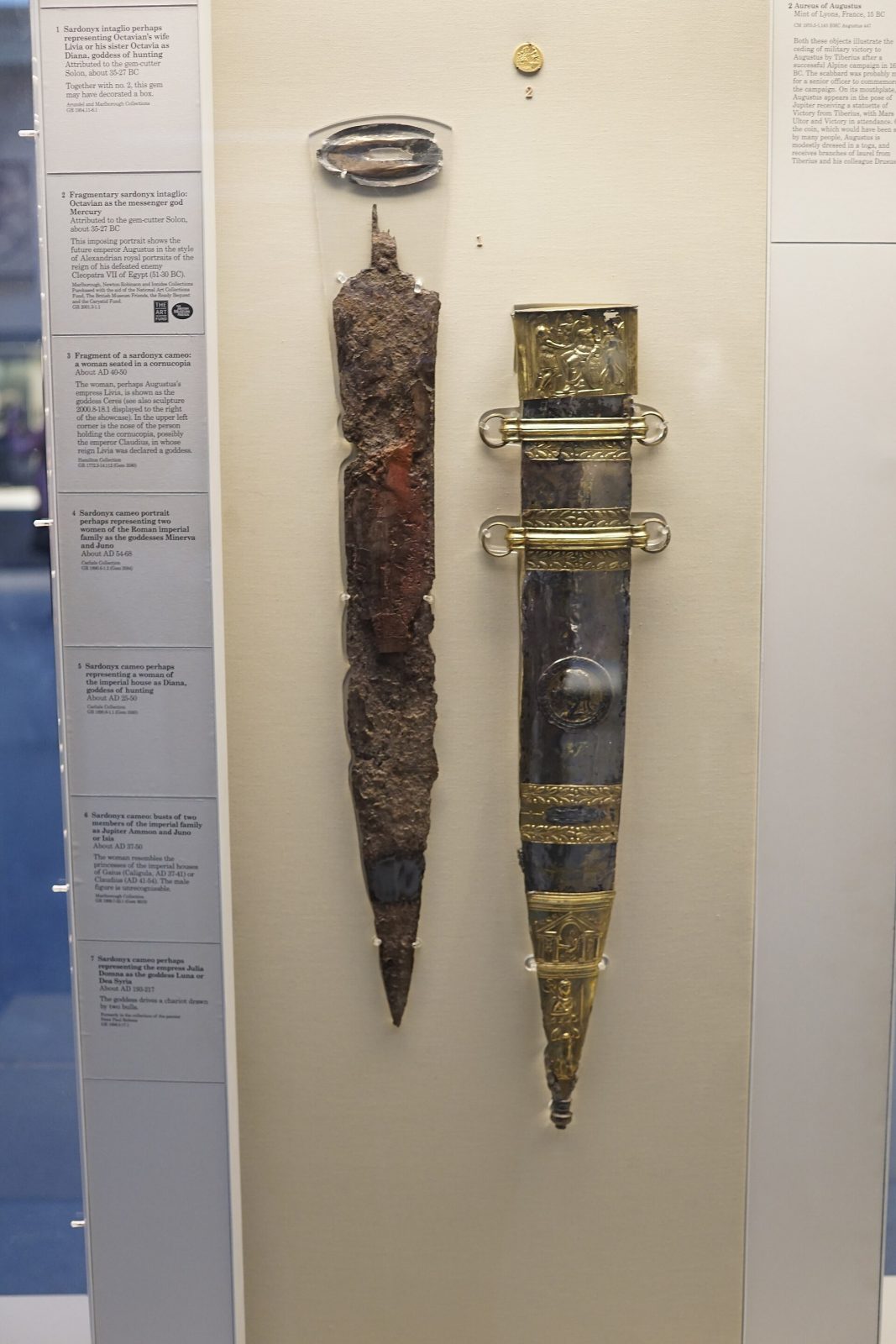
On 10 August 1848 railway workers at Mainz on the Rhine dug a Roman sword out of a ditch, still in its scabbard. The scabbard shows the emperor Tiberius receiving a figure of Victory, and the sword is now one of the treasures of the British Museum.
On 10 August 1848, workmen building a railway at Mainz, on the Rhine in western Germany, dug a Roman sword out of the mud and sand of a ditch near the river front. It was still in its scabbard. They sold it to a local dealer, Josef Gold. An account published the next year said that Gold had found it in a field near Mainz, which was probably a story to protect the men who really found it.
The sword is a gladius, the short stabbing sword of the Roman legions. Its blade, 53.3 centimetres long and 7 centimetres wide, was forged from layers of hard, high-carbon steel around a softer core and then quenched. The grip, guard and pommel, probably of wood or bone, have rotted away. The scabbard is wood covered in sheet bronze, tinned to shine like silver, which is why early writers thought it was decorated with silver and gold.
Its decoration is what makes it famous. The main panel shows the emperor Tiberius enthroned, receiving a small figure of Victory from a general, whom the British Museum identifies as his nephew Germanicus; a shield beside him reads FELICITAS TIBERI, "the good fortune of Tiberius", and a roundel below shows his predecessor Augustus. The museum dates it to about AD 14 to 18, although some scholars read the scene as Tiberius presenting a victory to Augustus after his campaigns in the Alps in 15 BC. The scenes were stamped from a mould, so similar scabbards may have been made in numbers, and scratched on the back is a name, AVRIILI, Aurelius, probably the officer who owned it.
Mainz was Roman Mogontiacum, one of the great legionary fortresses on the Rhine frontier, and the river and its banks have produced weapons, helmets and military fittings for centuries.
The sword passed from Gold to a collector in Wiesbaden and then to the English dealer Henry Farrer. After Farrer's death it was sold at auction in 1866 to the collector Felix Slade, who gave it to the British Museum the same year. It has been on display in the museum's Roman galleries in recent years.
Written for Global Finds from A. Kolouch (2024), J. Lang in Britannia (1988) and the British Museum. Photo: the Sword of Tiberius in the British Museum, Caeciliusinhorto, Wikimedia Commons, CC BY-SA 4.0.