The Seax of Beagnoth: a Viking-age knife from the Thames carrying the only complete rune alphabet from England
Famous find Made in the late 9th or 10th century · Found in 1857 See it on the timeline →
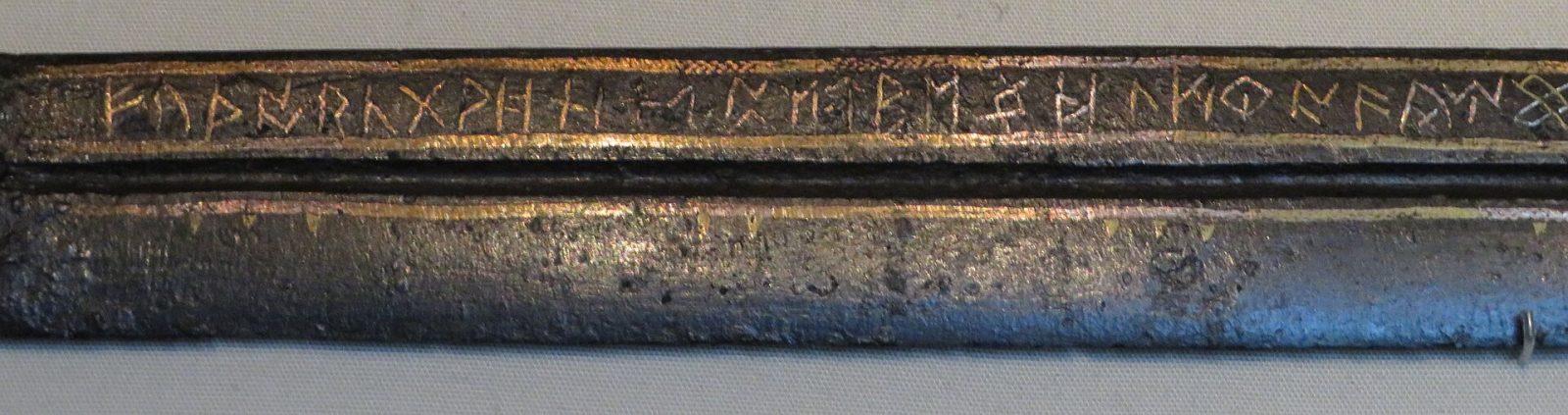
In 1857 the British Museum bought a long iron knife found in the Thames at Battersea. Inlaid in its blade in copper, brass and silver wire are the name Beagnoth and a 28-letter Anglo-Saxon runic alphabet, the only complete one inscribed on an object to survive in England.
In 1857, the British Museum bought from Henry J. Briggs a group of Anglo-Saxon iron weapons that had come out of the River Thames at Battersea. Briggs sold the museum finds from the Thames over many years, and some accounts describe him as a labourer who found this one himself. Among the weapons was a long seax, and that May the curator Augustus Wollaston Franks showed it to the Society of Antiquaries.
A seax is a single-edged knife, from a short utility blade to something close to a sword. This one is 72 centimetres long overall, with a blade of 55 centimetres, and weighs just under a kilogram. Into its iron the smith hammered twisted wires of copper, brass and silver, making patterns of lozenges on one side and groups of lines along the back of the blade.
On the other side are letters. They spell out a runic alphabet, the futhorc, in 28 characters, followed by a name, Beagnoth, probably the owner's or the smith's. The British Museum describes it as the only complete rune alphabet inscribed on an object to survive in England. It is not quite perfect: several letters are out of order and one has been squeezed in, which suggests the smith copied it, not very accurately, from a written model at a time when runes were falling out of everyday use. The museum dates the seax to the 10th century, although some scholars place it in the late 9th.
A seax from Keen Edge Ferry in Berkshire is so similar that both may have come from the same workshop. Many Anglo-Saxon and Viking weapons have been found in the Thames, and some archaeologists think they were thrown in deliberately, perhaps as offerings, though nobody knows why this one ended up in the river.
The Seax of Beagnoth is on display in the British Museum's gallery of early medieval Europe, Room 41.
Written for Global Finds from the British Museum collection record, R. I. Page, An Introduction to English Runes (1973), and D. M. Wilson (1964). Photo: the runes on the Seax of Beagnoth in the British Museum, BabelStone, Wikimedia Commons, CC BY-SA 3.0.