The Wittislingen Brooch: quarrymen broke into a noblewoman's grave, and one hid part of it for 23 years
Famous find Made about AD 600, buried about 650 · Found in 1881 See it on the timeline →
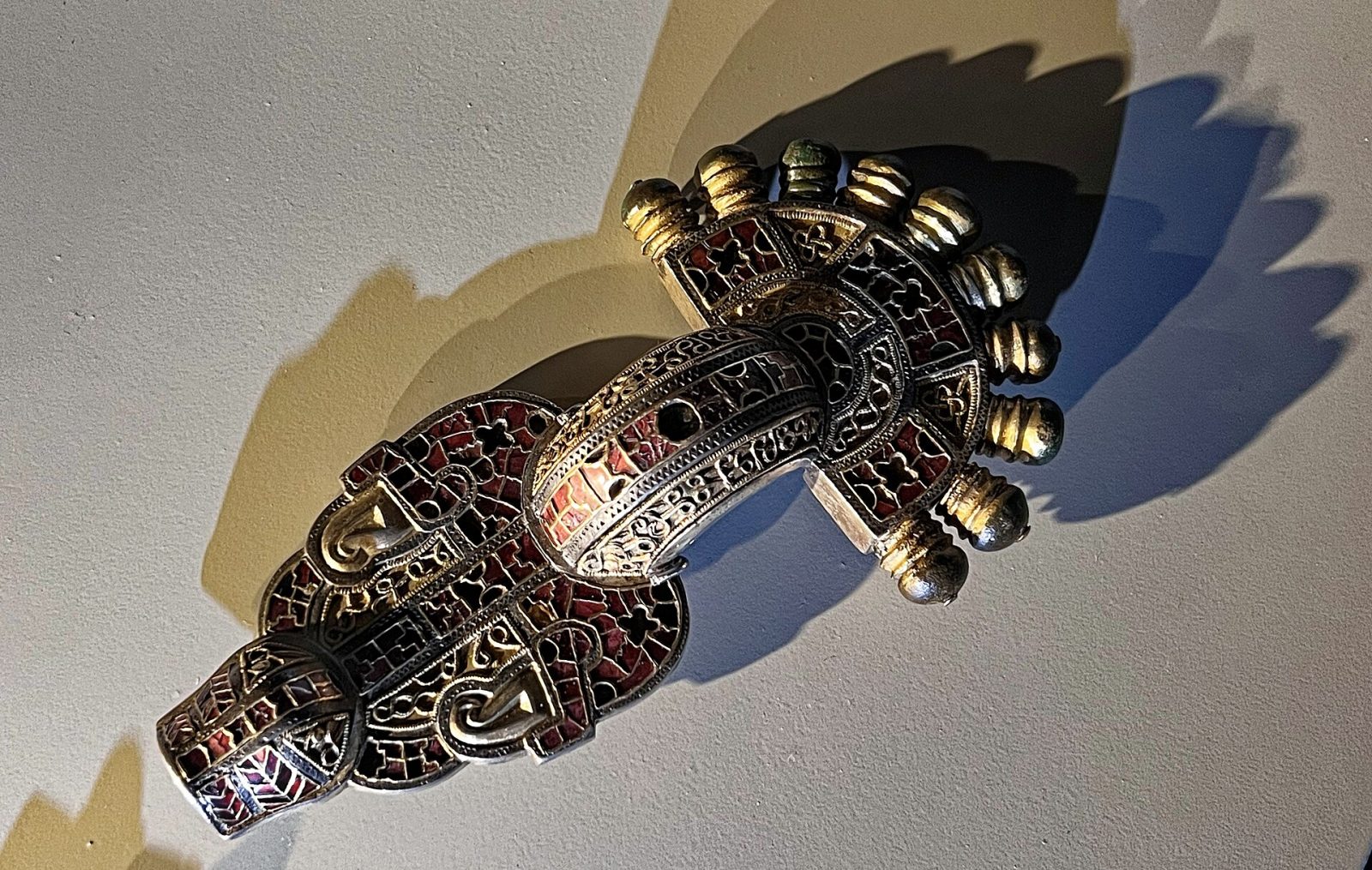
In November 1881 two quarrymen breaking stone at Wittislingen in Bavaria broke into a rich early medieval grave. Its great silver-gilt and garnet brooch, inscribed with a woman's epitaph and its maker's name, is one of the treasures of Munich's archaeology museum.
On 20 November 1881, two stonemasons, Josef Hochstädter and Josef Lanzinger, were breaking stone in a quarry belonging to the mill owner Johann Georg Keiß on the eastern edge of Wittislingen, a village in Bavarian Swabia. They broke into the side of a large grave cut into the soft tufa rock, about three metres long. It held a single, badly crushed skeleton, with valuable objects scattered around it. No archaeologist was present.
The quarrymen sold what they found to a local antiques dealer, but Keiß bought it back. Dealers quickly drove the price up, and within about three weeks he had an offer of 3,000 marks. On the day of the planned sale, a Munich headmaster and antiquarian, Friedrich Ohlenschlager, guaranteed the same sum to stop the treasure going abroad, and the Bavarian National Museum acquired the grave goods in January 1882. Not everything was there. Hochstädter had secretly kept three hairpin heads and parts of a necklace, which reached the museum only in 1905, after his death.
The star of the grave is a great bow brooch of silver and gold, just under 16 centimetres long and weighing 260 grams, set with red garnets, green glass and gilded bosses, its catch shaped like a fanged snake. On the back is a Latin inscription inlaid in black niello, read by the archaeologist Joachim Werner as a copy of an epitaph for a woman named Uffila, beginning "may Uffila live in God", followed by the maker's own name: Wigerig made it. A maker's signature on a brooch of this period is almost unknown. The early reports took the grave for a priest's, and Ohlenschlager was dismissed when he said Uffila was a woman's name. He was right.
The brooch was made around AD 600 and was already worn when it was buried some fifty years later. So heavy that a bronze safety ring was added, it was worn with the head pointing down. Where it was made is still debated: the Rhineland, Lombard Italy and southern Germany have all been suggested.
It is in the Archäologische Staatssammlung in Munich, which reopened in 2024 after eight years of rebuilding, and it is one of the museum's best-known treasures.
Written for Global Finds from J. Werner, Das alamannische Fürstengrab von Wittislingen (1950), F. Ohlenschlager in the proceedings of the Bavarian Academy of Sciences (1884) and Damals (2024). Photo: the Wittislingen brooch in the Archäologische Staatssammlung, Munich, Burkhard Mücke, Wikimedia Commons, CC BY 4.0.