The Theodoric Medallion: the only portrait of the Gothic king of Italy, ploughed up and kept secret by its finder
Famous find Struck about AD 493 to 526 · Found in 1894 See it on the timeline →
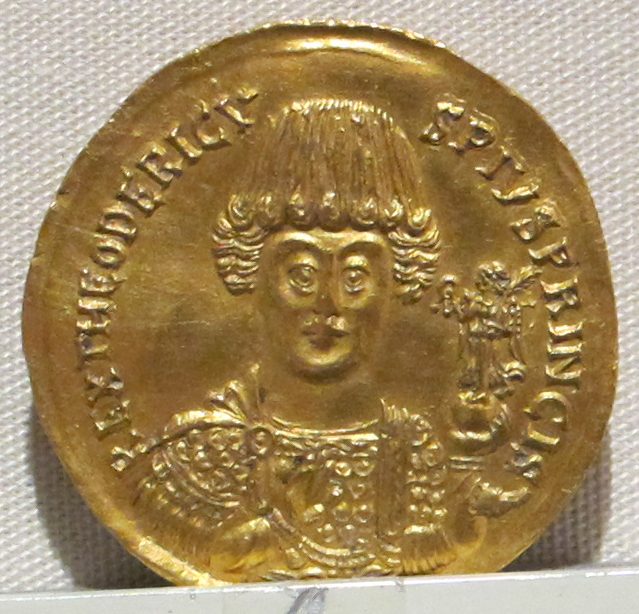
In December 1894 a farm worker near Senigallia in central Italy found a gold coin worth three solidi bearing the portrait of Theodoric the Great, the Ostrogothic king of Italy. Turned into a brooch in antiquity, it is the only known portrait of him on any object.
In December 1894, the ground was being worked on a hill in open country near Senigallia, on the Adriatic coast of the Marche in central Italy, when a large gold coin came to light among human bones, bricks and stones. It seems to have come from a burial. The finder's name was never published. The collector Francesco Gnecchi, who soon bought it, wrote in 1895 that the finder's jealousy or mistrust had kept the details of the discovery back. Modern studies place the find at Morro d'Alba, about twelve kilometres south of Senigallia.
The coin is a gold piece worth three solidi, 33 millimetres across, weighing about 13.6 grams without the gold fittings that were later attached. On the front is Theodoric, king of the Ostrogoths, facing out in armour, with long curled hair and a moustache, one hand raised and the other holding a globe topped by a tiny Victory. The inscription calls him REX THEODERICVS PIVS PRINCIS, "King Theodoric, the pious prince". On the back, Victory stands on a globe around the words REX THEODERICVS VICTOR GENTIVM, "King Theodoric, conqueror of peoples".
Theodoric ruled Italy from 493 to 526, after overthrowing Odoacer, and kept Roman government running under Gothic rule. He did not normally put his own face on his coins, which carried the portrait of the emperor in Constantinople. This medallion, struck in his early years as king, was probably a special gift. It is the only coin and the only surviving object that shows his portrait with his name. At some point two gold lugs were soldered to the back so that it could be worn as a brooch, and it seems to have ended up in a grave.
Gnecchi's collection went to the Museo Nazionale Romano in Rome in 1923. Its coin room at Palazzo Massimo reopened in December 2025 after six years, and the Theodoric medallion is on show there in Gnecchi's own coin cabinet. The museum displays a copy of the back alongside the original front.
Written for Global Finds from F. Gnecchi in the Rivista Italiana di Numismatica (1895), the Berlin Münzkabinett and Finestre sull'Arte (2025). Photo: the Theodoric medallion in the Museo Nazionale Romano, Palazzo Massimo, Rome, Sailko, Wikimedia Commons, CC BY-SA 3.0.