Priam's Treasure: Schliemann's gold of Troy, smuggled out of Turkey, lost in Berlin in 1945 and found in Moscow
Famous find Made about 2550 to 2250 BC · Found in 1873 See it on the timeline →
In May 1873 Heinrich Schliemann found a cache of gold and silver at Troy and named it the treasure of King Priam. It was a thousand years older than Homer's Troy. Taken from Berlin by the Red Army in 1945, it was secretly kept in Moscow until 1993.
On or about 31 May 1873, at the end of his third season of digging at Hisarlik in north-west Turkey, the mound he believed was Homer's Troy, Heinrich Schliemann found a cache of metal objects close to the city wall. Convinced he had found the treasure of King Priam, he smuggled it to Athens, avoiding the share that Ottoman law gave to the state. The Ottoman government sued him, and he settled by paying 10,000 gold francs.
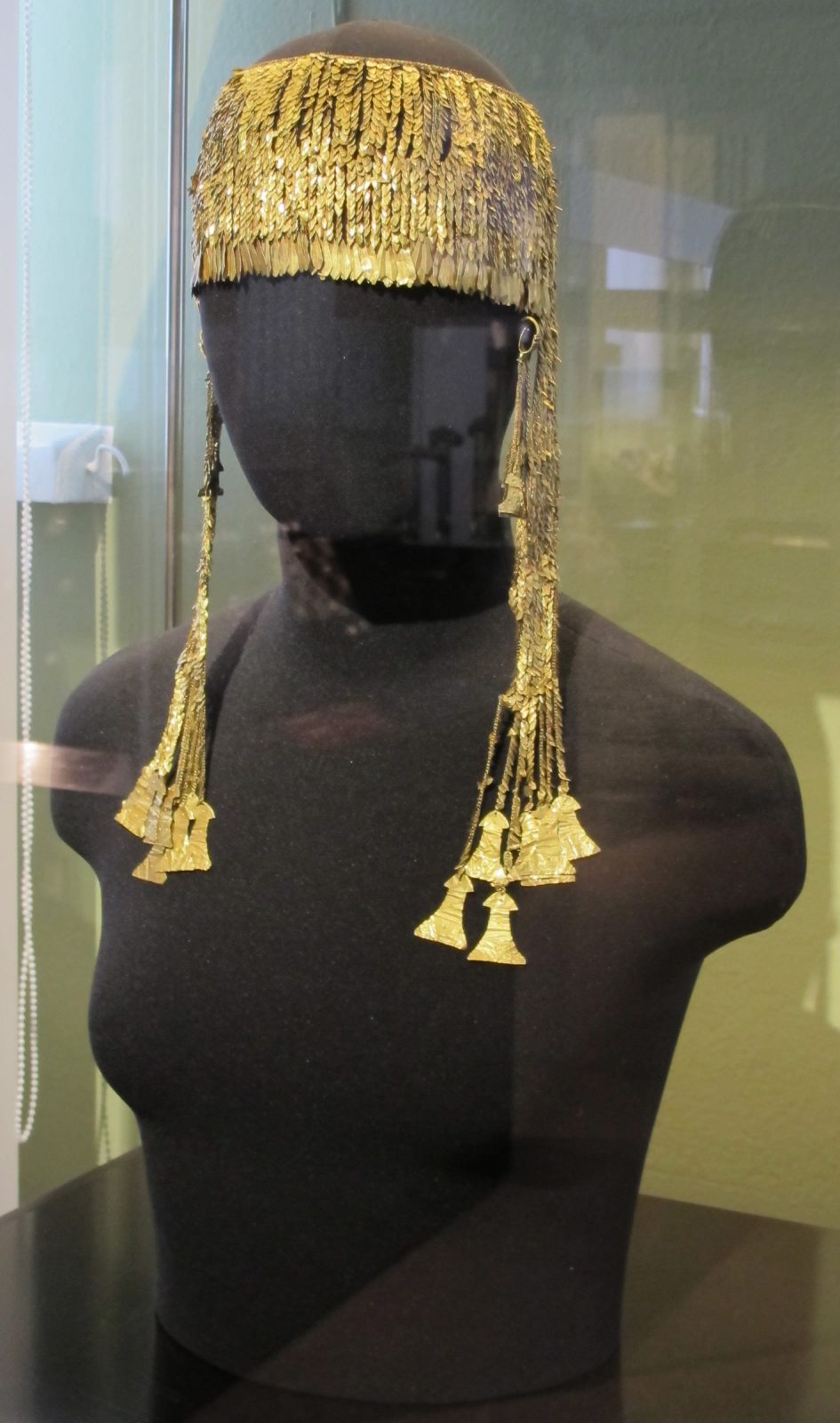
The treasure held nineteen vessels of gold and silver, weapons and tools of bronze, and, packed inside one vessel, a mass of gold jewellery: two diadems, a forehead band, earrings with little idol-shaped pendants, bracelets and thousands of gold beads. The Large Diadem, 33 centimetres wide, is made of about 16,000 tiny gold parts on 90 hanging chains. Schliemann had his wife Sophia photographed wearing it, and the picture made the treasure world-famous. His story that she had carried the gold out of the trench in her shawl was untrue: she was in Athens at the time.
The jewellery belongs to the second city at Troy, about 2550 to 2250 BC, more than a thousand years before any Trojan War, and some scholars think Schliemann put together objects from different parts of the site to make his treasure.
Schliemann gave the collection to Berlin in 1881. During the Second World War it was hidden in a flak tower by Berlin Zoo, and in 1945 it was handed to the Red Army and taken to Moscow. For almost fifty years the Soviet Union denied having it, until the Russian culture minister admitted in 1993 that it was there. The gold went on show at the Pushkin Museum in Moscow in 1996, and in 1998 the Russian parliament declared it state property. Berlin keeps the silver and pottery and displays copies of the gold.
The gold jewellery is displayed at the Pushkin State Museum of Fine Arts in Moscow, in its Troy gallery.
Written for Global Finds from the Pushkin State Museum of Fine Arts, the Berlin State Museums (2023) and D. F. Easton in Anatolian Studies. Photo: the Large Diadem from Priam's Treasure in the Pushkin Museum, Moscow, sailko, Wikimedia Commons, CC BY-SA 3.0.