The Sutton Brooch: ploughed up with Conqueror's pennies, and engraved with a curse on anyone who stole it
Famous find Made in the early 11th century · Found in 1694 See it on the timeline →
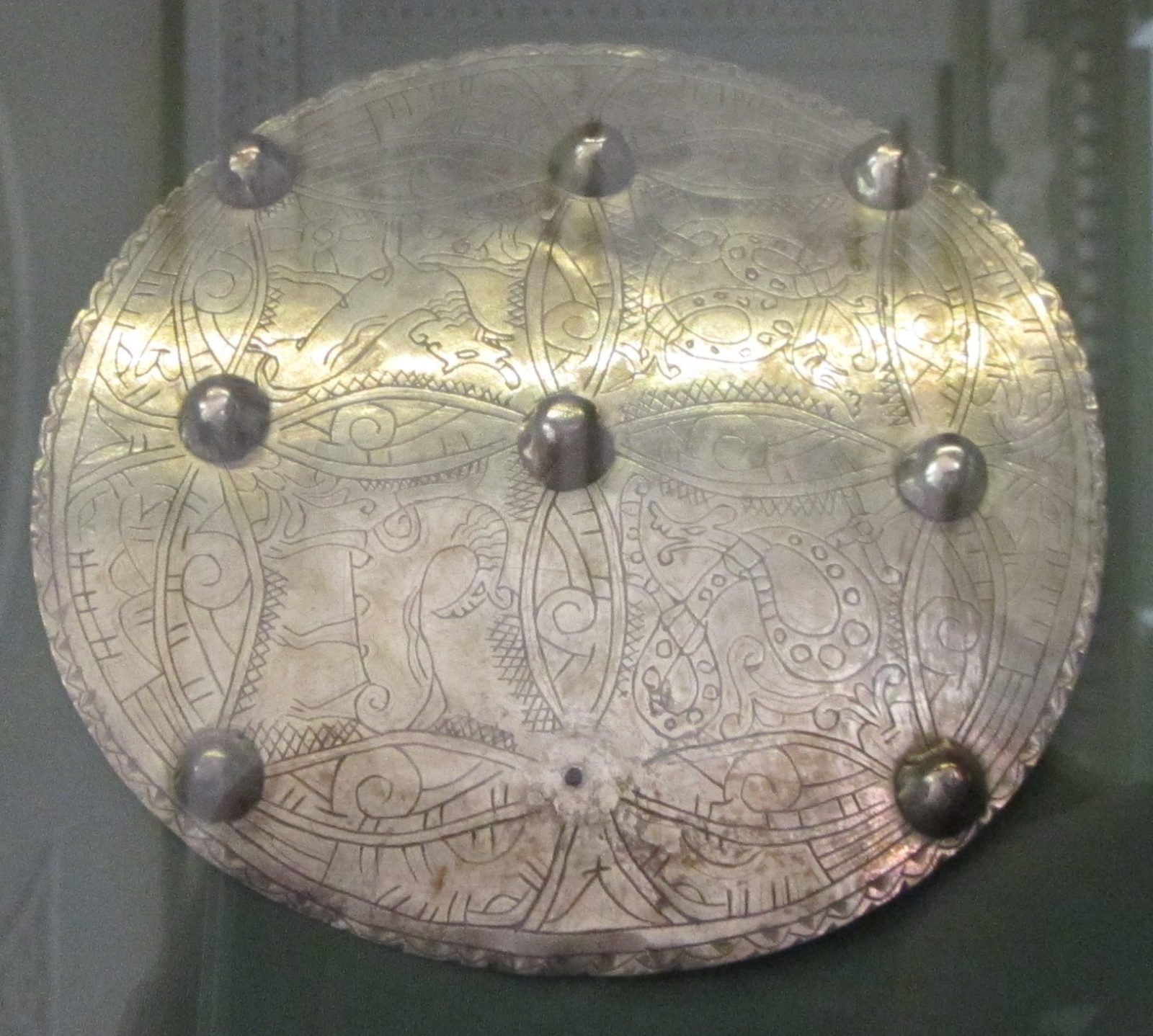
In 1694 a plough at Sutton on the Isle of Ely turned up a lead box holding about 100 silver pennies of William the Conqueror and a large silver brooch. Its edge carries an Old English curse on anyone who takes it from its owner, a woman called Ædwen.
In 1694, a plough working a field at Sutton, on the Isle of Ely in Cambridgeshire, broke into the remains of a lead casket. Inside, according to the earliest accounts, were about a hundred silver pennies of William the Conqueror, gold rings, a silver dish and a large silver disc brooch. The ploughman's name was not recorded, and the accounts written over the next half-century do not agree on exactly what the casket held. The coins and rings are long gone. The brooch survived.
It is a big piece, about 15 centimetres across, made of hammered sheet silver. Four overlapping circles are filled with animals and tendrils in the Ringerike style, a Scandinavian fashion of the early 11th century, and nine little cone-shaped bosses stood on its face, one of which is now missing. The workmanship is rough, but around the edge runs something rare: a verse in Old English. It reads, roughly, "Ædwen owns me, may the Lord own her. May the Lord curse whoever takes me from her, unless she gives me of her own free will." On the back, the strip that held the pin carries seven rune-like marks that nobody has been able to read.
The brooch was made in the early 11th century, but the coins show it was hidden after 1066, perhaps during the upheavals that followed the Norman Conquest. The Isle of Ely was the last stronghold of English resistance to William, held by Hereward the Wake until 1071, but there is no evidence linking the hoard to that rebellion. The British Museum's curators point out that a brooch this size, with a literate inscription, suggests Ædwen was a woman of some standing.
The antiquary George Hickes published an engraving of it in 1705, and then the brooch disappeared from view for nearly 250 years. It turned up again in a private collection in 1951, when the British Museum bought it, and it is in the museum's collection in London.
Written for Global Finds from J. D. A. Thompson in Medieval Archaeology (1959) and the British Museum's collection record. Photo: Ædwen's brooch in the British Museum, BabelStone, Wikimedia Commons, CC BY-SA 3.0.