The Dagmar Cross: a Byzantine gold cross from a royal grave, cleared to make room for a churchman's wife
Famous find Made in the 11th or 12th century · Found in 1683 See it on the timeline →
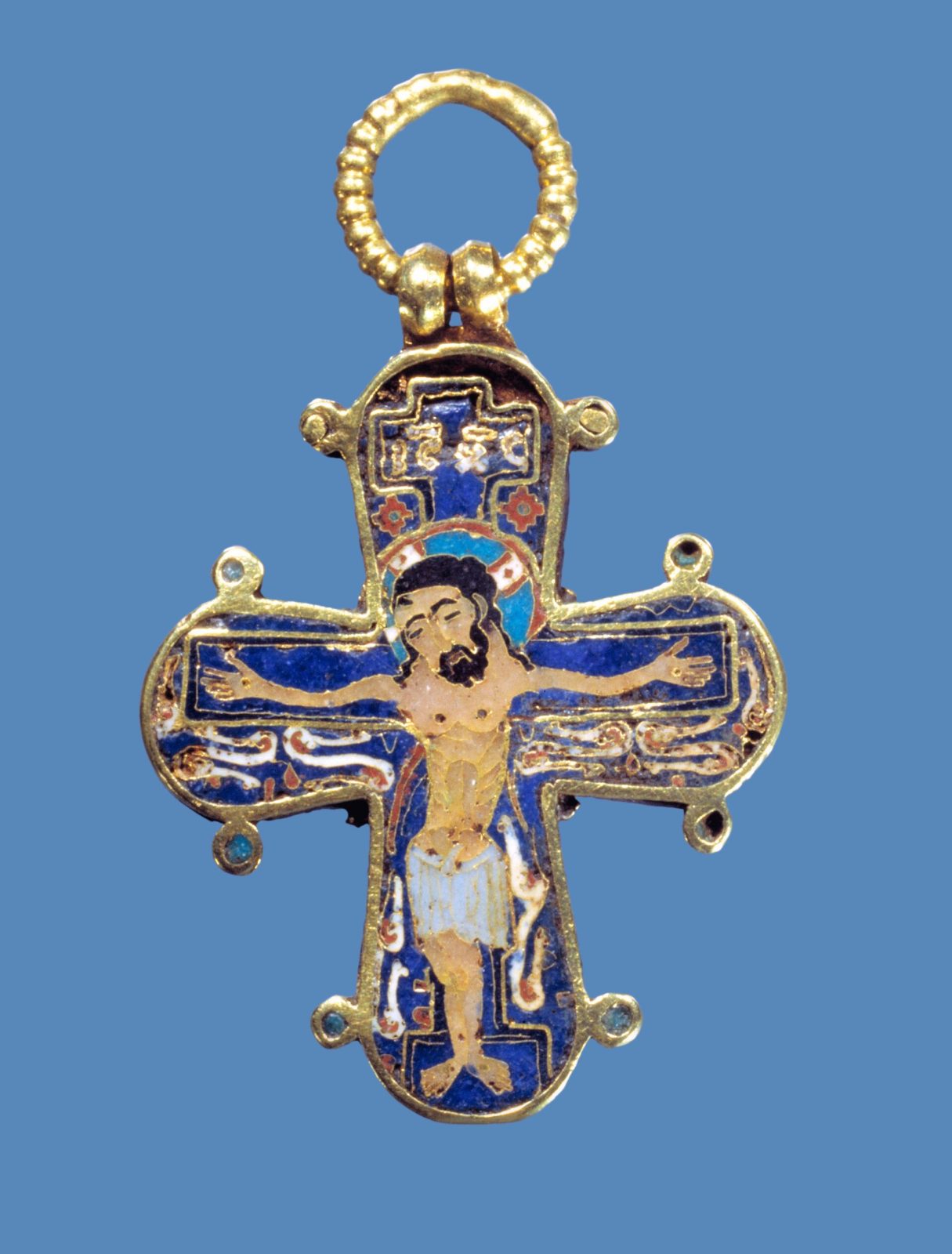
In 1683 royal graves in St Bendt's Church at Ringsted in Denmark were opened, and one held a tiny Byzantine gold and enamel reliquary cross. Legend gave it to Queen Dagmar, who died in 1212, and copies of it are still given to Danish children today.
In 1683, in St Bendt's Church at Ringsted on the Danish island of Zealand, the burial place of Denmark's medieval kings and queens, two royal graves were opened. According to the traditional story, the provost wanted room to bury his own wife. In one of the graves lay a small gold cross. It passed to the royal art collection in Copenhagen in 1695, and by then it was being called the cross of Queen Dagmar, the much-loved Bohemian princess who married King Valdemar II and died in 1212.
It is only 4.3 by 2.9 centimetres, made of gold decorated in cloisonné enamel, in which coloured glass is fused into tiny cells of gold wire. On the front is Christ on the cross, against a deep blue ground. On the back, Christ sits in judgement with the Virgin Mary, John the Baptist, St Basil and St John Chrysostom around him. The cross is made in two halves with a hollow inside for a relic, perhaps a splinter believed to be from the True Cross. It was made in the Byzantine world, probably in the 11th or 12th century, and how it reached Denmark is not known.
Whether it was really Dagmar's is less certain than the name suggests. Both graves were destroyed when they were opened, and the National Museum of Denmark now thinks the cross more likely belonged to Richiza, Valdemar II's sister, who died in 1220. Nobody can now check.
The name stuck, and so did the cross. In 1863 King Frederik VII gave a copy to Princess Alexandra of Denmark when she married the future Edward VII of Britain, and since then copies of the Dagmar Cross have become the traditional Danish gift for a christening or confirmation. The original belongs to the National Museum of Denmark in Copenhagen.
Written for Global Finds from the National Museum of Denmark and Den Store Danske (lex.dk). Photo: the front of the Dagmar Cross in the National Museum of Denmark, Lennart Larsen, Nationalmuseet, Wikimedia Commons, CC BY-SA 3.0.
Source: National Museum of Denmark