The Hockley Pendant: a three-year-old's first find with a metal detector, a Tudor gold reliquary with a secret back
Famous find Made in the early 16th century · Found in 2009 See it on the timeline →
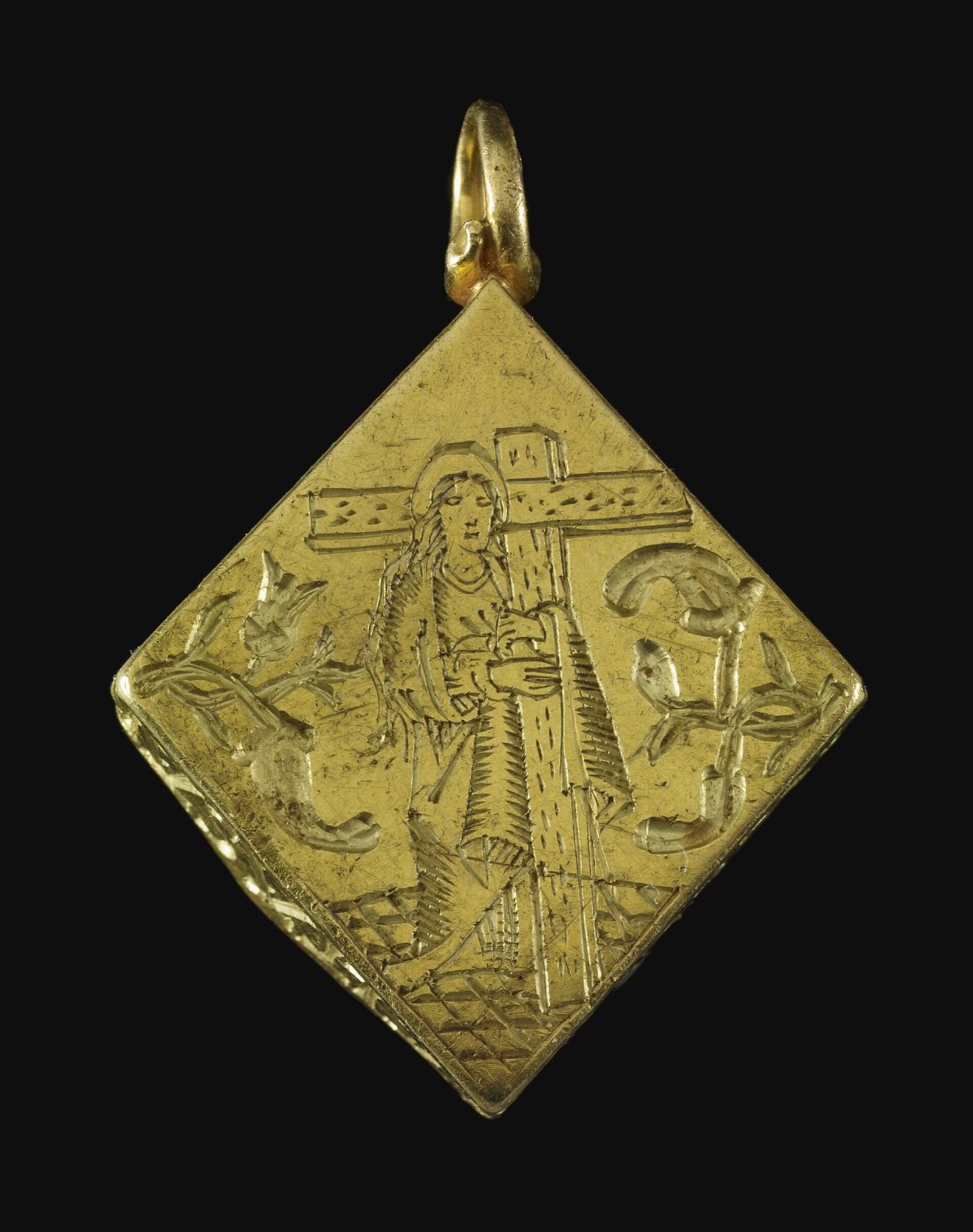
In May 2009 three-year-old James Hyatt, detecting with his father in a field at Hockley in Essex, found a gold reliquary pendant of the early 1500s. The papers guessed it was worth millions; it was valued at £70,000 and bought by the British Museum.
In May 2009, Jason Hyatt took his three-year-old son James metal detecting in a field at Hockley in Essex. Only minutes after they began, James got a signal, and about eight inches down they found a small gold pendant. Accounts differ on some details, including whether James was three or four and whose detector he was using, but the find itself was clear enough: a piece of Tudor gold jewellery.
It is a lozenge-shaped reliquary pendant about 33 by 25 millimetres. On the front a female saint, perhaps the Virgin Mary or St Helena, who was said to have found the True Cross, holds a cross spattered with drops of blood and stands on a chequered floor. The back is a sliding panel engraved with the Five Wounds of Christ and more drops of blood. Around the sides are the names of the three Magi, IASPAR, MELCIOR and BALTASAR, which were believed to protect the wearer against fever and the falling sickness. It was probably once enamelled, and it dates from the early 16th century, just before the Reformation swept such devotional objects away.
The pendant was reported to the Finds Liaison Officer and declared Treasure. When the story reached the press in 2010 the papers suggested it might be worth £2.5 million. The Treasure Valuation Committee valued it at £70,000, and the reward was shared between the family and the landowner. The British Museum acquired it with help from the Art Fund.
The back panel had jammed. When a British Museum conservator finally slid it open, everyone hoped for a relic. Inside there were only a few fibres of flax, perhaps the remains of a cloth wrapping round something that has long since disappeared. The pendant featured in the ITV series Britain's Secret Treasures in 2012, and it is in the British Museum's collection in London.
Written for Global Finds from the Art Fund, the Portable Antiquities Scheme and The History Blog (2013). Photo: the front of the Hockley Pendant, photographed for the Portable Antiquities Scheme, Ian Richardson, The British Museum, Wikimedia Commons, CC BY-SA 2.0.
Source: Art Fund