The Shropshire Sun Pendant: a detectorist's Bronze Age gold bulla, the first found in England since the 1700s
Famous find Made about 1000 to 750 BC · Found in 2018 See it on the timeline →
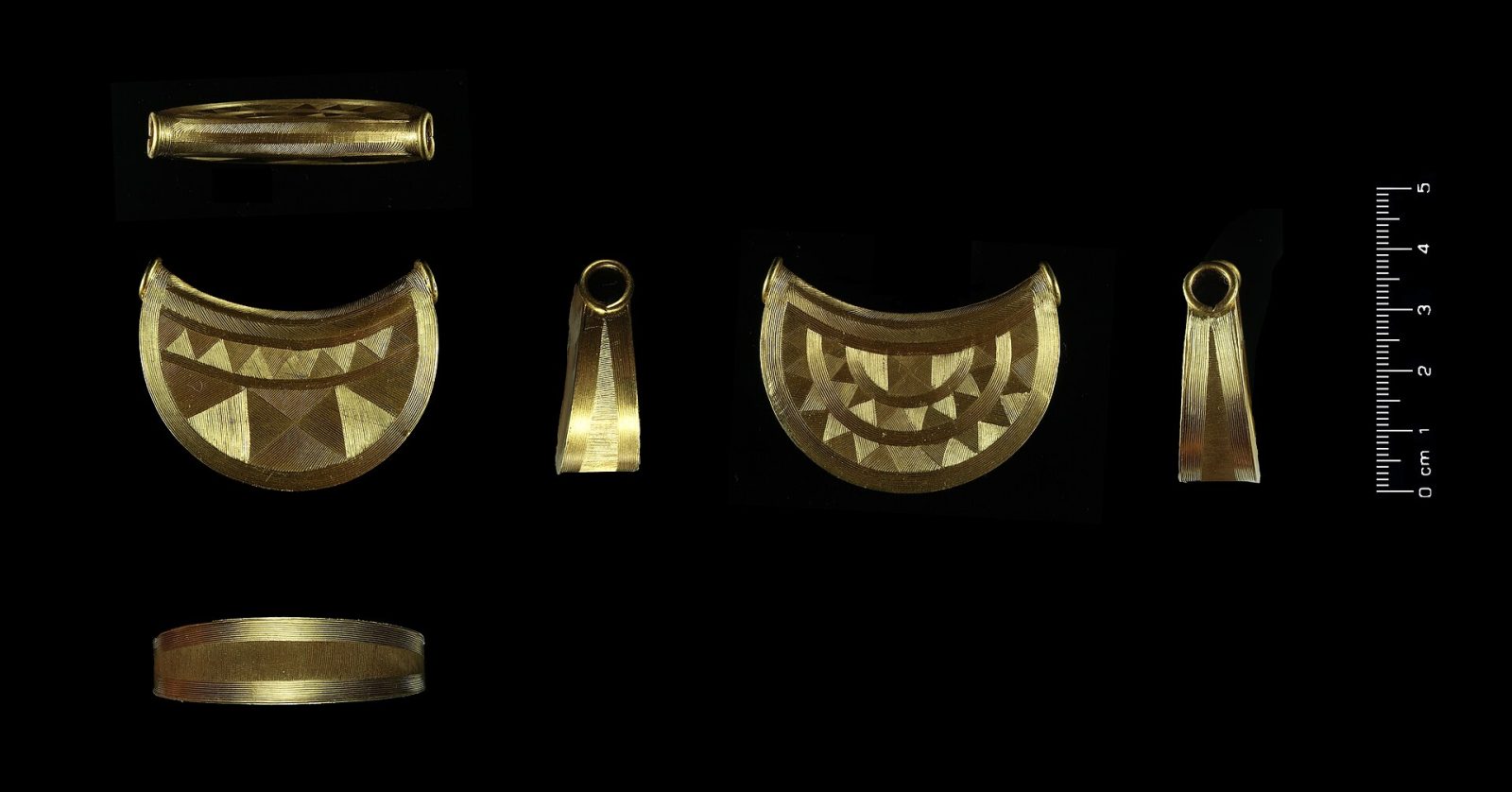
In May 2018 a metal detectorist in the Shropshire Marches found a small hollow gold pendant, about 3,000 years old, engraved with patterns like sunbursts. Only the second Bronze Age bulla ever found in England, it was bought by the British Museum for £250,000.
On 12 May 2018, a metal detectorist searching land in the Shropshire Marches, near the Welsh border, dug up a small, heavy piece of gold. The finder, whose name and exact findspot have been kept private, reported it straight away to Peter Reavill, the Finds Liaison Officer for Shropshire and Herefordshire, and it went through the Treasure process as case 2018 T343. Because the pendant is gold and prehistoric, it qualified as Treasure automatically, and a coroner's inquest confirmed it.
It is a bulla, a hollow pendant shaped rather like a boat's keel, 47 millimetres by 37 millimetres and weighing 26.6 grams, made of gold about 80 per cent pure. Both faces are engraved with geometric patterns of lines and concentric shapes, which have been read as the rays of the sun, so it soon became known as the Shropshire Sun Pendant. It is reversible, and because it is hollow it may once have held something inside.
It was made in the Late Bronze Age, between about 1000 and 750 BC. Bullae like this are very rare. Only one had been found in England before, dredged from the River Irwell near Manchester in the 18th century, in 1758 or 1772 according to different accounts, and that one has since been lost, so for most of the last two centuries the type was known in England only from old descriptions. Their purpose is uncertain. They may have been amulets, holding a charm or a sacred substance, worn by people of high status.
The British Museum acquired the pendant in March 2020 for £250,000, with support from the Art Fund. From 10 September to 12 December 2021 it was lent to Shrewsbury Museum and Art Gallery, so that people could see it close to where it was found, before returning to the British Museum's collection in London.
Written for Global Finds from Shropshire Council (2020), the Portable Antiquities Scheme and the British Museum. Photo: the Shropshire Sun Pendant, photographed for the Portable Antiquities Scheme, Peter Reavill, Birmingham Museums Trust, Wikimedia Commons, CC BY 2.0.
Source: Shropshire Council (2020)