The Guleboda Solidus: a Swedish farmer ploughed up a Roman emperor's gold coin that someone had worn round their neck
Famous find Struck AD 408 to 450, in the reign of Theodosius II · Found in 1854 See it on the timeline →
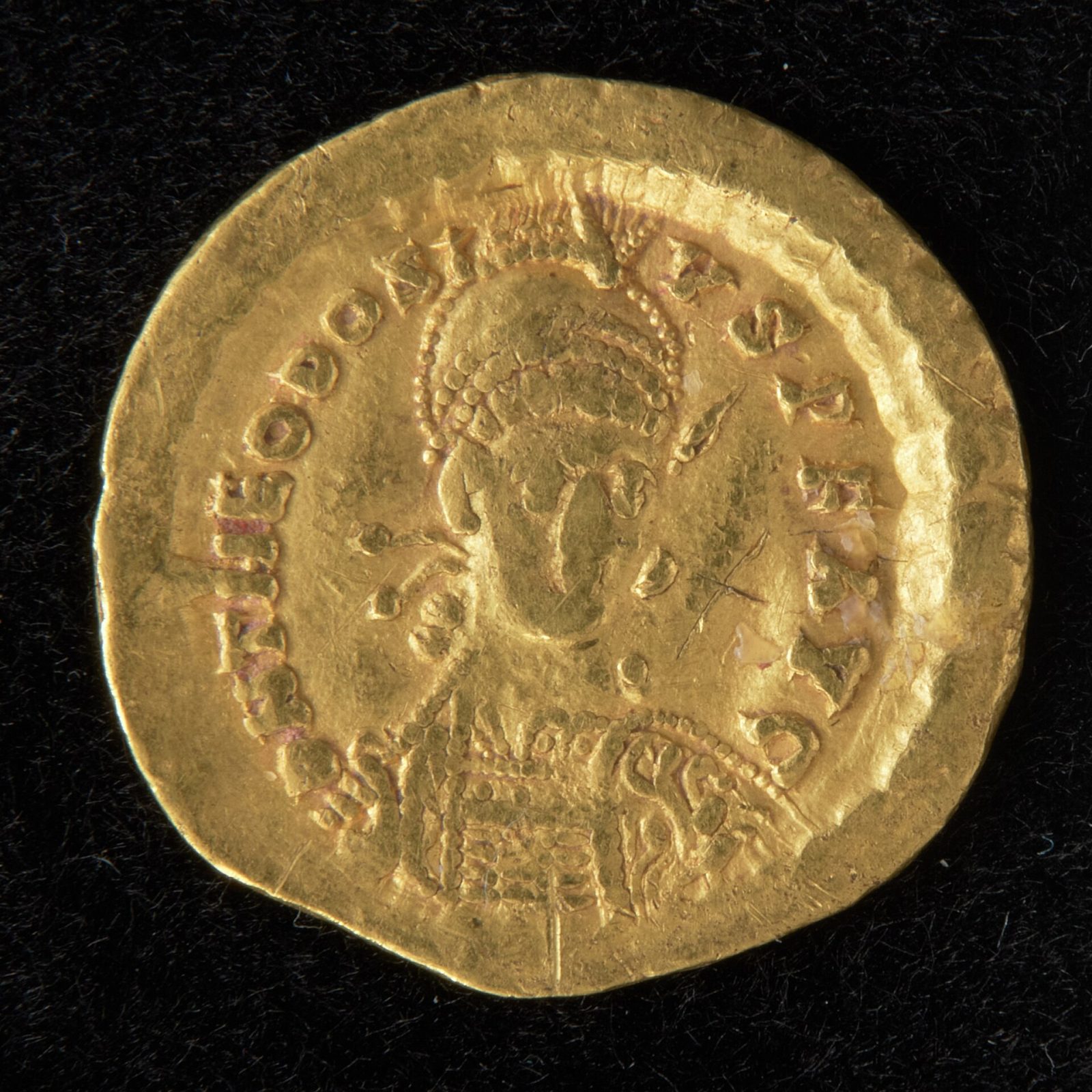
In 1854 the farmer Peter Magnus Svensson ploughed up a gold coin in his field at Guleboda, in Småland in southern Sweden. It was a solidus of Theodosius II, emperor in Constantinople, pierced so that it could be worn, and it went to the Swedish History Museum.
In 1854, Peter Magnus Svensson was ploughing a field on his farm at Guleboda, in Älmeboda parish, in the forests of Småland in southern Sweden, when a small gold coin came up in the soil. He reported it to the authorities and was paid a reward of 7 riksdaler and a few shillings. The coin went to the national collection in Stockholm, where it is still kept by the Swedish History Museum.
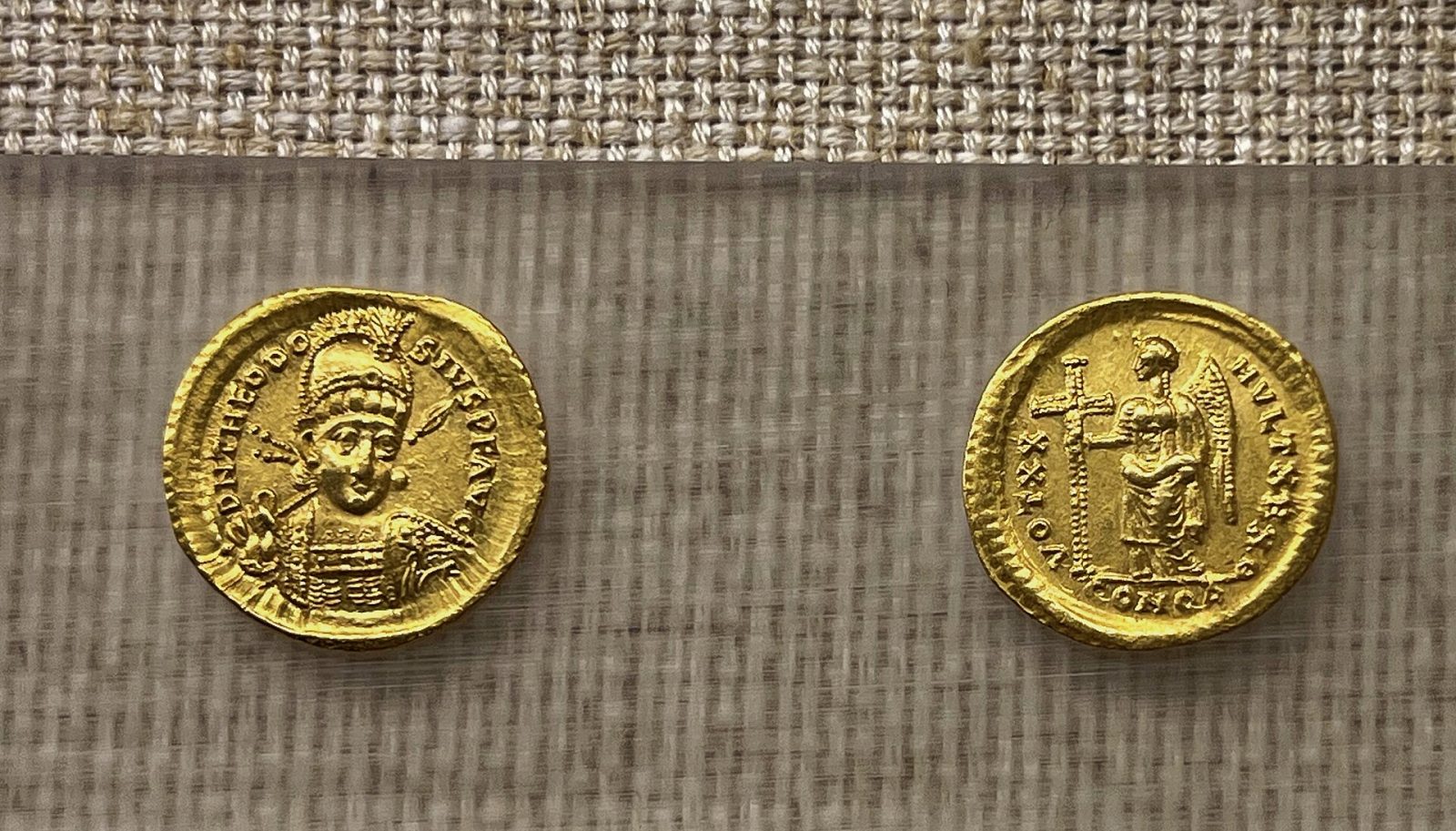
It is a solidus, the gold coin of the late Roman Empire, struck in the name of Theodosius II, who ruled the eastern empire from Constantinople from 408 to 450. It weighs 4.28 grams. On the front is the emperor in armour, with a spear and shield. On the back, the goddess of Constantinople sits on a throne. The museum's catalogue places it among a group of solidi marked COMOB, which some specialists think were struck in the western part of the empire. The most interesting thing about it is a small hole: someone pierced the coin so that it could be hung on a cord or chain and worn.
Solidi like this flooded into Scandinavia in the 5th century. The Roman Empire paid huge sums in gold to buy peace from the Huns and other peoples, and to pay soldiers from beyond its borders, and much of that gold travelled north. Hundreds of late Roman solidi have been found in Sweden, most of them on the islands of Öland and Gotland. A lone coin in a Småland field is much rarer. A local history of the find suggests it may have arrived with a trader using the lakes and rivers, or with a man who had served as a soldier in the Roman world and come home. The exact spot was never recorded, but an old map of 1817 shows fields to the north and south of the farm, and stone and bronze axes have been found there too.
Ploughmen found several other single solidi in Småland in the 19th century, among them a coin of Romulus Augustus, the last emperor in the west, found at Rinkaby in 1850.
Written for Global Finds from the Swedish History Museum, J. M. Fagerlie, Late Roman and Byzantine Solidi Found in Sweden and Denmark (1967), and Tingsryd tourism (Naturkartan). Photo: a solidus of Theodosius II of a similar type from a Polish museum collection, not the Guleboda coin, Wikimedia Commons, CC0.
Linked finds
Source: Swedish History Museum