The Fulford Ring: a medieval gold love ring with a ruby and an emerald, found in a frozen York potato field
Famous find Made in the 15th century · Found in 2016 See it on the timeline →
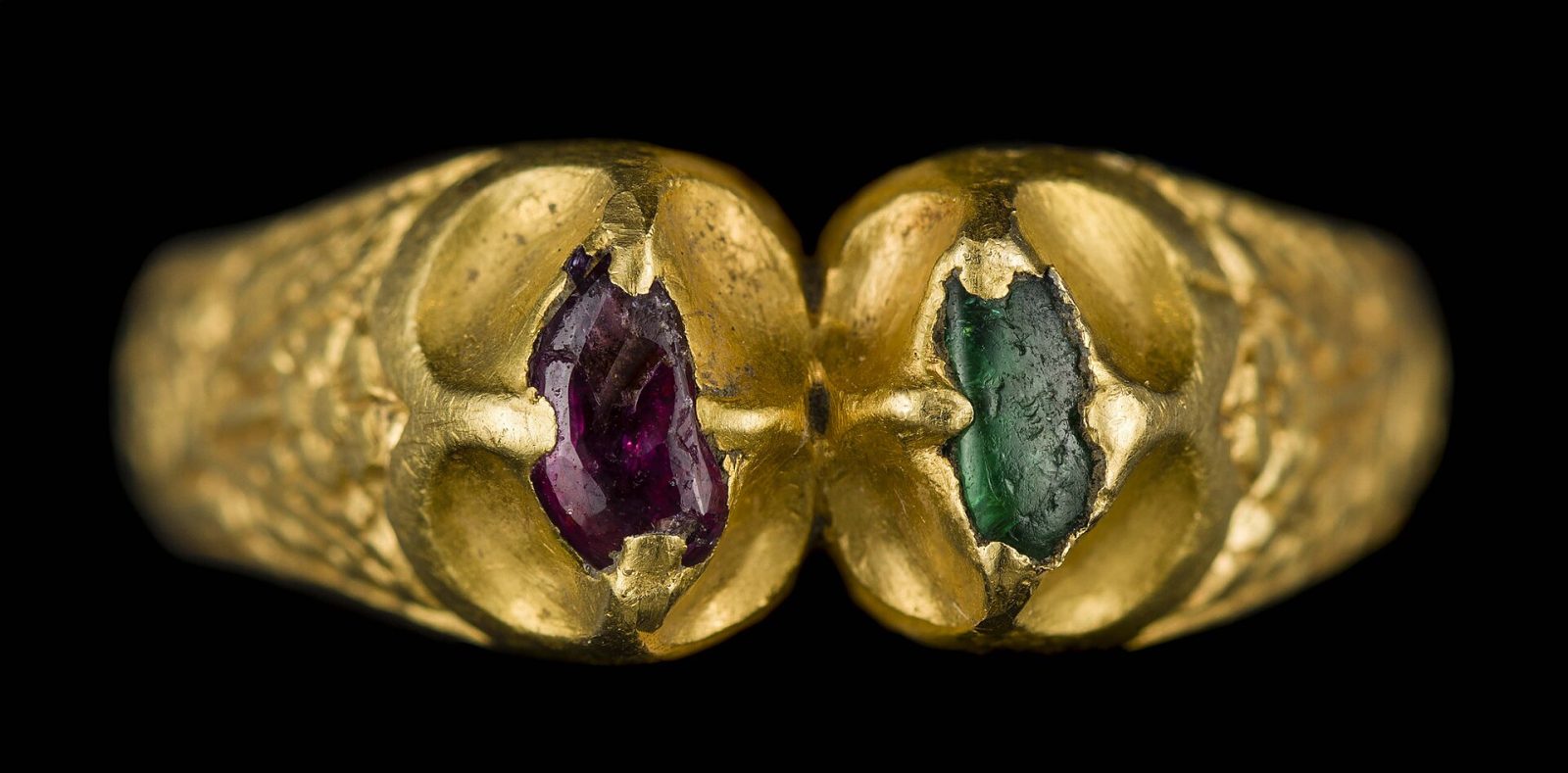
On 29 December 2016 detectorist Paul Ibbotson, searching a frozen potato field at Fulford near York, found a 15th-century gold ring set with a ruby and an emerald. It was declared Treasure and bought by the Yorkshire Museum in 2019.
On the freezing morning of 29 December 2016, Paul Ibbotson, a detectorist from Lancashire who had been searching since 1981 and had driven over to the York area once or twice a month for some thirty years, was working a field at Fulford, just south of the city. It had been under potatoes and was waiting to be ploughed. The ground was frozen hard, so he followed the sun around the field as it thawed the soil. About six inches down, he saw engraving, then the glint of two stones. He later told the York Press that he dropped to the ground in shock: "Oh my God, this is the find of a lifetime!"
It is a complete gold finger ring, made in the 15th century. The bezel is a double oval, each half shaped as a quatrefoil, a four-lobed flower, and each holds a stone: one red, one green. Scientific testing identified them as a ruby and an emerald. The shoulders are engraved with flowers and still show traces of the coloured inlay that once filled the lines. It weighs 4.42 grams and is made of gold mixed with a little silver and copper. It needed no cleaning.
Medieval books on gemstones gave both stones special powers. The emerald was linked with chastity and the ruby with love and the calming of anger, so a ring with both was very likely a gift between lovers or a betrothal ring. Finds Liaison Officers have compared it with similar rings from Green Hammerton in North Yorkshire and Launde in Leicestershire, but it was the first gold ring with two different gemstones found in York.
The ring was declared Treasure at an inquest in York in 2017. York Museums Trust bought it in 2019 for about £20,000, with money from the Headley Museums Archaeological Acquisition Fund, the Arts Council England/V&A Purchase Grant Fund and donations from the public, and it went on show at the Yorkshire Museum that September. It is part of the museum's medieval collection.
Written for Global Finds from the Yorkshire Museum, the York Press (2017), YorkMix (2020) and the Portable Antiquities Scheme (YORYM-DE9DA0). Photo: the Fulford Ring in the Yorkshire Museum, York Museums Trust, Wikimedia Commons, CC BY-SA 4.0.
Linked finds
Source: Yorkshire Museum