The Towton Torc: Iron Age gold in a Yorkshire stream bed, near the bloodiest battlefield in England
Famous find Made about 100 to 50 BC · Found in 2010 See it on the timeline →
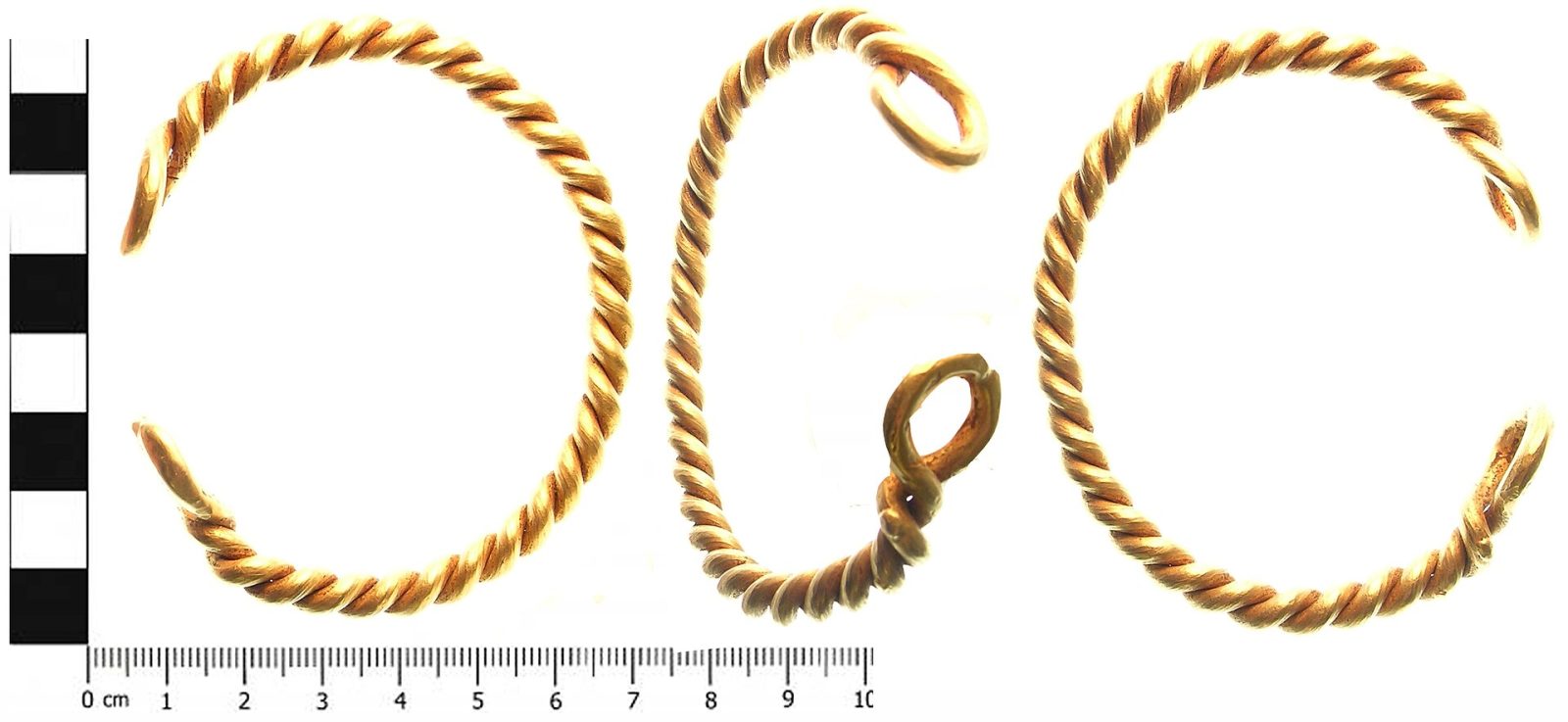
In May 2010 detectorists Andrew Green and Shaun Scott found a twisted gold torc-bracelet in a stream bed near Towton, North Yorkshire. A second turned up nearby the next year. The Yorkshire Museum calls them the first Iron Age gold jewellery found in northern England.
In May 2010, two metal detectorists, Andrew Green and Shaun Scott, were searching near Towton, close to Tadcaster in North Yorkshire. The village is best known for the Battle of Towton in 1461, the bloodiest battle of the Wars of the Roses. This find was far older. In the bed of a small stream, they came across a ring of twisted gold.
It is a torc-bracelet, made from two round gold wires twisted together into a rope and finished with a loop at each end. It is about 75 millimetres across and weighs 67.7 grams, and it is made of a gold alloy containing silver and a little copper. It was made in the Late Iron Age, probably between about 100 and 50 BC.
In April 2011, a second gold torc was found in the same stream, within a few metres of the first. Made from two plaited ropes of wire, it is slightly larger, and its loops were filled with a gold alloy that melts at a lower temperature so that they look solid. The two were probably buried together and washed downstream, perhaps from a burial, since torcs are not usually found in water. The Yorkshire Museum describes them as the first Iron Age gold jewellery ever found in northern England.
They are closely similar to torcs from the great Snettisham hoards in Norfolk, the heartland of the Iceni, which raises the possibility that they came north to the Brigantes as gifts, trade or plunder. That is a theory rather than a proven link.
Both torcs were declared Treasure. The Yorkshire Museum launched a £60,000 appeal, bought the first for £25,000 in 2012 and the second in November 2013, with help from the V&A Purchase Grant Fund, charities and anonymous donors. Both are in the Yorkshire Museum's collection in York.
Written for Global Finds from BBC News (2011 and 2013), the Yorkshire Museum and the Portable Antiquities Scheme (SWYOR-CFE7F7). Photo: the first Towton torc, photographed for the Portable Antiquities Scheme, Amy Downes, West Yorkshire Archaeology Advisory Service, Wikimedia Commons, CC BY-SA 2.0.
Source: BBC News (2011)