The Revninge Woman: a detectorist phoned a Viking museum to say he had made 'the find of my life'
Famous find Made in the 9th century AD · Found in 2014 See it on the timeline →
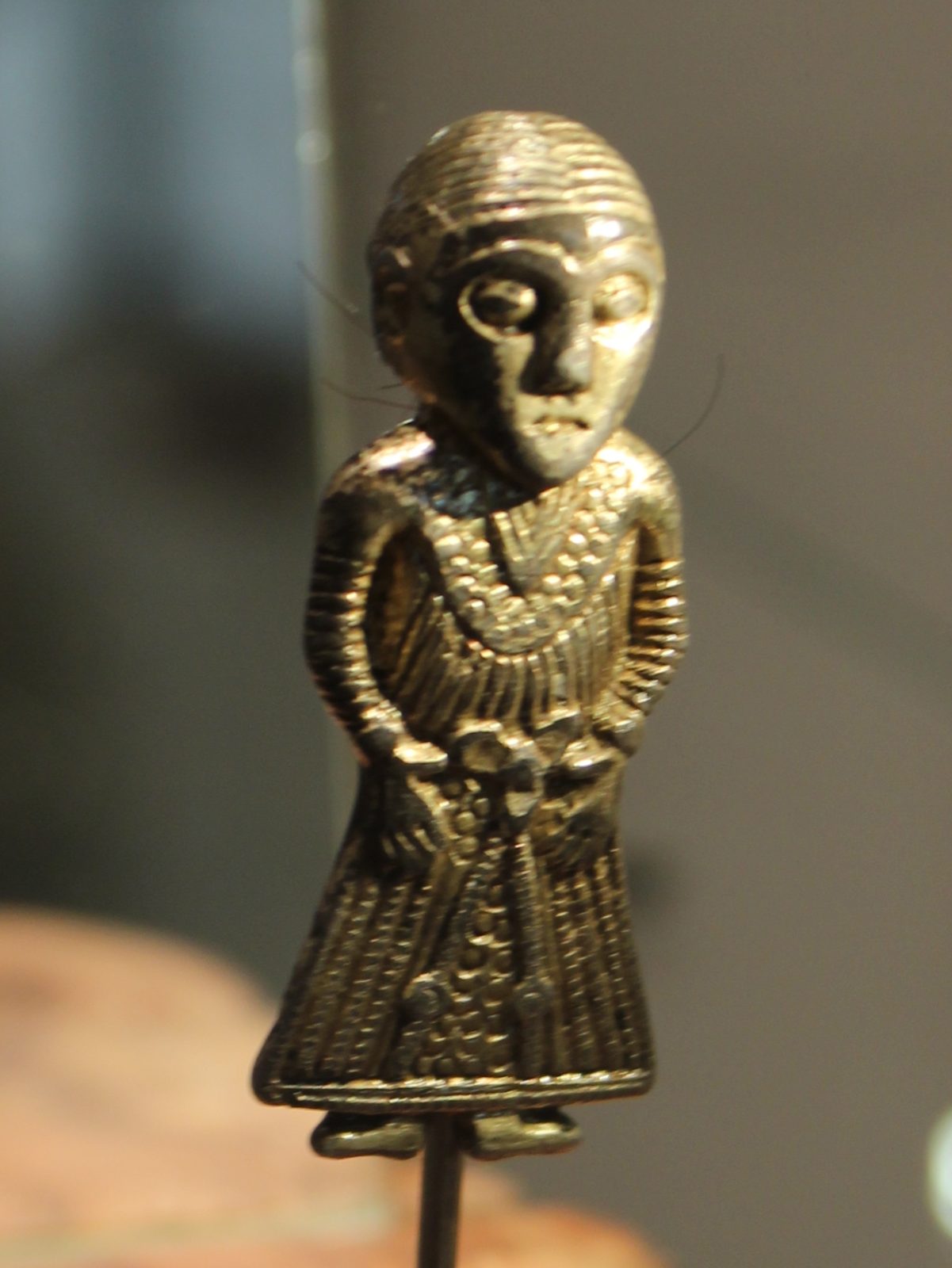
On 22 April 2014 metal detectorist Paul Uniacke found a gilded silver figure of a woman, 4.6 centimetres tall, in a field at Revninge on the Danish island of Funen. The Viking-age pendant shows how women of the 9th century wore their clothes and jewellery.
On 22 April 2014, the metal detectorist Paul Uniacke was searching a field at Revninge, a village south of Kerteminde in north-east Funen, Denmark, when he dug up a small silver figure. He rang the Viking Museum at Ladby, a few kilometres away, and told them he had made the find of his life. Archaeologists from Østfyns Museer confirmed it, conserved it and announced it on 28 May 2014.
The figure is 4.6 centimetres tall, cast in solid silver and gilded. It shows a woman standing with her hands resting on her body. Her hair is parted in the middle and drawn back into a small bun. She wears an ankle-length gown with long sleeves, each part decorated with its own pattern of grooves, bands of beads and stamped circles, and a necklace of several strands. At her waist is a three-lobed brooch, a surprise, because in Viking graves brooches like this are usually found on the chest. Small holes at the back of the neck show the figure was worn as a pendant.
The archaeologist Claus Feveile of Østfyns Museer said that it was highly unusual for the head to be fully three-dimensional while the body is flat. It dates from the 800s. At first it was hailed in the press as an image of the goddess Freyja, but nobody knows whom it represents. Feveile later pointed out that the same pose of the hands appears on earlier figures from Sweden and Bornholm that seem to be men, and experts agree that it is not a valkyrie, since it has no weapon or shield. What it does show, in rare detail, is how a well-dressed person in Viking-age Denmark looked.
The find was one of the Danish heritage agency's top ten archaeological finds of 2014, and a local brewery even named a beer after it. In Denmark, finds of precious metal belong to the state as danefæ, and the finder receives a tax-free reward. The figure was put on display at the Viking Museum at Ladby, near where it was found.
Written for Global Finds from Archaeology magazine (2014), the Danish Agency for Culture's top ten finds of 2014 and the Viking Museum at Ladby (2014). Photo: the Revninge woman at the Viking Museum at Ladby, Toxophilus, Wikimedia Commons, CC BY-SA 4.0.
Source: Archaeology magazine (2014)