The Adro Vello Coin: a quarter-gram medieval coin, dug from a sand-buried church, showing St James's last voyage
Famous find Struck in the reign of Fernando II of León, 1157 to 1188 · Found in 1985 See it on the timeline →
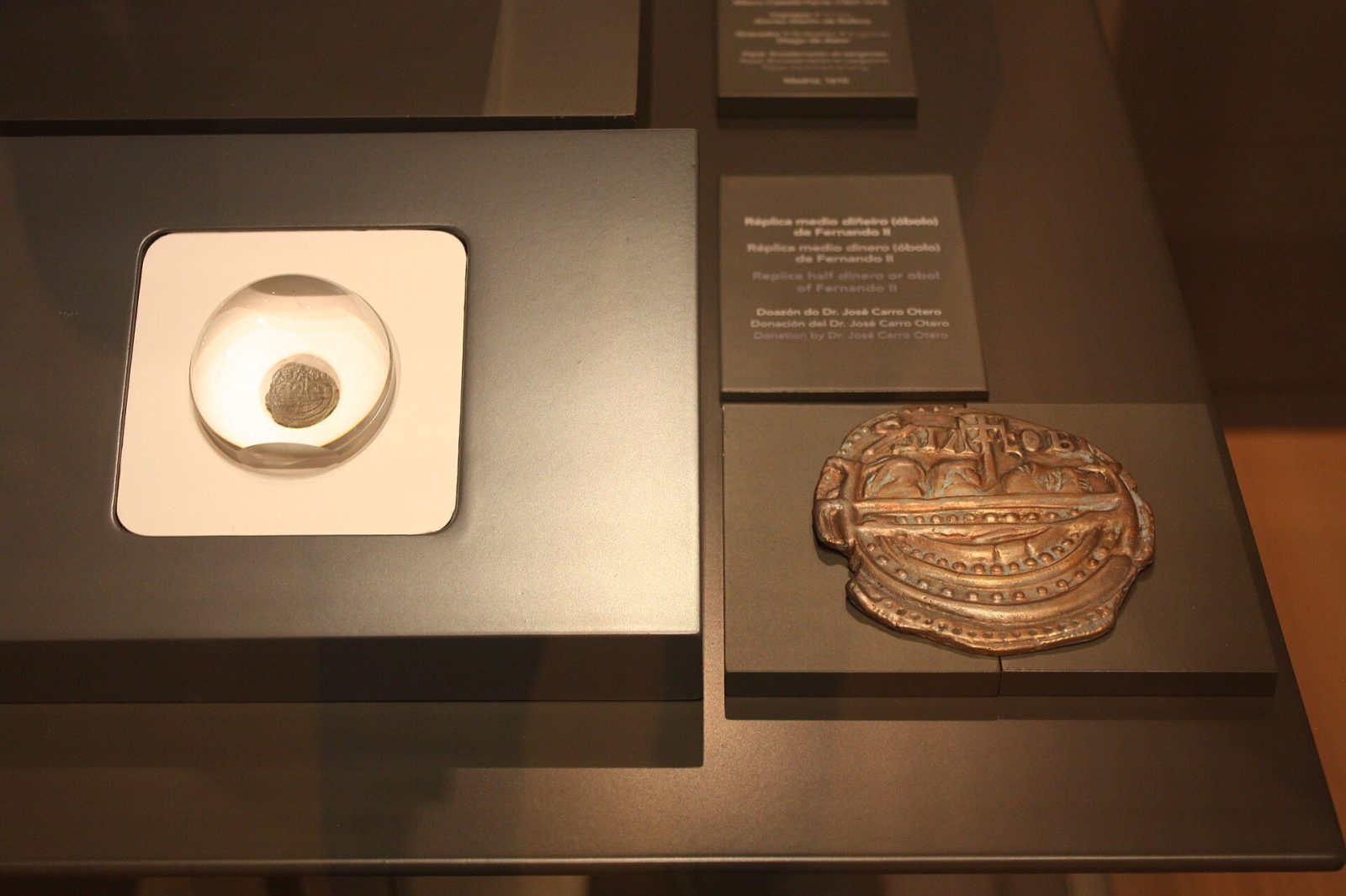
In 1985 excavators at Adro Vello, a sand-buried church and cemetery on the Galician coast of Spain, found a tiny 12th-century coin of King Fernando II of León. It shows St James's body arriving by boat, the founding legend of the Camino de Santiago, and is unique.
In 1985, archaeologists led by José Carro Otero were excavating at Adro Vello, beside Carreiro beach at O Grove on the coast of Galicia in north-west Spain. The site had a long history: a Roman villa and fish-salting works, then a church with a tower and a cemetery used from about the 6th to the 18th century, with more than 200 graves. When the parish church moved inland in the 18th century, the old site was swallowed by sand and forgotten, until a road was cut through it. Half of it still lies under that road. Among the finds of the 1985 season was a tiny coin. Exactly where on the site it was found has not been published.
It is a meaja, a half-penny of billon, a silver alloy, weighing only about 0.27 grams and 13 to 14 millimetres across. On one side a lion, the emblem of León, walks to the right with a cross on a scallop shell over its back, around the name FERNANDVS REX. On the other is a curved boat carrying the body of St James, his head resting at one end, watched over by two disciples, with a mast topped by a cross dividing the legend SIA COBI. It was struck at Santiago de Compostela for Fernando II, king of León from 1157 to 1188, perhaps late in his reign.
The scene is the Translatio, the legend that after his martyrdom in Jerusalem the apostle's body was carried by boat to Galicia and buried where Santiago de Compostela now stands, the goal of the pilgrimage route known as the Camino. The coin is described as the earliest known image of the voyage on a coin, struck while the great cathedral was being built, and no other example has been found. It came out of the ground on the very estuary through which, in the legend, the saint's boat arrived.
The excavator published it in 1987. The coin is on permanent display under a magnifying dome in the Museo das Peregrinacións e de Santiago in Santiago de Compostela, beside a large replica given by Carro Otero.
Written for Global Finds from M. Mozo Monroy in Documenta & Instrumenta 20 (2022), the Museo das Peregrinacións e de Santiago and the Xunta de Galicia. Photo: the Adro Vello coin under its magnifier, left, beside an enlarged replica, in the Museo das Peregrinacións, Lameiro, Wikimedia Commons, CC BY-SA 4.0.