The Burela Torc: a farmer turned up nearly two kilograms of Celtic gold at a Galician hillfort
Famous find Made in the 3rd or 2nd century BC · Found in 1945 See it on the timeline →
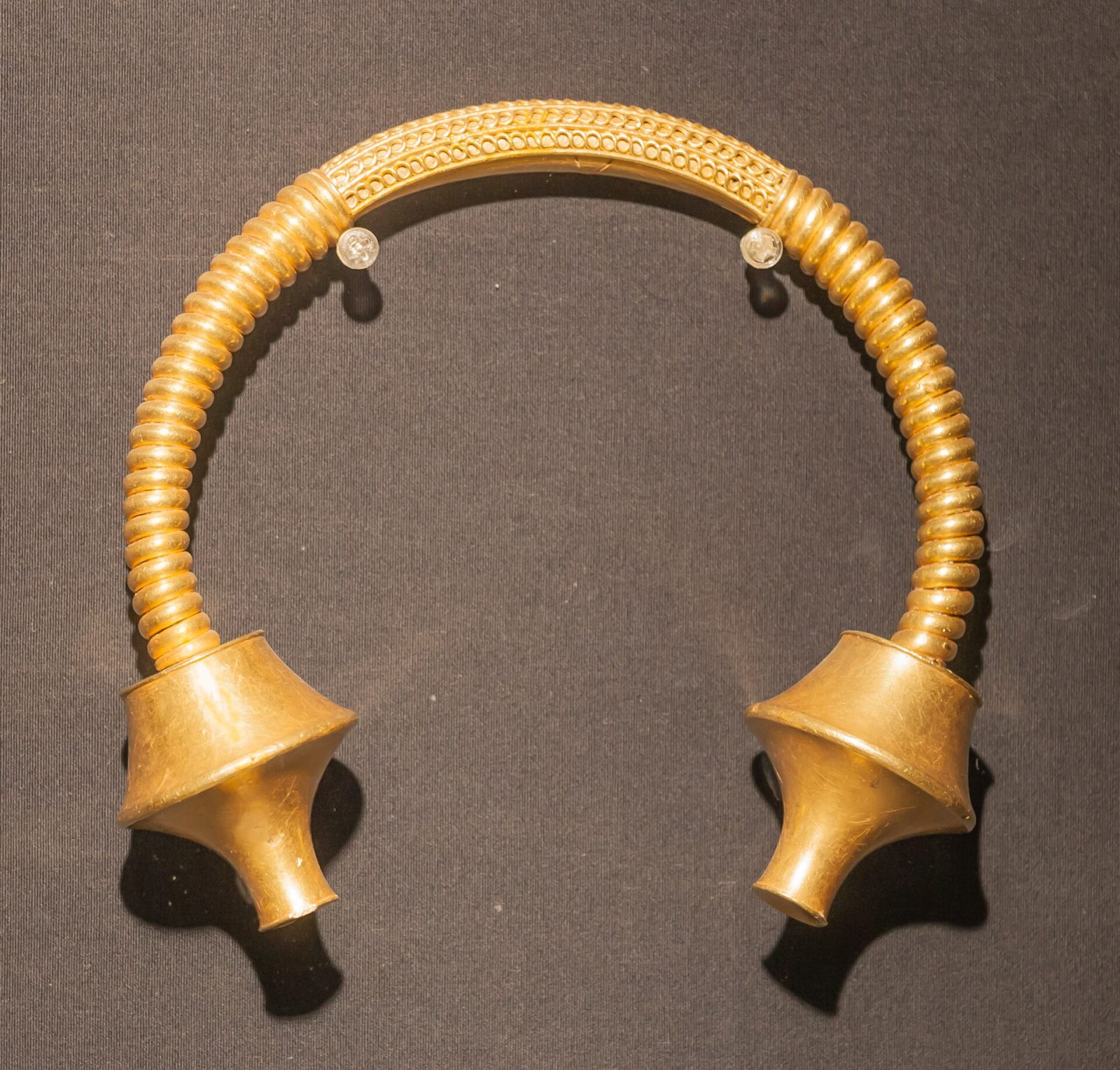
In 1945 a farmer working at the Chao de Castro hillfort in Burela, Galicia, in north-west Spain, found a massive gold torc, reportedly first mistaken for the handle of a cauldron. At about 1.8 kilograms, it is the largest torc ever found in Galicia.
In 1945, a farmer working the ground at Chao de Castro, the site of an Iron Age hillfort at Burela on the north coast of Galicia in Spain, found a heavy curved bar of gold. His name has not been recorded. According to local accounts, it was at first taken for the handle of a cauldron.
It was a torc, a neck-ring of the kind worn by the leaders of the Castro culture, the Iron Age people of north-west Spain who lived in fortified hilltop settlements called castros. It is the largest torc ever found in Galicia: about 21 centimetres across and weighing about 1.8 kilograms of almost pure gold, more than three times the weight of a typical Galician torc. Its bar is wrapped with gold wire, and its ends swell into double cones, a style that archaeologists link with workshops in the area of Lugo and Asturias. It was made in the 3rd or 2nd century BC.
Torcs like this were symbols of power and status, worn by chiefs and warriors, and sometimes offered to the gods. Their weight in gold made them a store of wealth as well. Many have been found in Galicia and Asturias, which were rich in gold, and later became a major source of gold for the Roman Empire.
The Burela torc did not go straight to a museum. It passed through private collections, including that of the collector Álvaro Gil Varela, and was deposited at the Provincial Museum of Lugo. After a long legal dispute, his heirs removed it from the museum in 2013, and in 2015 the provincial government of Lugo bought back the collection for more than two million euros, so the torc returned. It is displayed in the Provincial Museum of Lugo, and it appears on the coat of arms of Burela.
Written for Global Finds from Galician tourism (Turismo de Galicia), Galician and Spanish published accounts of the find, and the Provincial Museum of Lugo. Photo: the Burela torc in the Provincial Museum of Lugo, Luis Miguel Bugallo Sánchez, Wikimedia Commons, CC BY-SA 3.0.
Source: Turismo de Galicia