The Mary I Half-Angel: an extremely rare gold coin of England's first crowned queen, creased into a cross
Famous find Struck in 1553 or 1554 · Found in 2019 See it on the timeline →
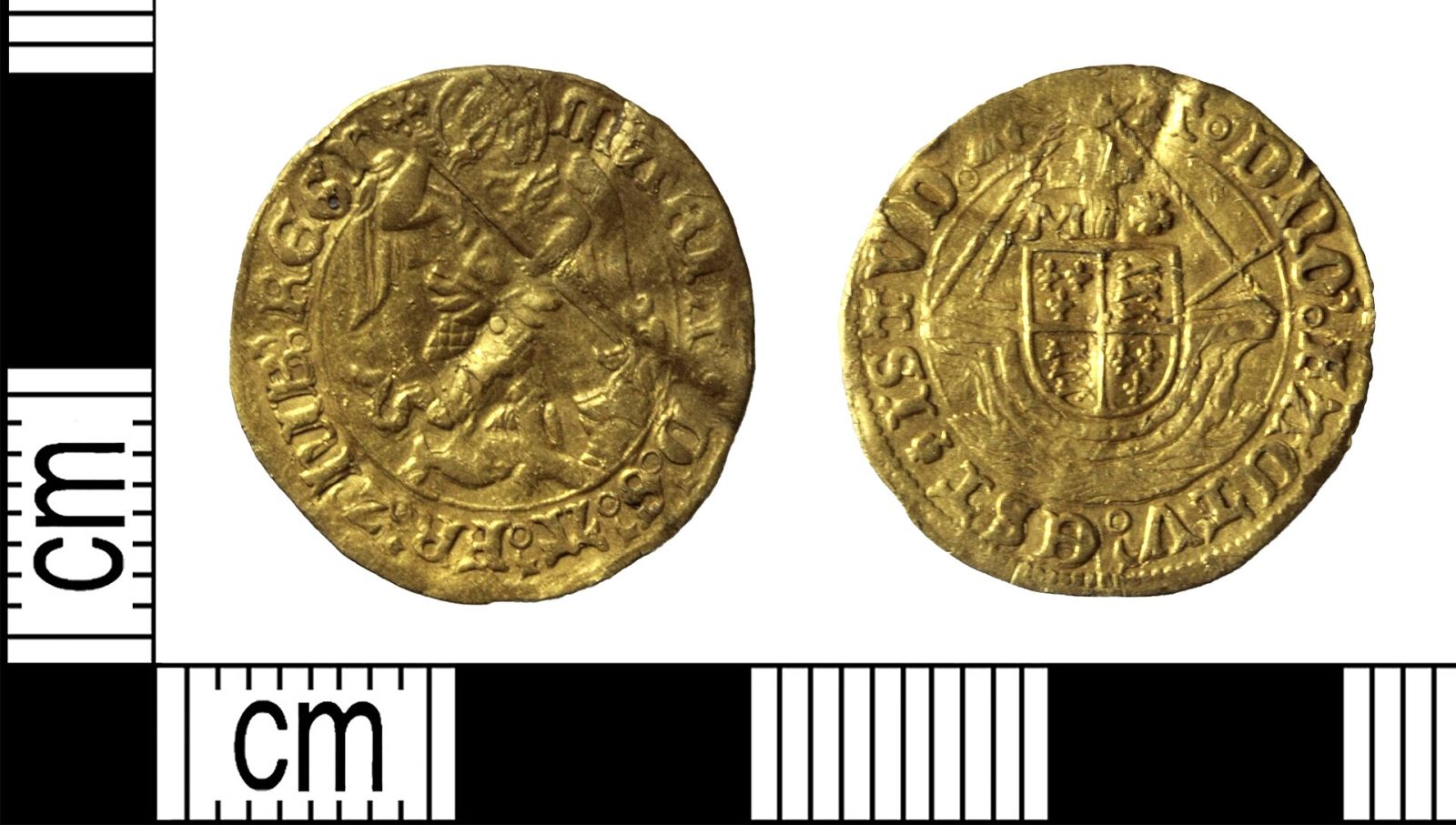
A detectorist at Kirby Bellars in Leicestershire found a gold half-angel of Mary I, struck in 1553 or 1554 before she married Philip of Spain. Creased in the shape of a cross, the extremely rare coin was recorded in 2020 and offered at auction that year.
A metal detectorist searching cultivated land in the parish of Kirby Bellars, near Melton Mowbray in Leicestershire, found a small gold coin with a deep crease across it. The finder's name has not been published. The coin was recorded with the Portable Antiquities Scheme in January 2020 by Derby Museums.
It is a half-angel, one of the smaller gold coins of the Tudors. It is 21.5 millimetres across and weighs 2.5 grams. On the front St Michael spears a dragon, around the words MARIA D G ANG FRA Z HIB REGINA, "Mary, by the grace of God, Queen of England, France and Ireland". On the back is a ship with a shield on its mast, an M and a rose beside it, and a line from Psalm 118: "This is the Lord's doing, and it is marvellous in our eyes."
Mary I was England's first crowned queen to rule in her own right. She came to the throne in July 1553 after defeating the attempt to make Lady Jane Grey queen, and in July 1554 she married Philip of Spain. After the wedding her coins carried both their names. This half-angel, from her first coinage, carries hers alone, so it was struck in her first year, before the marriage. Half-angels of Mary are extremely rare.
The coin has a strong crease along the line of the angel's spear and a fainter one across it, forming a rough cross. Coins were sometimes bent deliberately in the medieval and Tudor periods, as vows or tokens, but the Scheme's record notes that nobody knows whether this one was ever bent and straightened again, and any meaning in its creases is guesswork.
After recording, it was returned to the finder. In October 2020 the auction house Hansons offered it with an estimate of £12,000 to £15,000; its valuer called it extremely rare and in good condition for its age. Where it is now has not been published.
Written for Global Finds from the Portable Antiquities Scheme (DENO-047CA2) and Hansons Auctioneers (2020). Photo: the Mary I half-angel from Kirby Bellars, Maria Kneafsey, Derby Museums Trust, Portable Antiquities Scheme, Wikimedia Commons, CC BY 2.0.