The Needwood Forest Torc: Iron Age gold dug up by fox cubs and found by a gamekeeper at the mouth of their den
Famous find Made about 100 to 50 BC · Found in 1848 See it on the timeline →
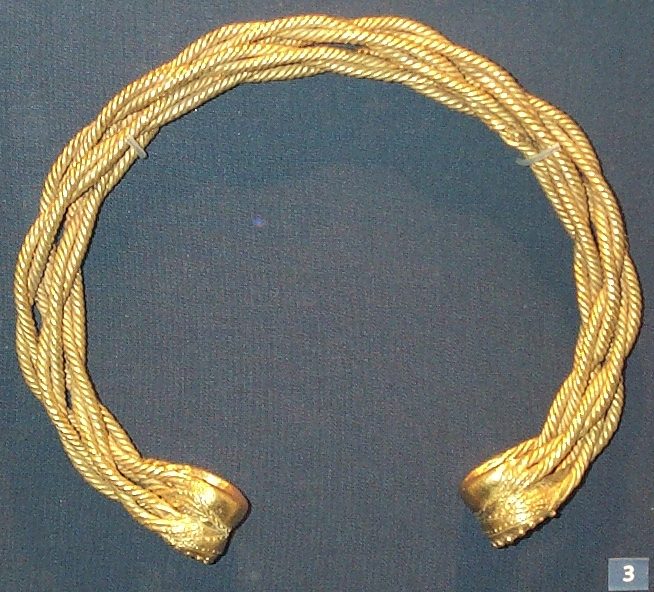
In 1848 a gamekeeper in Needwood Forest, Staffordshire, found a heavy gold torc lying at the mouth of a new fox earth. The cubs seemed to have dug it up and played with it. It belongs to the Crown and is on loan to the British Museum.
In 1848, a keeper working in Needwood Forest in Staffordshire, an old royal hunting forest on land belonging to Queen Victoria as Duchess of Lancaster, found a twisted gold neck ring lying at the mouth of a hole. A new fox earth had been dug there, and, as Sir Henry Ellis told the Society of Antiquaries in London on 8 June that year, "the Cubs appeared to have been sporting with the Torquis, which it is supposed they dug up". The keeper's name was not recorded, and nobody marked the exact spot.
It is a torc, a neck ring worn by people of high status, weighing about 427 grams. It is made of 32 gold-alloy wires, coiled in fours into eight ropes, twisted in pairs and then twisted together again into a thick, heavy cable. The ends have cushion-shaped terminals decorated with chased and punched patterns, one carrying nine raised dummy rivets and the other twelve. The style is very close to the torcs from Snettisham in Norfolk and to the Newark torc, both on Global Finds, and it dates from the Late Iron Age, in the first or second century BC.
At the time nobody knew how old it was. It was not until 1933 that the archaeologist E. T. Leeds placed it firmly in the Iron Age. The archaeologist Tess Machling has argued that it was the first Iron Age gold torc found in Britain to be recognised as a torc, since an earlier find from Netherurd in Scotland in 1806 had been taken for the head of a staff. Her study of how it was made suggests the wires were hammered and fused rather than cast.
Because it was found on Duchy of Lancaster land, the torc became Crown property, and it is in the Royal Collection. By 1936 it had been placed on long-term loan to the British Museum, where visitors have photographed it on display.
Written for Global Finds from Royal Collection Trust, T. Machling, "Excavated by Victorian foxes", in PAST 108 (2024), and H. Ellis in Archaeologia (1849). Photo: the Needwood Forest torc in the British Museum, Simon Speed, Wikimedia Commons, public domain.
Source: Royal Collection Trust