The St Martin's Ring: a medieval gold seal ring with a windmill, two saints and a hidden image against the skin
Famous find Made about 1350 to 1550, probably in the 15th century · Found in 2017 See it on the timeline →
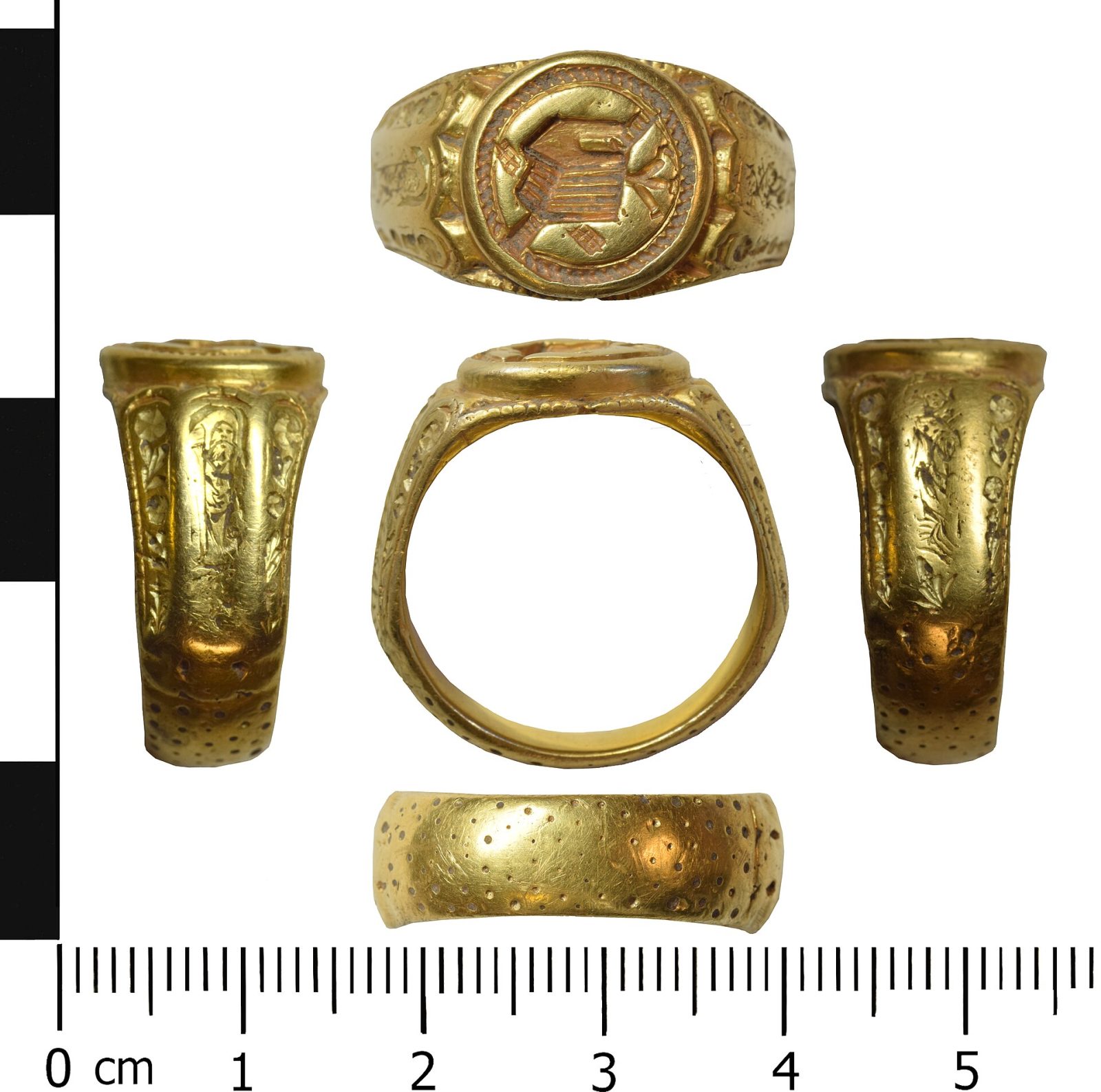
On 23 June 2017 a detectorist in a ploughed field near St Martin's in north Shropshire found a heavy gold signet ring of the late Middle Ages. Its bezel shows a windmill, its shoulders two saints, and inside, against the wearer's finger, the Virgin holding Christ.
On 23 June 2017, a metal detectorist searching a ploughed field in the St Martin's area of north Shropshire, close to the Welsh border, found a gold ring in stunning condition. The finder's name has not been published. It was first reported to Susie White, the Finds Liaison Officer at National Museum Wales, and recorded with the Portable Antiquities Scheme.
It is a large, heavy signet ring weighing almost 16 grams. The bezel, the flat top, is engraved with a medieval windmill of the kind called a post-mill, shown standing on three sturdy legs. The design is cut in reverse so that it could be pressed into wax as a personal seal, to close or sign letters and documents. On the shoulders of the ring are two saints: St Christopher, carrying the Christ child, who was believed to protect travellers from sudden death, and John the Baptist. Inside the ring, on the underside of the bezel where it would have pressed against the wearer's finger, is a hidden image of the Virgin Mary holding the dead body of Christ.
Rings like this are known as iconographic rings. They were fashionable from about 1350 to 1550, most often in the 15th century, and fell out of use at the Reformation, when images of saints became unacceptable. Each image was believed to protect the wearer. The windmill may have been a personal or family emblem, perhaps a pun on a name, or a sign of the owner's trade or property. One specialist suggested a link with a badge used by Henry V, but that is a suggestion rather than an established fact.
Because the ring was gold and more than 300 years old, the coroner for Shropshire, John Ellery, declared it Treasure at an inquest on 31 January 2019. The British Museum said it hoped to acquire it.
Written for Global Finds from Shropshire Council (2019) and the Portable Antiquities Scheme. Photo: the St Martin's gold iconographic ring, Susie White, National Museum Wales, Portable Antiquities Scheme, Wikimedia Commons, CC BY 2.0.
Source: Shropshire Council (2019)