The Brigstock Brooch: a gold, spinel and diamond jewel from a royal deer park, taken for a bottle cap
Famous find Made about 1400 to 1450 · Found in 2017 See it on the timeline →
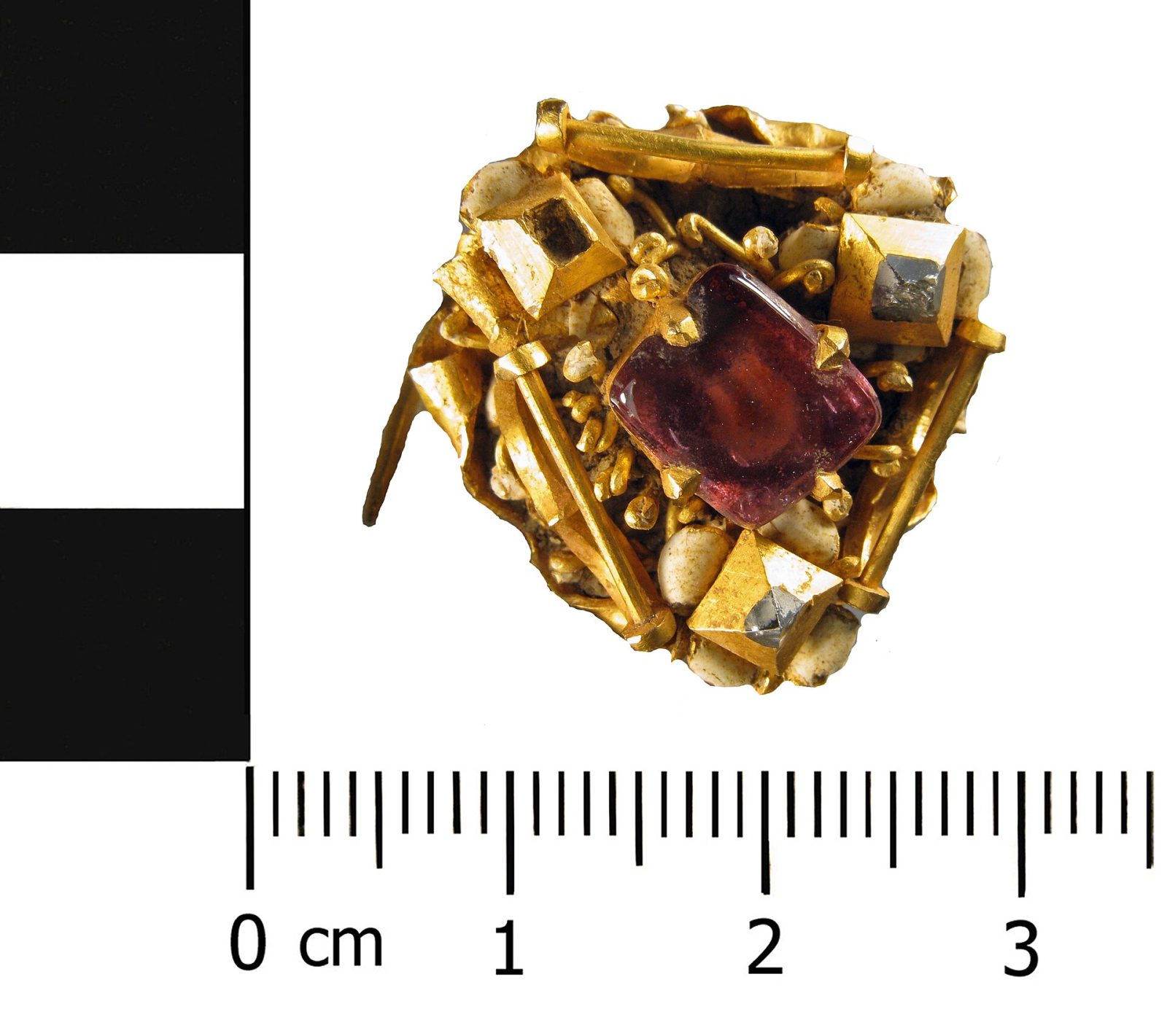
On 10 June 2017 detectorist Justin Owens, on a group dig near Brigstock in Northamptonshire, dug what he took for a bottle cap. It was a 15th-century gold cluster brooch set with a spinel and diamonds, the only one of its kind found in the UK. The V&A bought it.
On 10 June 2017, Justin Owens was detecting with a group on farmland near Brigstock in Northamptonshire, once part of the Great Park, a royal deer park covering hundreds of hectares in the Middle Ages. About four inches down he dug up a small, mud-caked object he thought at first was a bottle cap. When the mud came off, it was gold, set with stones.
It is a cluster brooch, about 24 millimetres across, made of gold. In the centre is a domed red stone, at first taken for a ruby, which scientific analysis showed to be a spinel. Around it were three more stones. Two survive, both diamonds, and they are natural crystals, polished rather than cut into facets, as diamonds usually were at the time. Between them, flowers and bows in white enamel alternate around the frame, and little gold rods once held pearls, which have long since decayed. The pin is still there, though bent.
Brooches like this were high fashion among the wealthiest people of the early 15th century, and the Victoria and Albert Museum dates it to about 1400 to 1450, probably made in continental Europe. The V&A describes it as the only one of its kind found in the UK and one of only seven known in the world. How it came to be lost in a royal deer park can only be guessed at. Press reports suggested it might have been torn from a hunter's clothing during a chase, but that is speculation.
Justin reported the brooch under the Treasure Act, and it was recorded by the Portable Antiquities Scheme. In 2019 the V&A acquired it, with help from the museum's Hildburgh Fund and the Bollinger family, one of very few objects the museum has acquired through the Treasure process. Conservators cleaned it gently, using pheasant and ostrich feathers. It is on display in the V&A's William and Judith Bollinger Jewellery Gallery in South Kensington, London.
Written for Global Finds from the Victoria and Albert Museum, Medievalists.net (2020) and the Portable Antiquities Scheme (WMID-D2BDA7). Photo: the Brigstock cluster brooch, Vic Allnatt, Birmingham Museums Trust, Portable Antiquities Scheme, Wikimedia Commons, CC BY 2.0.
Source: Victoria and Albert Museum