The Wanstrow Solidus: Constantine the Great's gold, found on a detectorist's first visit to an odd-shaped Somerset field
Famous find Struck about AD 313 to 315 · Found in 2019 See it on the timeline →
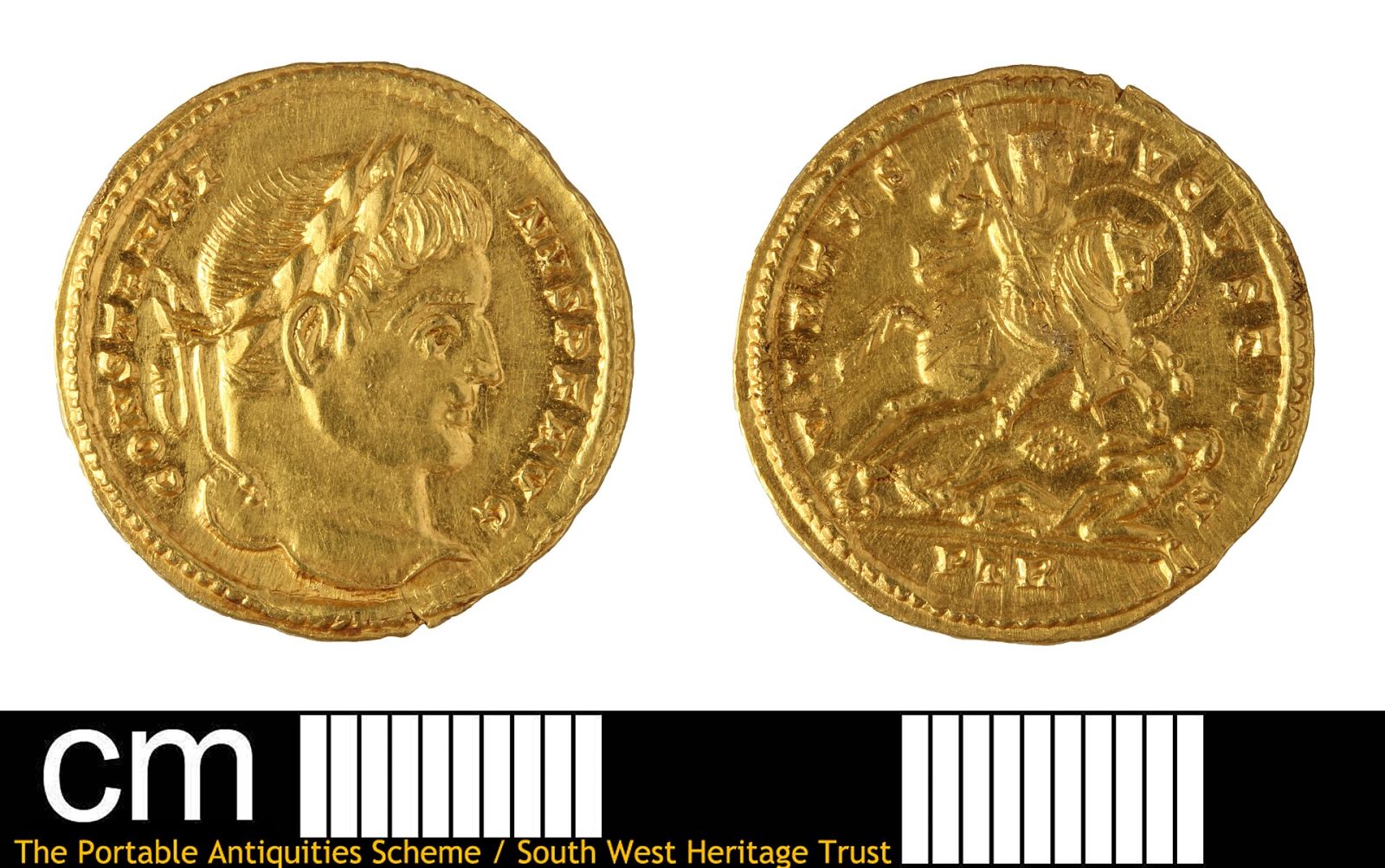
On 7 June 2019 a detectorist searching an oddly shaped field at Wanstrow in Somerset, near a Roman lead-mining road, dug a near-perfect gold solidus of Constantine the Great, struck at Trier about AD 313 to 315. It was the first of its type recorded from Britain.
On 7 June 2019, a metal detectorist searching a field at Wanstrow, in the Mendip district of Somerset, for the first time, found a gold coin about a foot down. The finder's name has not been published. According to press reports, he had chosen the field because of its curious, unnatural shape. It lies near a Roman road that once carried lead from the Mendip mines, and the same day he found a Roman brooch and lumps of lead ore. The coin was recorded with the Portable Antiquities Scheme by Laura Burnett, the Finds Liaison Officer for Somerset.
It is a gold solidus of Constantine the Great, struck at Trier, in what is now Germany, around AD 313 to 315. It weighs 4.45 grams, is 19.2 millimetres across and is hardly worn. On the front is the emperor's laureate head, around CONSTANTINVS P F AVG. On the back, under the words VIRTVS AVGVSTI N, the "valour of our emperor", Constantine gallops to the right, spearing one enemy while another crouches under his horse holding a shield. Press reports linked the scene with Constantine's victory at the Milvian Bridge outside Rome in 312, which made him master of the western empire and, according to tradition, led him to Christianity.
The Portable Antiquities Scheme noted that this type was missing from the standard catalogue of Roman gold coins found in Britain, published in 2010, and that it was only the fourth gold coin of its period on the national database. It was recorded for the British Numismatic Journal's register of important coin finds.
As a single coin it was not Treasure, and after recording it was returned to the finder. It was sold by Dix Noonan Webb in London on 17 September 2019, against an estimate of £10,000 to £12,000, for a hammer price of £16,000, or £20,608 with the buyer's premium. The buyer was a dealer acting for a European collector, and the coin is in a private collection.
Written for Global Finds from the Portable Antiquities Scheme (SOM-A557C8), Coin World and Numismatic News (2019). Photo: the Wanstrow solidus of Constantine I, Laura Burnett, Somerset County Council, Portable Antiquities Scheme, Wikimedia Commons, CC BY 2.0.
Source: Coin World (2019)