Lt Dixon's Gold Coin: the double eagle that stopped a bullet at Shiloh, found with him inside the Hunley submarine
Famous find Minted in 1860; lost with the Hunley in 1864 · Found in 2001 See it on the timeline →
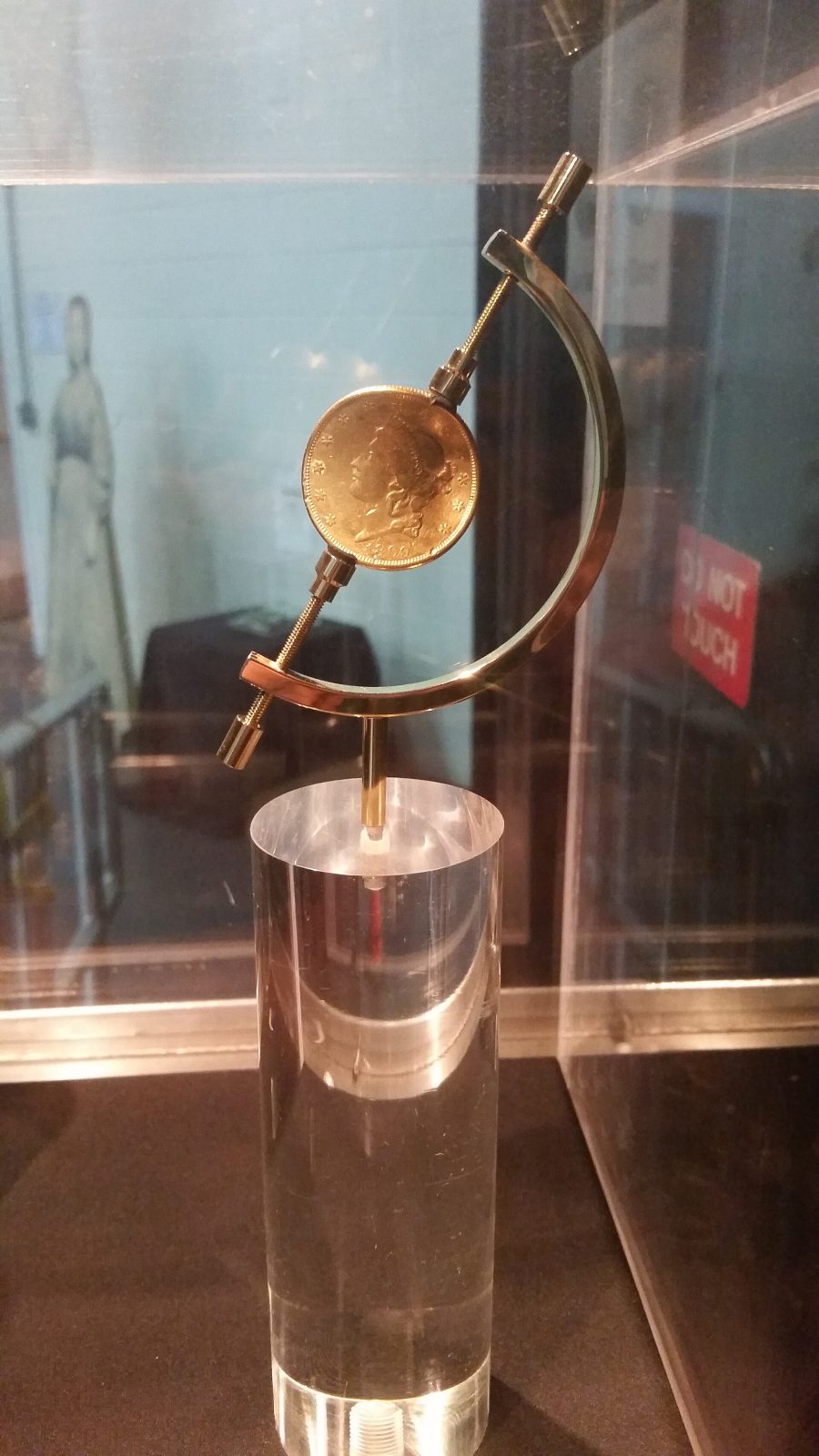
In May 2001 archaeologist Maria Jacobsen, excavating the inside of the Confederate submarine H. L. Hunley, found a bent $20 gold coin beside the remains of its commander, Lt George Dixon. It had saved his life at Shiloh in 1862 and was engraved "My life Preserver".
On the evening of 23 May 2001, the archaeologist Maria Jacobsen was excavating the silt inside the H. L. Hunley, the Confederate submarine that had been raised from the sea off Charleston, South Carolina, the year before. She was working beside the remains of the submarine's commander, Lieutenant George Dixon, when her fingers found something in the mud. "As soon as I touched it through the mud," she said, "I knew it was the coin."
For years there had been a story that Dixon carried a lucky gold coin. At the Battle of Shiloh in Tennessee, on 6 April 1862, he was shot in the hip, and the bullet struck a gold coin in his pocket. A fellow officer wrote to his wife two days later that Dixon had been "shot in the hip, the ball striking a gold piece". Many people assumed it was just a legend.
It was real. The coin is a United States $20 gold piece, a double eagle, dated 1860. It is bent into a bell shape where the bullet hit it, and traces of lead were found on the coin and on Dixon's thigh bone. On the back is engraved: "Shiloh, April 6, 1862, My life Preserver, G.E.D." The find helped confirm that the remains were Dixon's.
The Hunley made history on 17 February 1864, when it became the first submarine to sink an enemy warship, the USS Housatonic, off Charleston. It never came home. The submarine and its crew of eight were lost that night. The wreck was found in 1995 and raised in August 2000, and the excavation of its interior revealed the crew and their possessions.
Legend says Dixon's fiancée, Queenie Bennett, gave him the coin, but the inscription does not mention her. In November 2002 the coin went on display at the Warren Lasch Conservation Center in North Charleston, where the submarine is being conserved.
Written for Global Finds from the Friends of the Hunley and the Charlotte Observer via The E-Sylum (2001 and 2002), and the Advisory Council on Historic Preservation. Photo: Lt George Dixon's gold coin on display at the Warren Lasch Conservation Center, North Charleston, Pi3.124, Wikimedia Commons, CC BY-SA 4.0.