The Wattisham Dinar: medieval Islamic gold from North Africa, dug from a Suffolk field
Famous find Struck about 1168 to 1184 · Found in 2006 See it on the timeline →
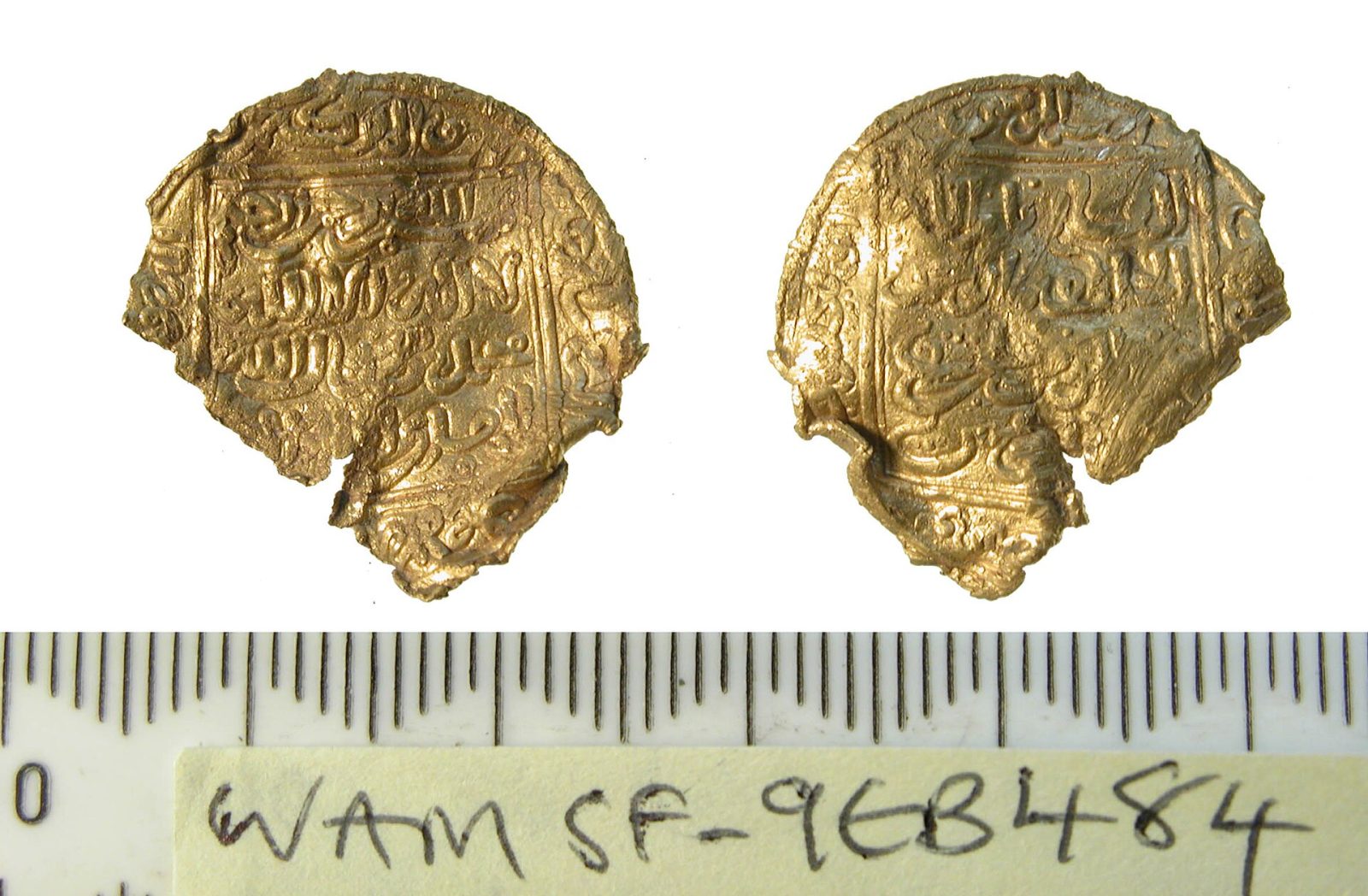
On 25 April 2006 a detectorist at Wattisham in Suffolk found a folded gold coin covered in Arabic script. It was a half-dinar of the Almohad caliph Abu Ya'qub Yusuf, struck in North Africa in the 1160s to 1180s. The Fitzwilliam Museum in Cambridge bought it.
On Tuesday 25 April 2006, a metal detectorist searching cultivated land at Wattisham, in the Babergh district of Suffolk, found a small, folded and damaged gold coin. It was covered not with a king's head but with lines of Arabic script. The finder's name has not been published. The coin was recorded with the Portable Antiquities Scheme by the Suffolk County Council Archaeology Service and identified by the specialist Luke Treadwell.
It is a gold half-dinar of the Almohads, a Berber dynasty that ruled North Africa and much of Spain in the 12th and 13th centuries. It was struck for the caliph Abu Ya'qub Yusuf I, who reigned from 1163 to 1184, and its use of the title "commander of the faithful" places it after 1168. It weighs 2.01 grams and is 20.6 millimetres across. Its inscriptions are set inside and around a central square, a design that is typical of Almohad coins. No mint is named on it.
How did a coin from North Africa reach a field in Suffolk? Gold was scarce in England in the 12th and 13th centuries, and Islamic gold coins travelled north through trade with Spain and the Mediterranean, carried by merchants, pilgrims and crusaders. They were used as bullion, given as gifts or kept as curiosities. The historian David Carpenter has noted that part of Henry III's gold reserve, the gold used for his gold penny, came in the form of Byzantine coins and Islamic gold from Murcia in Spain. There is no suggestion that this coin was ever in the king's treasure, but it shows the kind of gold that was in circulation. In Friesland and northern Germany, similar coins were even made into brooches.
Mark Blackburn of the Fitzwilliam Museum noted that the closest English parallels were two gold dinars reported found near St Paul's Cathedral in London around 1879. After recording, the coin was returned to the finder, and it was then bought by the Fitzwilliam Museum in Cambridge for its coin collection.
Written for Global Finds from the Portable Antiquities Scheme (SF-9EB484), the Fitzwilliam Museum, Spink Insider (2022) and Palaeohistoria (1994). Photo: the Wattisham Almohad half-dinar, Faye Minter, Suffolk County Council Archaeology Service, Portable Antiquities Scheme, Wikimedia Commons, CC BY-SA 2.0.
Source: Fitzwilliam Museum