The Trumpington Cross: a teenage girl's gold and garnet cross, buried with her on a bed near Cambridge
Famous find Made about AD 650 to 680 · Found in 2011 See it on the timeline →

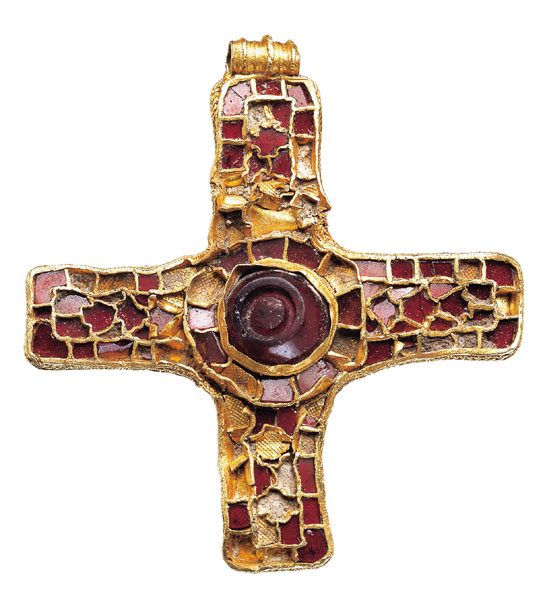
In 2011, archaeologists excavating ahead of new housing at Trumpington, Cambridge, found the grave of a girl of about 16 laid on a wooden bed. On her chest was a gold cross set with garnets, made around AD 650 to 680. Only a handful of such crosses are known.
In the summer of 2011, a team from the Cambridge Archaeological Unit, led by Alison Dickens, was excavating land at Trumpington Meadows on the southern edge of Cambridge, ahead of a new housing development. Among the finds was a grave of a kind archaeologists rarely see: a teenage girl, about 16 years old, laid on a wooden bed held together with iron fittings. On her chest was a gold cross set with garnets.
The cross is about 3.5 centimetres across, made of gold with each arm set with cut garnets. Loops on the back suggest it was sewn onto her clothing rather than hung on a chain. With her were a pair of gold and garnet pins linked by a fine gold chain, an iron knife, a chatelaine and glass beads. The cross was made around AD 650 to 680, and the university described it as only the fifth of its type found in Britain. Another is the cross found in the coffin of St Cuthbert at Durham.
The girl lived at a turning point. Christianity was spreading through the Anglo-Saxon kingdoms, and she was buried with a Christian cross but also with the bed and grave goods of an older, pagan tradition of rich burials. Bed burials are rare, with fewer than twenty known in Britain. In 2023, analysis of her bones and teeth showed that she had probably grown up in the region of the Alps, perhaps in what is now southern Germany, and moved to England after the age of seven. After she arrived, her diet seems to have become poorer. Her face was reconstructed in the same year.
The cross and the other finds were declared Treasure. The landowner, Grosvenor, donated them to the Museum of Archaeology and Anthropology at the University of Cambridge, where they were shown in the exhibition Beneath Our Feet in 2023 and 2024 and have been photographed on display since.
Written for Global Finds from the University of Cambridge (2012 and 2023) and the Portable Antiquities Scheme. Photo: the Trumpington Cross in the Museum of Archaeology and Anthropology, Cambridge, Ethan Doyle White, Wikimedia Commons, CC BY-SA 4.0.
Linked finds

Source: University of Cambridge