The Ely Torc: the largest gold torc found in England, bought by a small museum, then stolen in under a minute
Famous find Made about 1300 to 1100 BC · Found in 2015 See it on the timeline →
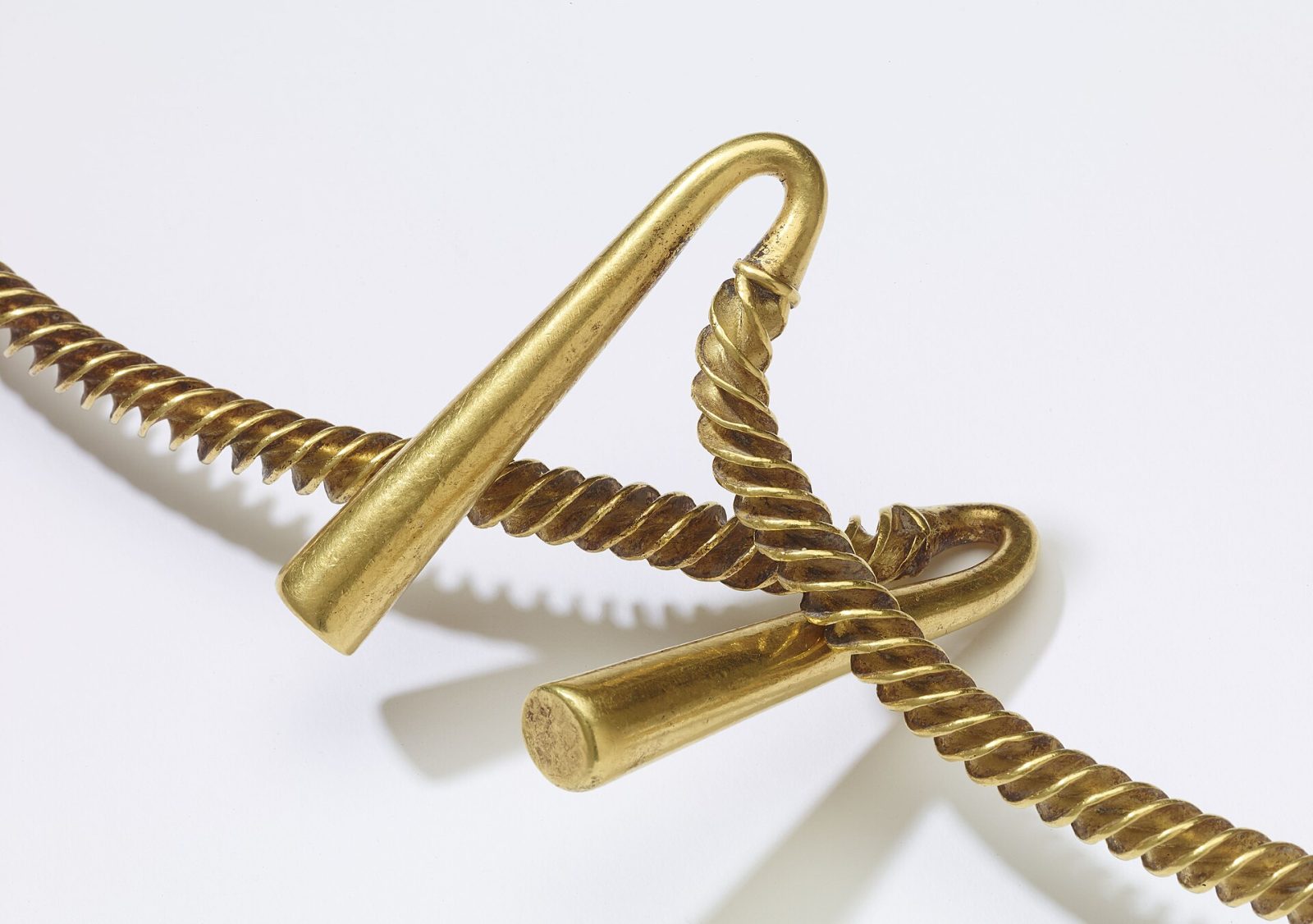
In September 2015 detectorists in East Cambridgeshire found a Bronze Age gold torc weighing 730 grams, the largest ever found in England. Ely Museum raised £220,000 to buy it. In May 2024 thieves smashed its case and it has not been seen since.
On 26 September 2015, metal detectorists searching a recently ploughed field in East Cambridgeshire dug up a heavy coil of twisted gold. The finders and the exact field have been kept anonymous. When it came out of the finder's briefcase, the Finds Liaison Officer, Helen Fowler, said she was gobsmacked; it was too big for her weighing scales.
It is a torc, a twisted gold bar made from a single bar hammered into a cross-shaped section and then twisted, with a trumpet-shaped terminal bent back at each end. It weighs about 730 grams, is made of about 87 per cent gold, and measures more than 1.2 metres around, not counting the terminals. When found it was loosely bundled, and it was later opened out into a single loop. It was made in the Middle Bronze Age, about 1300 to 1100 BC, and it is described as the largest gold torc ever found in England.
At 1.2 metres it is far too big to wear around the neck. Neil Wilkin of the British Museum, who praised its astonishingly accurate workmanship, suggested it might have been worn over thick clothing, placed around a sacrificial animal, or even lent to pregnant women for protection. A similar torc was found at nearby Grunty Fen in 1844, and another of the same type, the Corrard torc, was found in Northern Ireland in 2009.
The torc was declared Treasure and valued at £220,000. Ely Museum raised the money with grants from the National Heritage Memorial Fund, the Arts Council and V&A Purchase Grant Fund, the Art Fund and others, plus more than £7,000 from local people, and the reward was shared between the finders and the landowner. It went on display at the museum in October 2017.
At about 1.20 in the morning on 7 May 2024, thieves forced a shuttered window at Ely Museum, smashed the case with a sledgehammer in under a minute, and escaped with the torc and a Bronze Age gold bracelet. In December 2024 police filed the case pending new evidence, and the torc is still missing.
Written for Global Finds from the National Heritage Memorial Fund, Ely Museum, the Ely Standard (2026), the Wisbech Standard (2017) and the Portable Antiquities Scheme. Photo: the terminals of the East Cambridgeshire torc, Mafalda Raposo, Portable Antiquities Scheme, Wikimedia Commons, CC BY 2.0.
Source: National Heritage Memorial Fund