The Kirkhaugh Gold: four boys found the missing partner of a gold ornament their great-great-grandfather helped dig up in 1935
Famous find Made about 2400 to 2200 BC · Found in 2014 See it on the timeline →
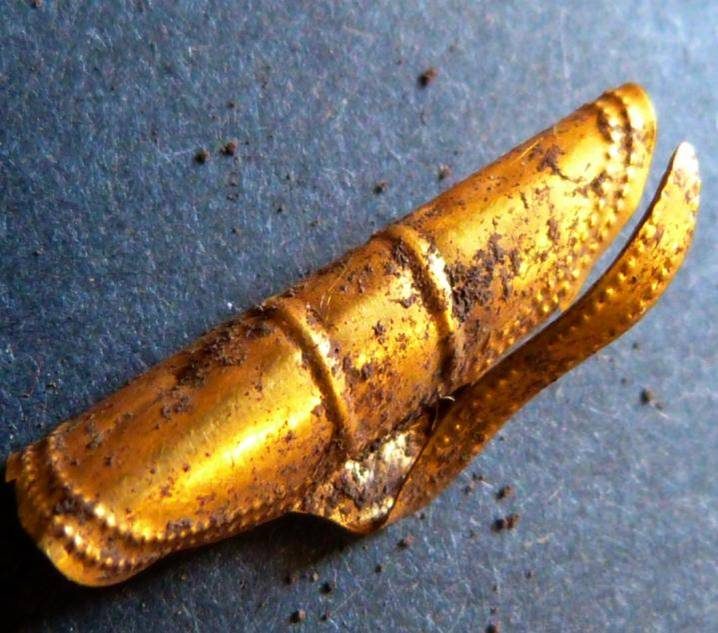
On 23 July 2014, four boys on a community dig at Kirkhaugh in Northumberland found a tiny Early Bronze Age gold ornament. Its twin had been found in the same burial cairn in 1935, and two of the boys were great-great-grandsons of a man on that dig.
In September 1935 the archaeologist Herbert Maryon excavated a small burial cairn at Kirkhaugh, near Alston in the North Pennines of Northumberland. One of his helpers was a local man, Joseph William Alderson, who had mined gold in Africa and Canada. In the cairn they found an early Beaker pot, flint arrowheads, a stone tool used for working metal, and a little ornament of rolled gold, now in the Great North Museum: Hancock in Newcastle. It is thought to be the earliest gold object yet found in northern England.
Nearly eighty years later, in 2014, the Altogether Archaeology community project, led by the archaeologist Andrew Fitzpatrick, went back to re-excavate the cairn. On 23 July, four boys aged between seven and ten were helping on the dig: the brothers Sebastian and Luca Alderson and the brothers Joseph and Aidan Bell. One of them held up something small and asked whether it was anything, because it looked like plastic. It was gold. Two of the boys were great-great-grandsons of Joseph Alderson from the 1935 dig.
The 2014 ornament is a single oval sheet of almost pure gold, rolled into a cylinder, with a folded tang at one end and rows of tiny punched dots along the edges. It is 33 millimetres long and weighs only half a gram, almost exactly the size of the 1935 piece. Ornaments like this are known as basket-shaped ornaments. They may have been worn as earrings or wrapped around locks of hair, and only about ten are known from Britain. They are usually found in pairs, which nobody knew in 1935, so the second one had lain in the cairn all along. The burial dates from the Early Bronze Age, about 2400 to 2200 BC, and with its metalworking tool it is one of only two known early Beaker graves in Britain of a metalworker, the other being that of the Amesbury Archer.
The ornament was declared Treasure at an inquest in Morpeth in December 2020.
Written for Global Finds from A. Fitzpatrick, "The Kirkhaugh Cairn: an old find and a new tale", PAST 79 (2015), the Portable Antiquities Scheme (DUR-02828D), the Hexham Courant (2020) and Countryfile. Photo: the 2014 Kirkhaugh gold ornament, Portable Antiquities Scheme, Wikimedia Commons, CC BY 2.0.
Source: Countryfile