The Bramham Moor Ring: a gold Anglo-Saxon ring carved with a magic spell in runes, found on a Yorkshire moor
Famous find Made in the 9th century AD See it on the timeline →
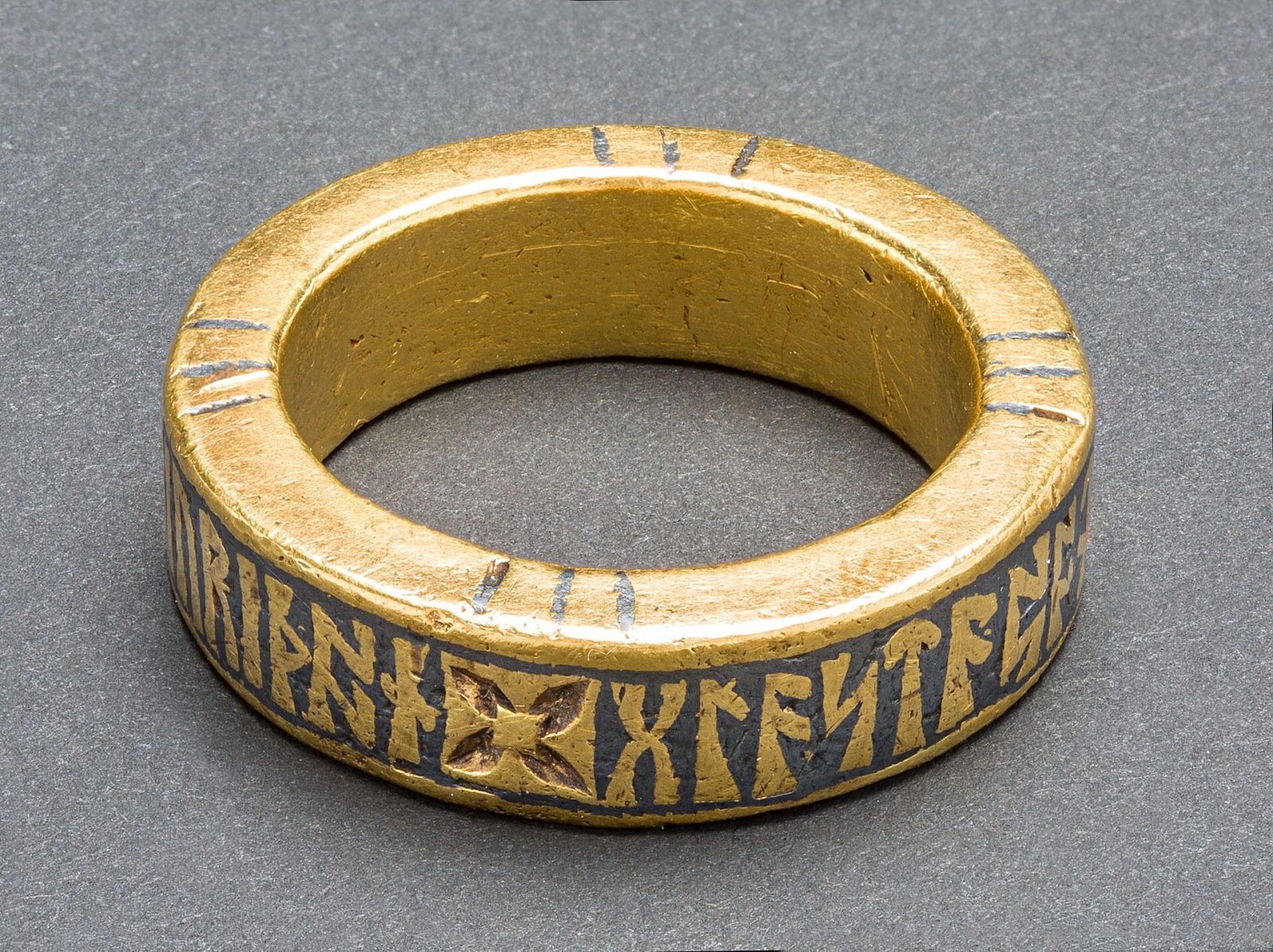
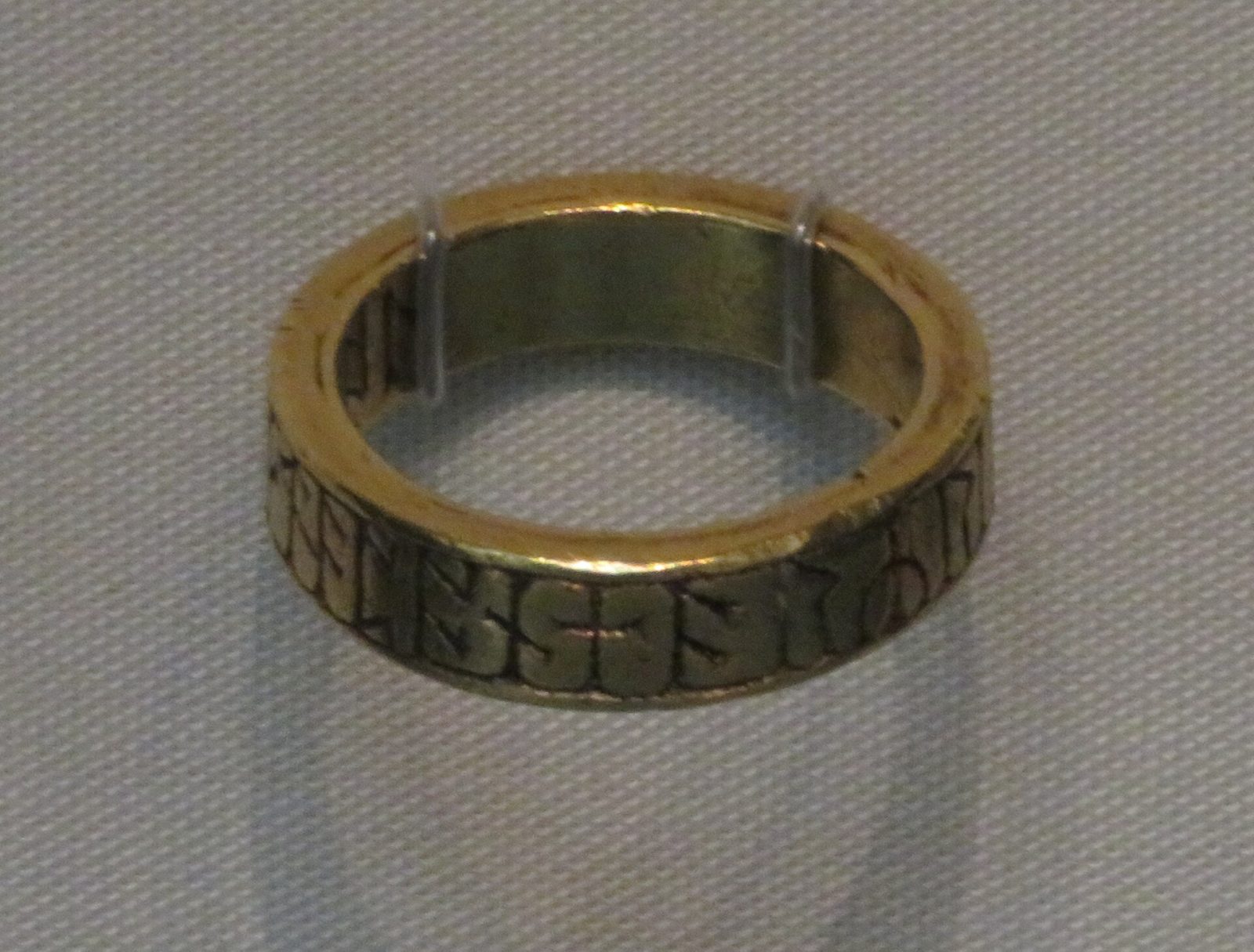
Some time before 1736, a gold ring inscribed with runes was found by chance on Bramham Moor in West Yorkshire. Its 9th-century inscription is not a name or a message but a string of magic letters, and it now belongs to the National Museum of Denmark.
Some time before 1736, a gold finger ring was found by chance on Bramham Moor, near Bramham, between Leeds and York in West Yorkshire. Who found it, and exactly when, was not recorded. Its inscription was drawn in Francis Drake's history of York, Eboracum, published in 1736, and at some point the ring passed to Copenhagen, where it belongs to the National Museum of Denmark. How it got there is not recorded in the sources used here.
The ring is about 29 millimetres across, made of gold and decorated with niello, a black inlay. Around it runs an inscription in Anglo-Saxon runes, set out in three groups: ærkriufltkriuriþonglæstæpontol. It is not Old English or Latin, and it is not a name. Scholars read it as a charm, a string of letters with magical power, and the scholar Elisabeth Okasha groups it with two other rings as amulet rings, worn for protection. The magic seems to lie in the runes themselves, in the use of three and multiples of three, and in the way the letters echo groups of letters in Anglo-Saxon medical charms. The opening run, ærkriu, has been compared with words in a charm against bleeding in Bald's Leechbook, a 10th-century book of remedies.
What makes the ring remarkable is that it has two near twins. A gold ring found at Kingmoor near Carlisle in 1817 carries almost exactly the same inscription, and an agate ring probably from Linstock Castle in Cumbria has a very similar one. Three rings from different places carrying the same spell suggest that the words were a known charm, copied from ring to ring, perhaps by the same workshop or for people who believed in the same protection. All three date from the 9th century, the time of the Viking wars in northern England.
The ring is held in the National Museum of Denmark in Copenhagen.
Written for Global Finds from E. Okasha, "Anglo-Saxon inscribed rings", Leeds Studies in English 34 (2003), and the National Museum of Denmark. Photo: the Bramham Moor ring, Arnold Mikkelsen, National Museum of Denmark, Wikimedia Commons, CC BY-SA 4.0.