The Shropshire Angel: the county's first gold medieval coin, bought by a museum's friends from a detectorist
Famous find Struck in London in 1473 See it on the timeline →
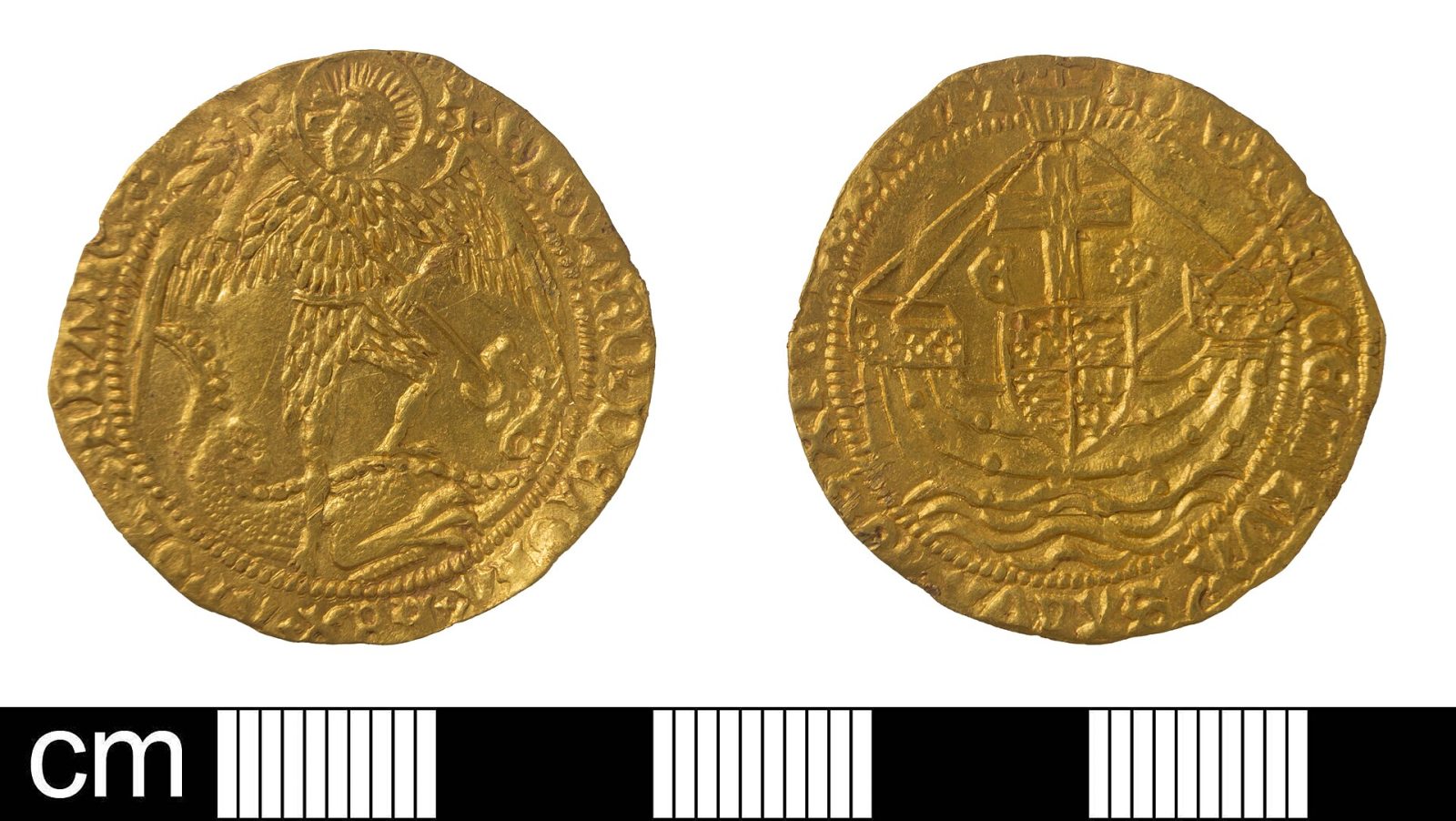
A metal detectorist in mid-Shropshire found a gold angel of Edward IV, struck in London in 1473. It was the first of its kind recorded from Shropshire, one of only 17 across the UK, and in 2019 the Friends of Shrewsbury Museum bought it for the county.
A metal detectorist searching land in mid-Shropshire found a small gold coin and reported it to Peter Reavill, the Finds Liaison Officer for Herefordshire and Shropshire. The finder's name and the exact date have not been published. The coin turned out to be a gold angel of King Edward IV, struck at the London mint in 1473.
The angel was a new coin in Edward's time. He introduced it in 1465 as part of a reform of the coinage, and it was worth six shillings and eightpence, about two weeks' wages for a skilled craftsman when this coin was struck. It takes its name from its design: on the front, St Michael the Archangel stands over a dragon and drives a spear into its mouth. On the back, a ship carries a shield bearing the royal arms, with a cross for a mast. Angels were also given by kings to people who came to be touched for the King's Evil, a skin disease that the royal touch was believed to cure, and some were kept for generations as charms.
Edward IV's reign was a turbulent one. He seized the throne in 1461 during the Wars of the Roses, lost it in 1470 and won it back in 1471, and this coin was struck two years after his return, when his position was finally secure. The Shropshire coin was the first example of its type recorded from the county by the Portable Antiquities Scheme, and one of only 17 recorded across the UK.
As a single coin it was not Treasure, so it belonged to the finder and the landowner, who offered it for sale. The Friends of Shrewsbury Museum and Art Gallery bought it and gave it to Shropshire Museums, which had never before owned an English gold coin of the Middle Ages. Peter Reavill called it an important find for Shropshire. Announced in November 2019, it went on display in the Medieval Gallery of Shrewsbury Museum and Art Gallery.
Written for Global Finds from Shropshire Council (2019) and the Portable Antiquities Scheme. Photo: a gold angel of Edward IV from the London mint, found in Somerset, not the Shropshire coin, Laura Burnett, Somerset County Council, Portable Antiquities Scheme, Wikimedia Commons, CC BY 2.0.
Source: Shropshire Council (2019)