The Magnentius Solidus: gold of a usurper with a British father, whose fall brought terror to Britain
Famous find Struck at Aquileia, AD 351 to 352 · Found in 2018 See it on the timeline →
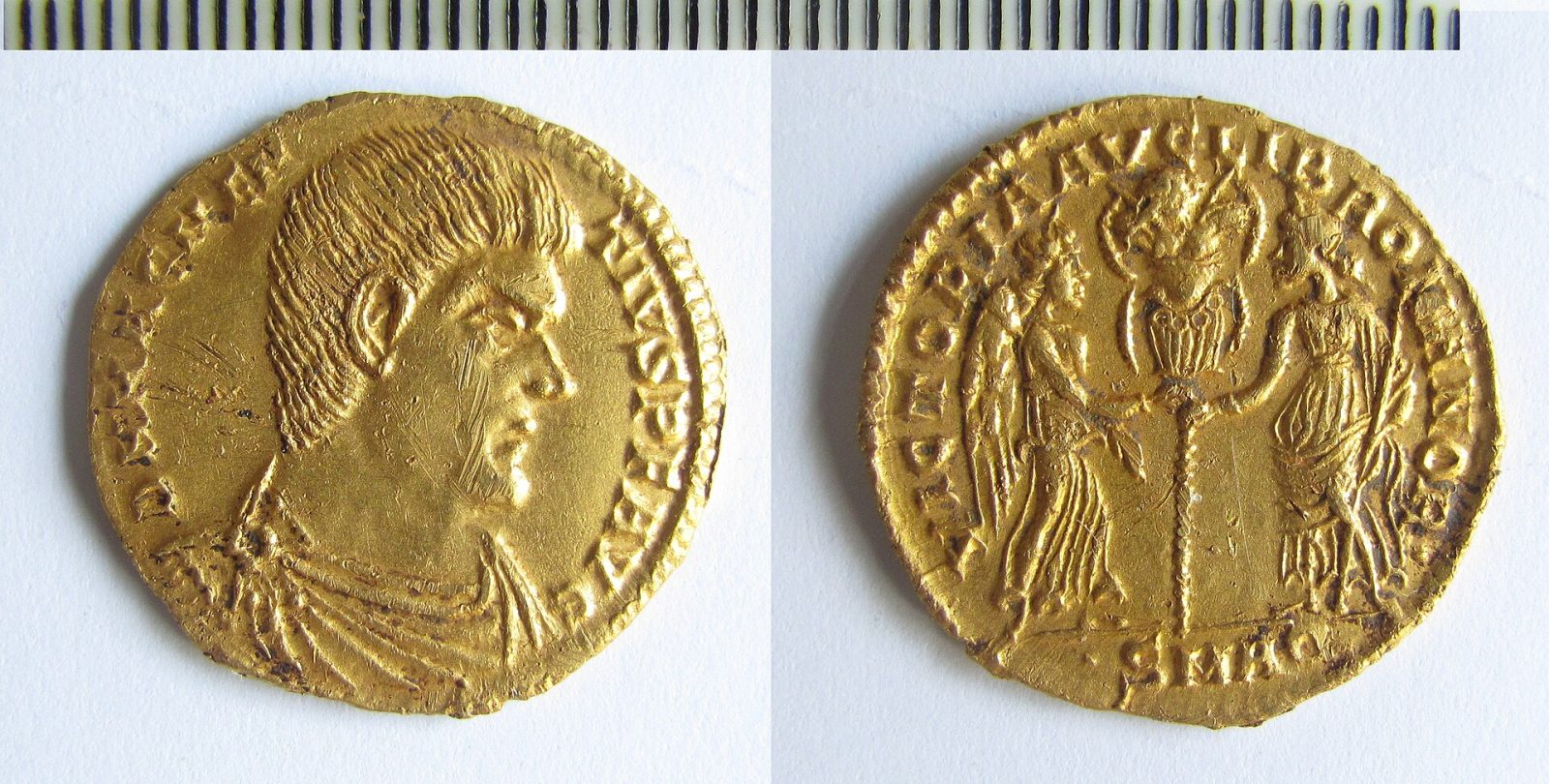
In 2018 metal detectorists in north Suffolk found a gold solidus of Magnentius, who seized the western Roman Empire in AD 350. Struck at Aquileia, it hails him as liberator of the Romans. After his defeat, an imperial agent called 'the Chain' was sent to hunt his supporters in Britain.
In the first months of 2018, metal detectorists searching land in north Suffolk found a gold coin. The finders' names have not been published. They reported it to the Portable Antiquities Scheme, where the numismatist Adrian Marsden recorded it, and it was returned to them.
It is a solidus of Magnentius, 21 millimetres across and weighing 4.27 grams, struck at Aquileia in northern Italy in 351 or 352. On the front is the emperor's bare-headed bust and his name and titles. On the back, Victory and Libertas, the goddess of freedom, hold up a trophy of captured arms between them, around the words VICTORIA AVG LIB ROMANOR: the victory of the emperor, liberator of the Romans. Aquileia was in Magnentius's hands for only a short time, and coins of this type are described by dealers as extremely rare.
Magnentius was an army officer who seized power in the west in January 350, and the emperor Constans was hunted down and killed. According to one late Roman writer, his father was a Briton. He ruled Gaul, Britain, Spain and Italy for three years, but in 351 he was defeated in one of the bloodiest battles of the century, at Mursa in modern Croatia, by Constans's brother Constantius II. In 353, cornered in Gaul, he took his own life.
Britain paid a price for backing him. The historian Ammianus Marcellinus tells how Constantius sent his agent Paulus, nicknamed Catena, "the Chain", to Britain to round up Magnentius's supporters. Paulus arrested innocent and guilty alike. Martinus, the governor of Britain, tried to protect them, and when he was threatened with arrest himself he took his own life. Coins of Magnentius are among the reminders of those three years when Britain followed a rebel emperor.
As a single gold coin, the solidus was not Treasure, and it belonged to the finders and landowner. It was sold at auction three times, by Noonans in 2020, by The Coin Cabinet in 2023 and by Leu Numismatik in Switzerland in July 2024, when it made 4,200 Swiss francs before fees. It is in a private collection.
Written for Global Finds from Leu Numismatik (2024), the Portable Antiquities Scheme (NMS-453EDD) and Ammianus Marcellinus, History, book 14. Photo: the Suffolk solidus of Magnentius, Adrian Marsden, Portable Antiquities Scheme, Wikimedia Commons, CC BY 2.0.
Source: Leu Numismatik (2024)